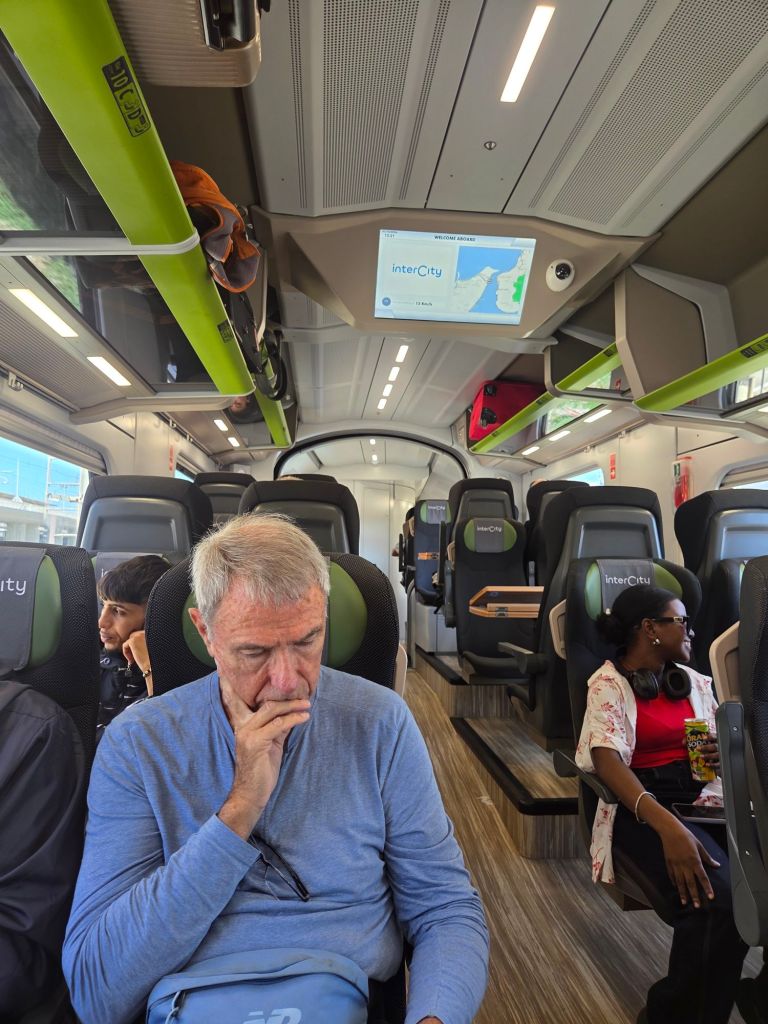
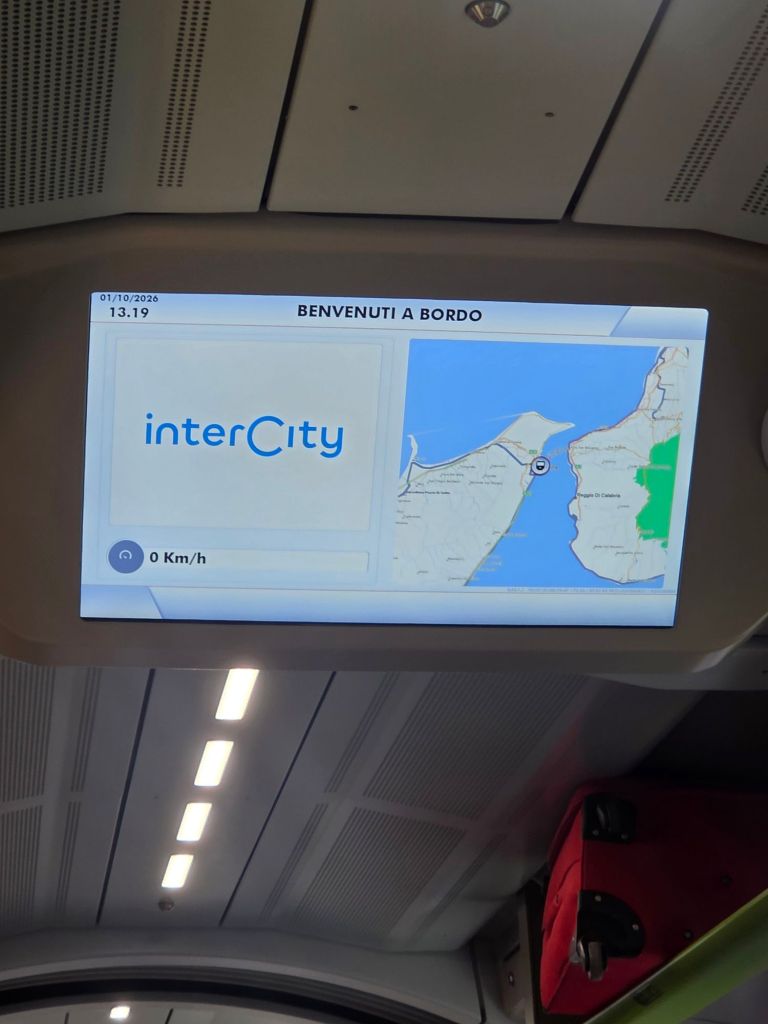
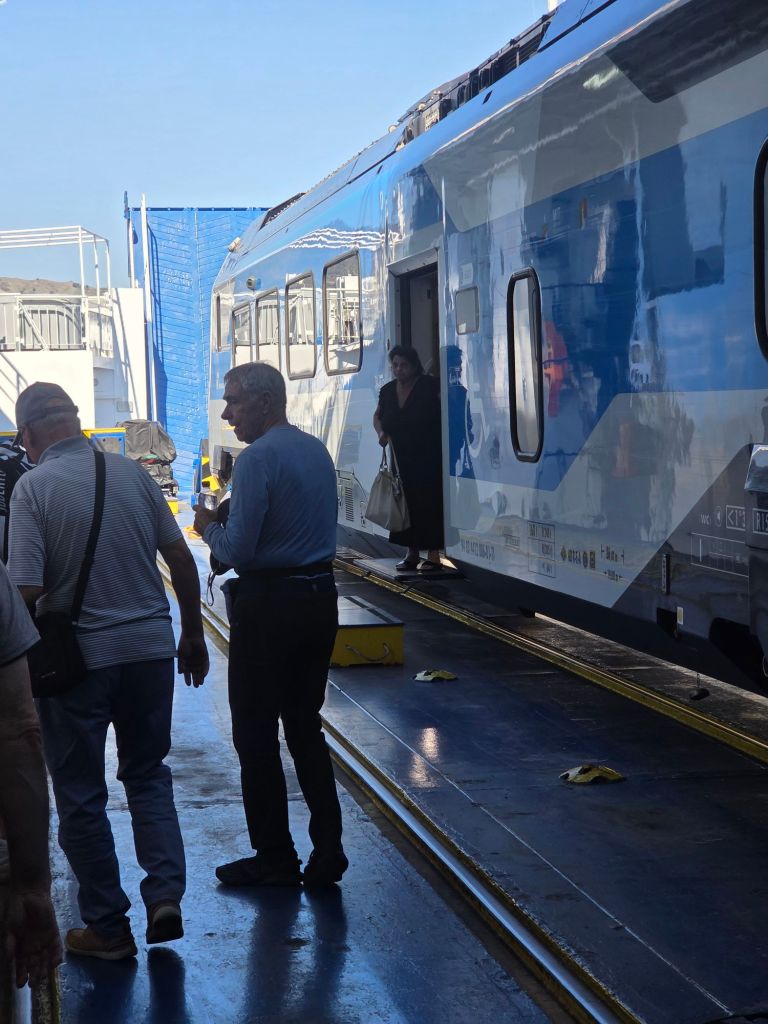
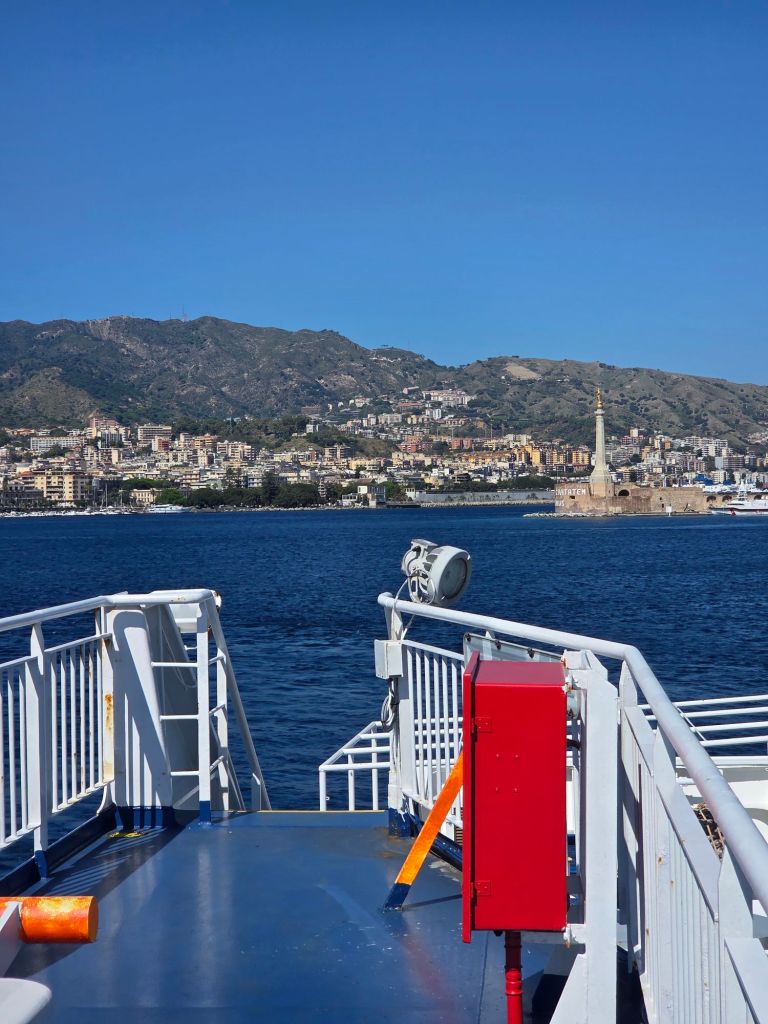
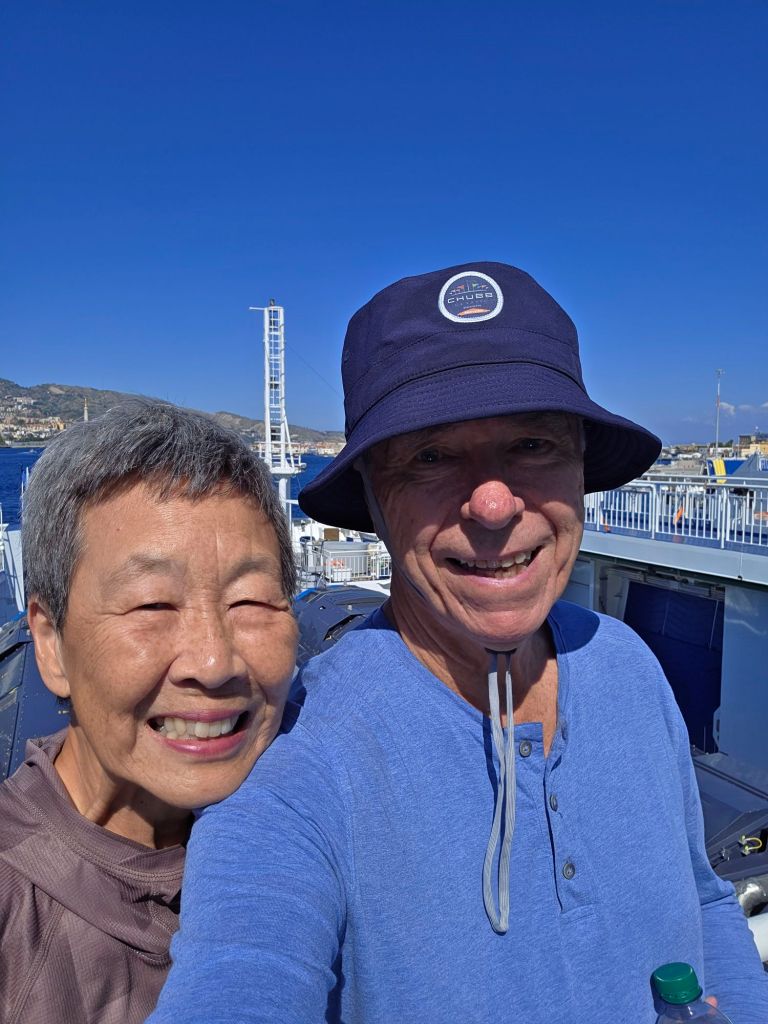
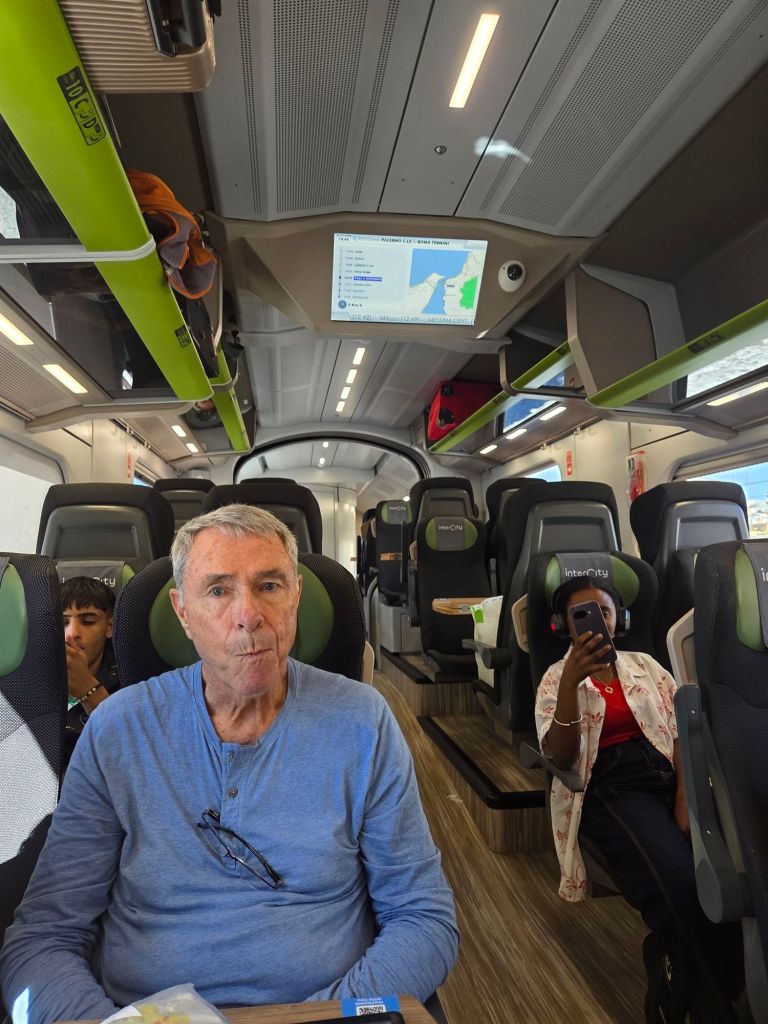
In the last post we promised to tell you why our crossing of the Straits of Messina from Sicily to the mainland of Italy was so exciting. As a master of fact, everyone who travels this route by train gets a treat: the entire train, carriages and passengers, is shunted into a giant ferry boat and taken on a five mile-long cruise.
Inside the train, the monitor shows a black “X” where the tracks end on the Sicily side of the Straits of MessinaOnce our train carriage is driven on board the ferry, passengers are allowed to exit their trail car and climb up on deck to enjoy the sea crossing in the fresh air. We had a sunny day with calm seas for our crossing. The whole process, although only five miles on the water, took about 80 minutes with loading and unloading the train cars on and off the ferry.We’ve telemed to our train seats. The monitor now shows the train is now on the mainland of Italy.
For decades through to today there have been promises to build a bridge over the Straits as an impetus to economic development for Sicily and southern Italy. It would be the longest bridge in the world and the latest proposed project, announced by the politicians in 2025, is budgeted for 13 billion euros. We are not holding our breaths for project completion. Meanwhile, Trenitalia operates the last remaining passenger train ferry in Eutope, providing us with slow passage and great fun.
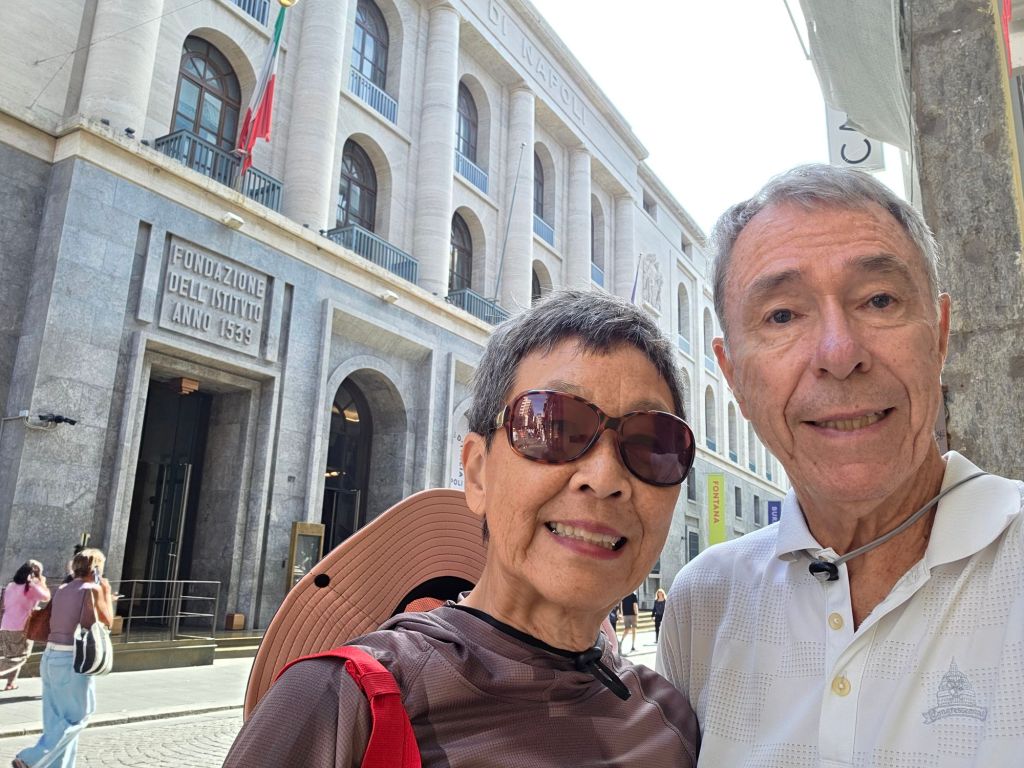
Our first stop on the mainland is Naples, the beautiful, energetic, crowded, noisy city overshadowed by Vesuvius on the far side of its blue bay.
Caravaggio wanted to stay in Rome, the center of power, influence and the wealth to support artists, but was forced to leave to avoid prison for murder. Naples is one of the places he went and today three major works can still be found in the city.
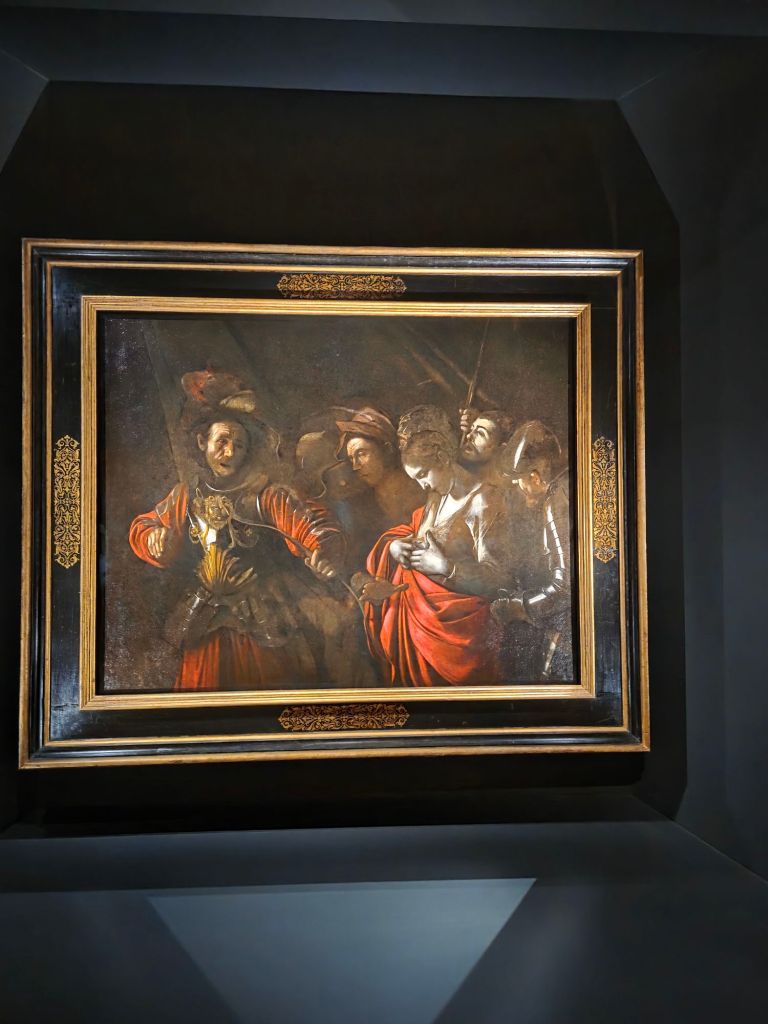
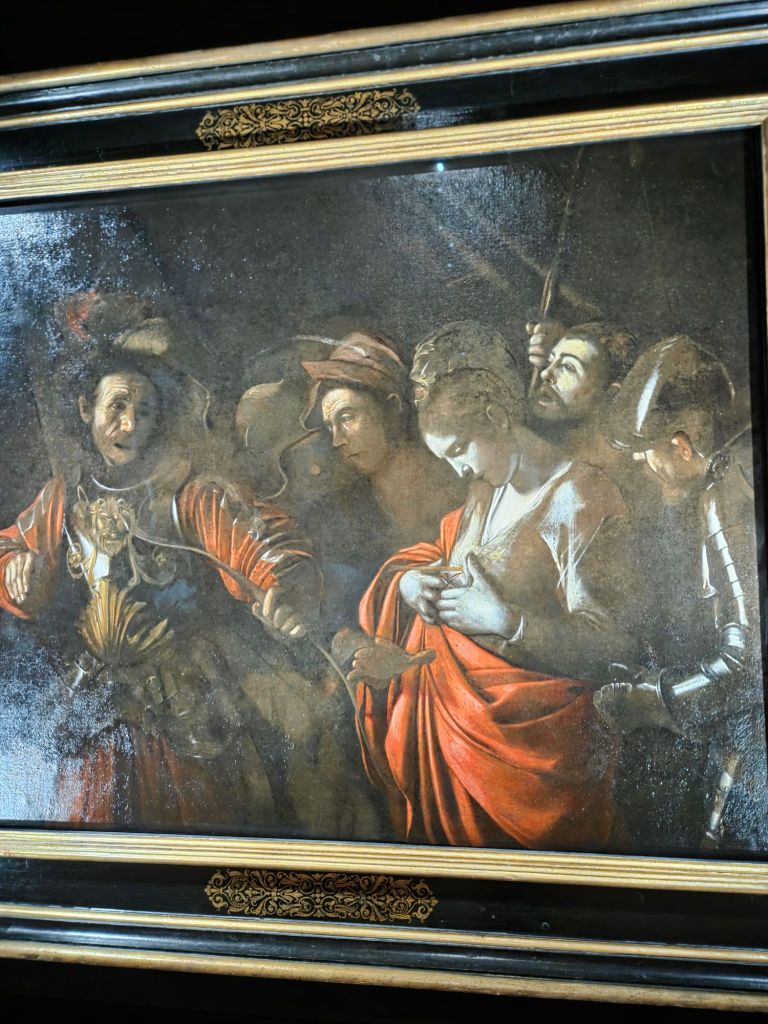
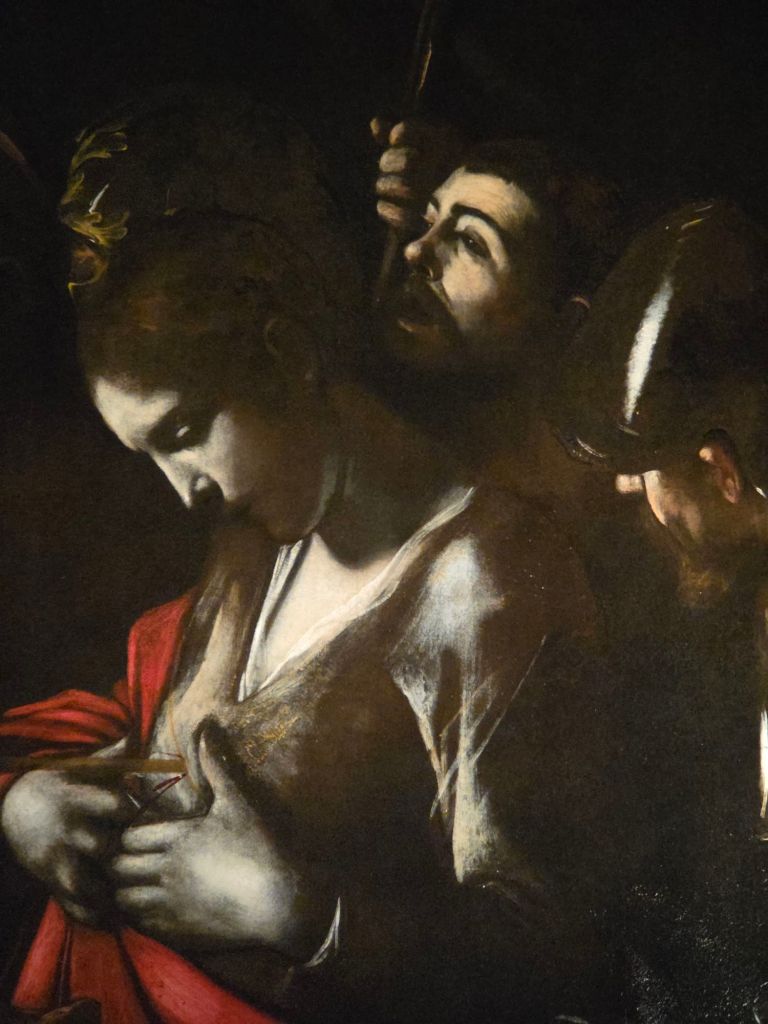
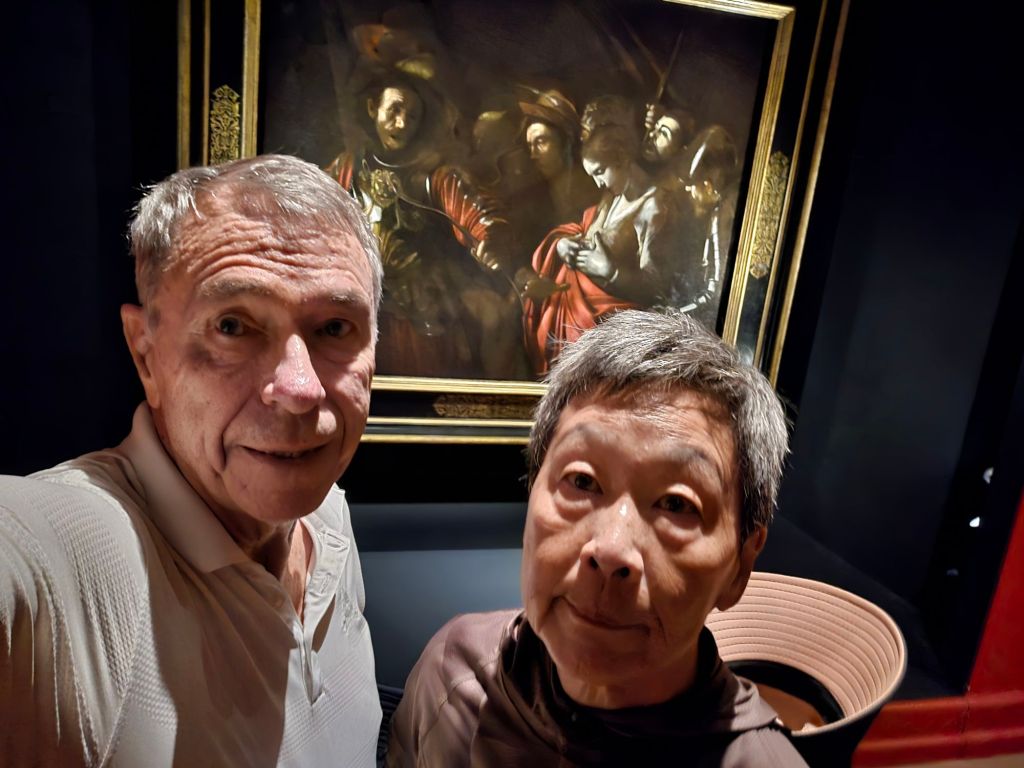
In the Galerie d’Italia Palazzo Zevallos can be found the very last work ever painted by Caravaggio, The Martyrdom of Saint Ursula (1610).
Saint Ursula led a large group of virgins on a pilgrimage. Unfortunately they ran into Huns who slaughtered all the women except UrsulaUrsula was offered marriage to the Hunnish leader. When she refused him, he shot her in the stomach with bow and arrow at point blank range. The perpetrator is at the far left.Ursula looks at the arrow piercing her body. Behind her, standing so close that only his head can be seen, groaning as though HE had been shot, is (yet another) self-portrait of the artist.
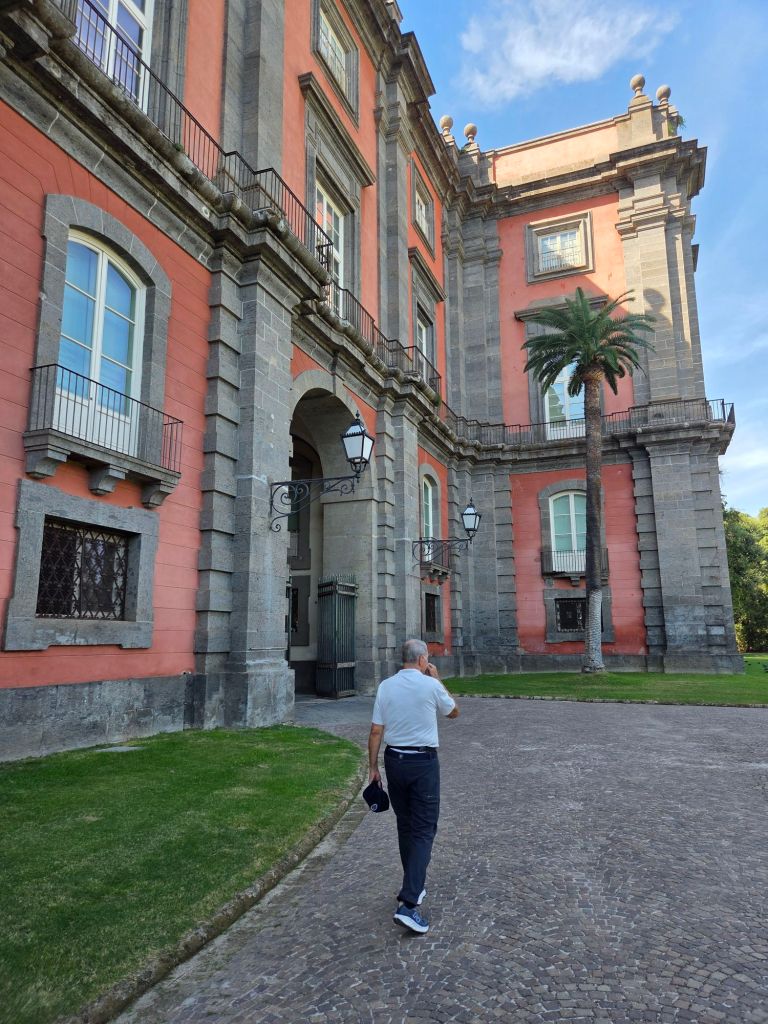
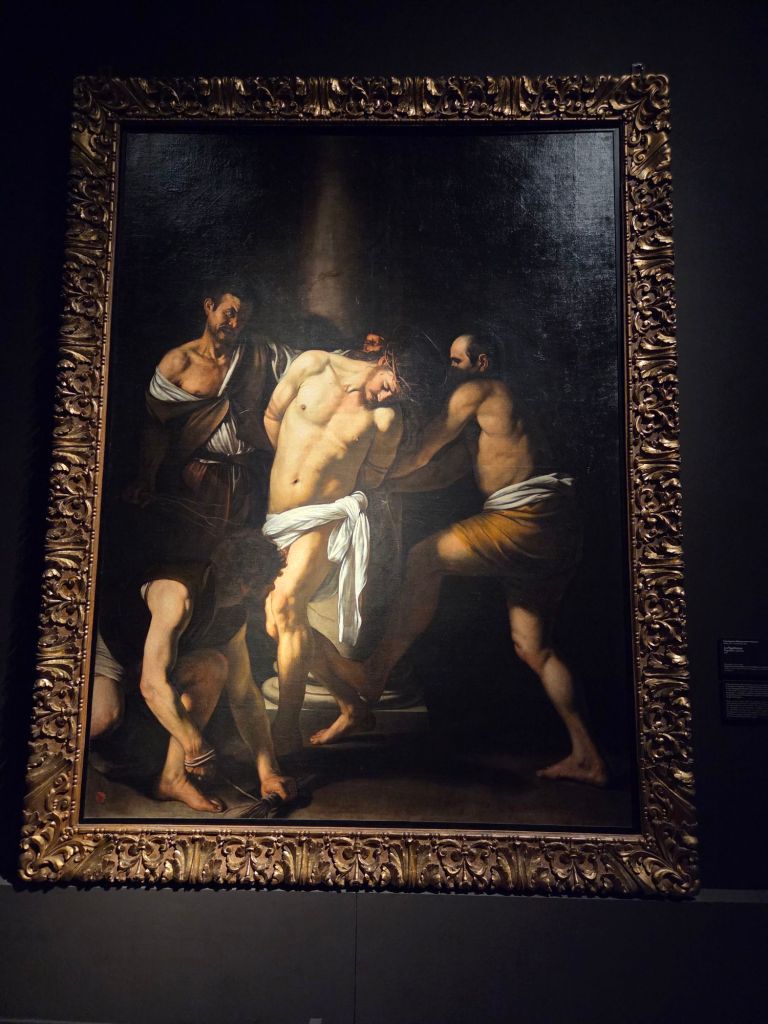
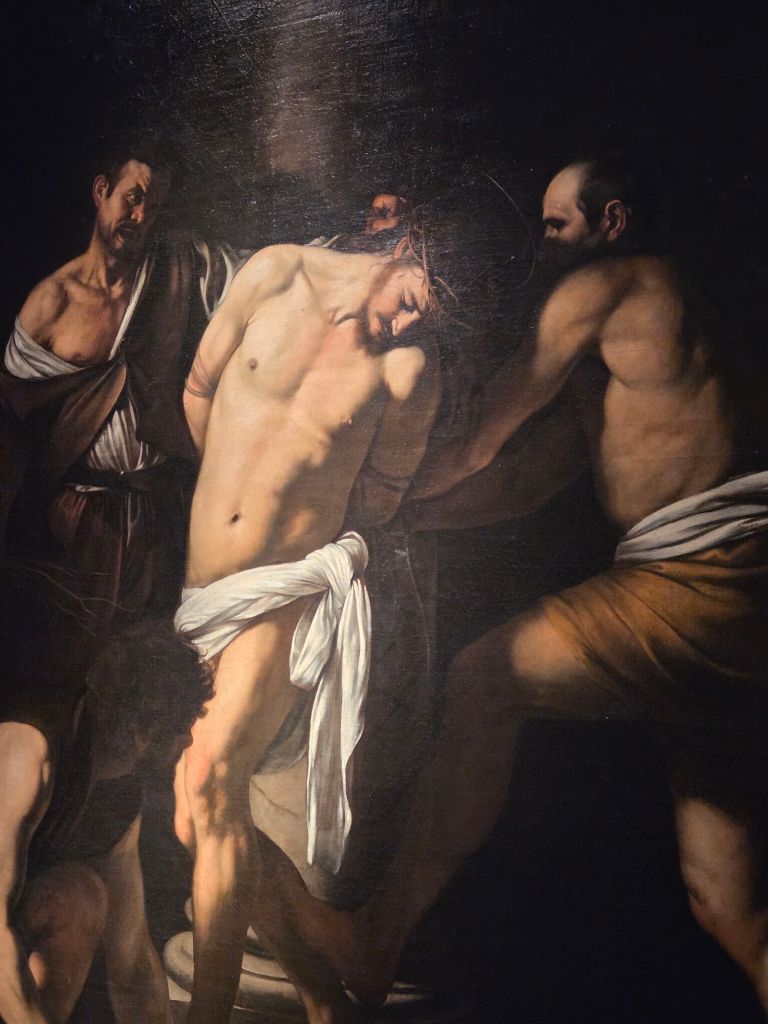
In the opposite direction, on the north side of Naples, an hour’s bus ride brought us to the Museo Real di Capodimonte, a former royal palace and garden which form a beautiful and spacious green space. There we found the stunning Flagellation of Christ.
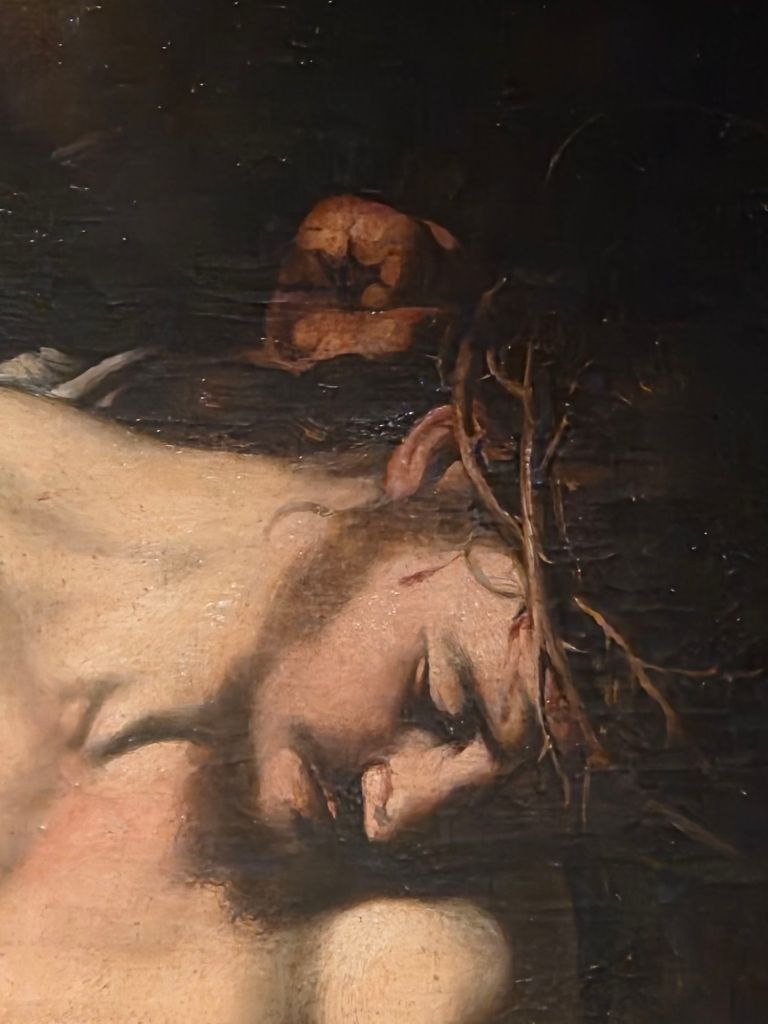
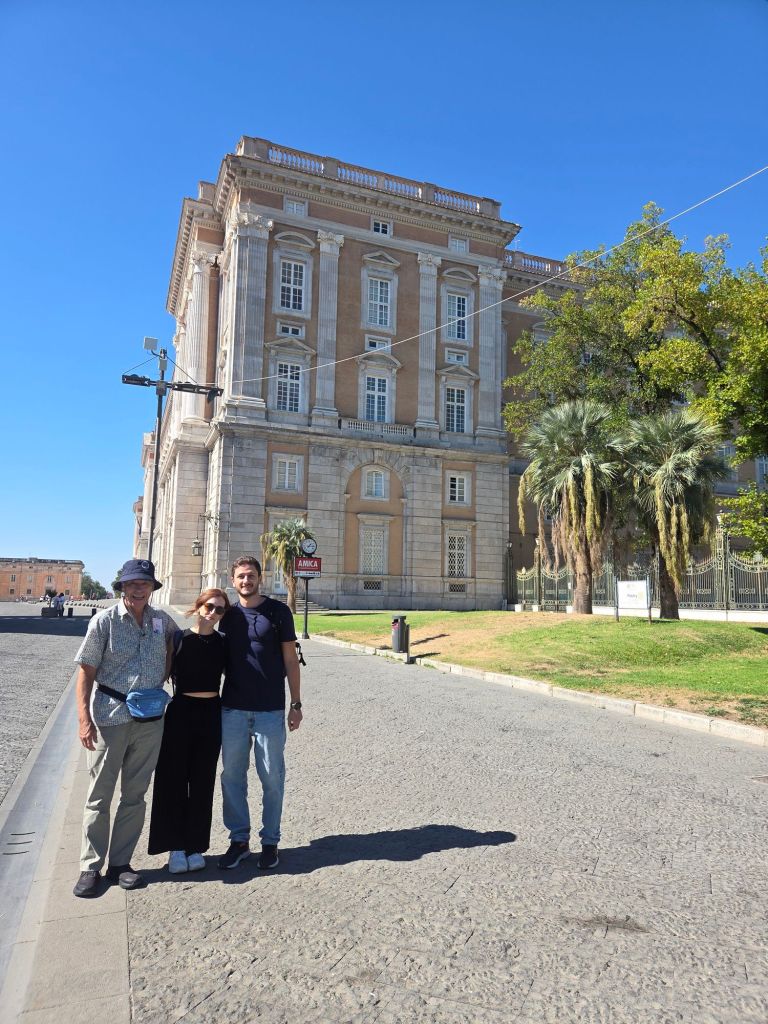
Ed walks up to the Museo’s entranceChrist, tortured and exhausted, is surrounded by three henchmen binding him in order to flog him. The pillar to which he is being tied forms a light, vertical beam rising upward.The torturer on the left grasps Christ ‘s hair to jerk his head back. Drops of blood fall from the thorns thrust onto His scalp. We cannot look into His eyes.
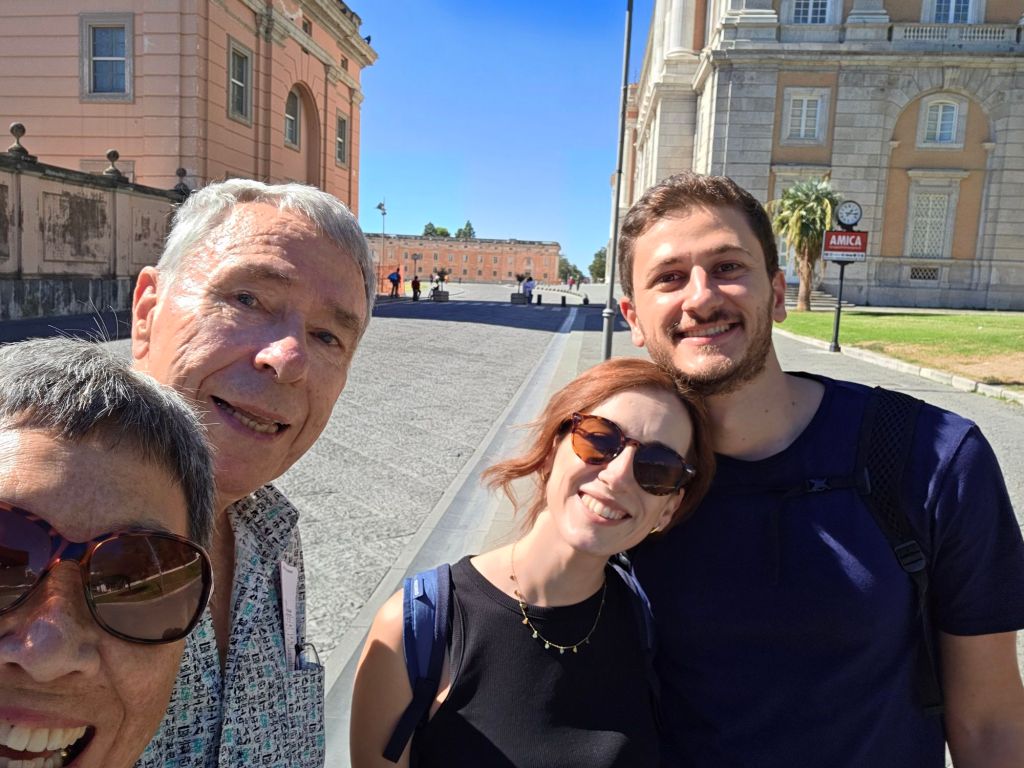
On our second of three days in Naples we gave ourselves a special treat: we took a detour off the Caravaggio path to get together with our friends, Enrico and Carla, who live and work in Naples. Together we investigated the Royal Palace of Caserta, a short train ride outside Naples.
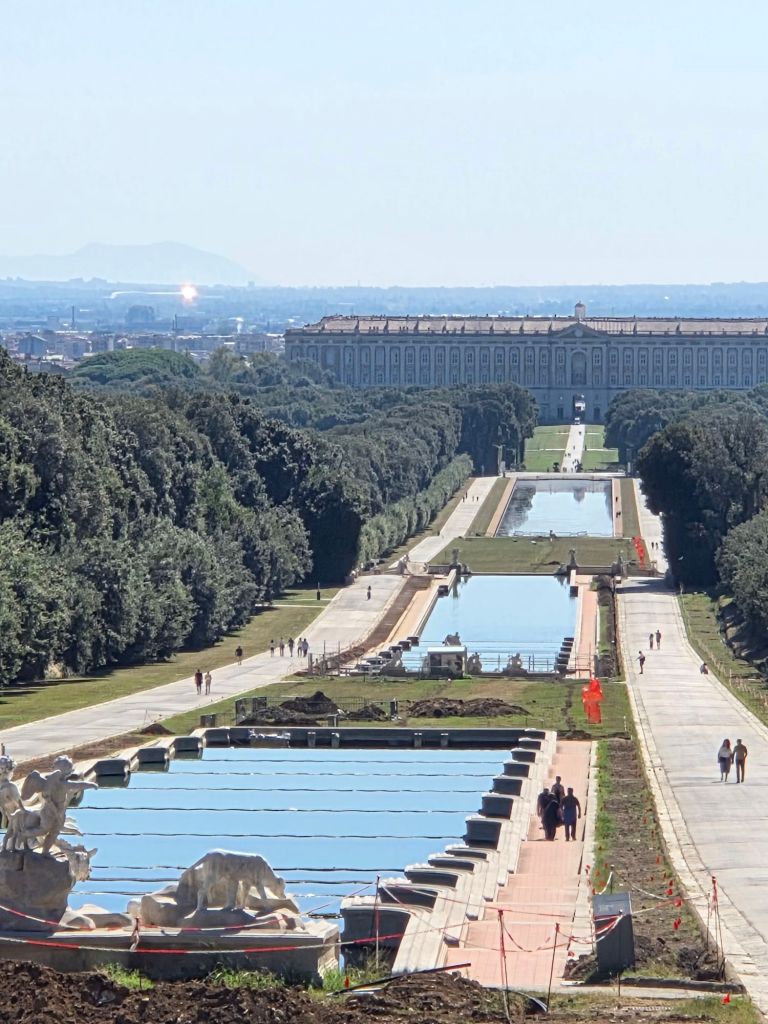
Built in there 18th century by Carlos II and the House of Bourbon it was the palace of the Kingdom of the Two Sicilies, the largest in Europe.
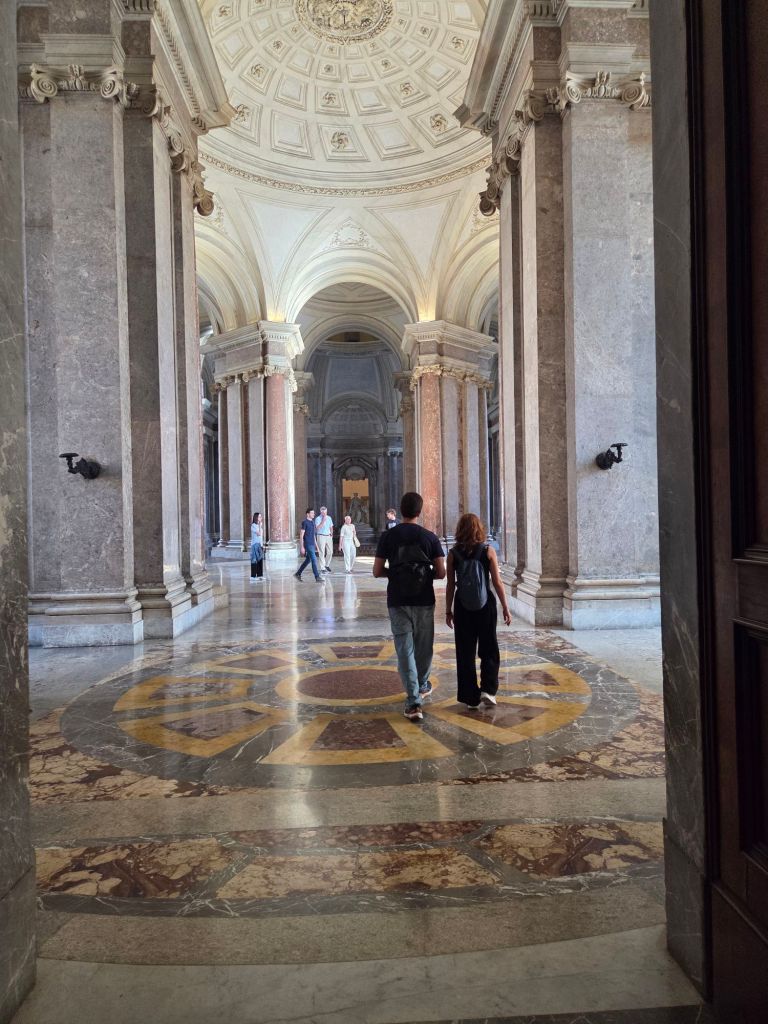
The enormous Palace can be seen in the distance at the foot of a huge water feature fed from distant mountains by special aqueduct. (There might be a bit of algae in the pools…)Enrico and Carla stroll through the Palace.
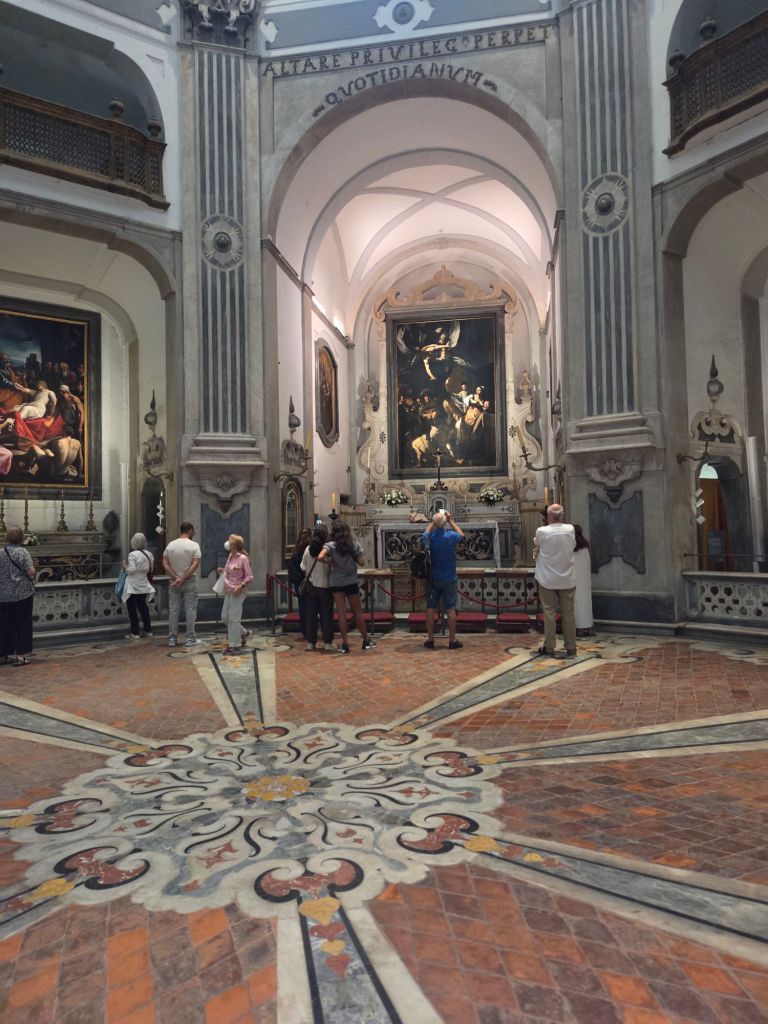
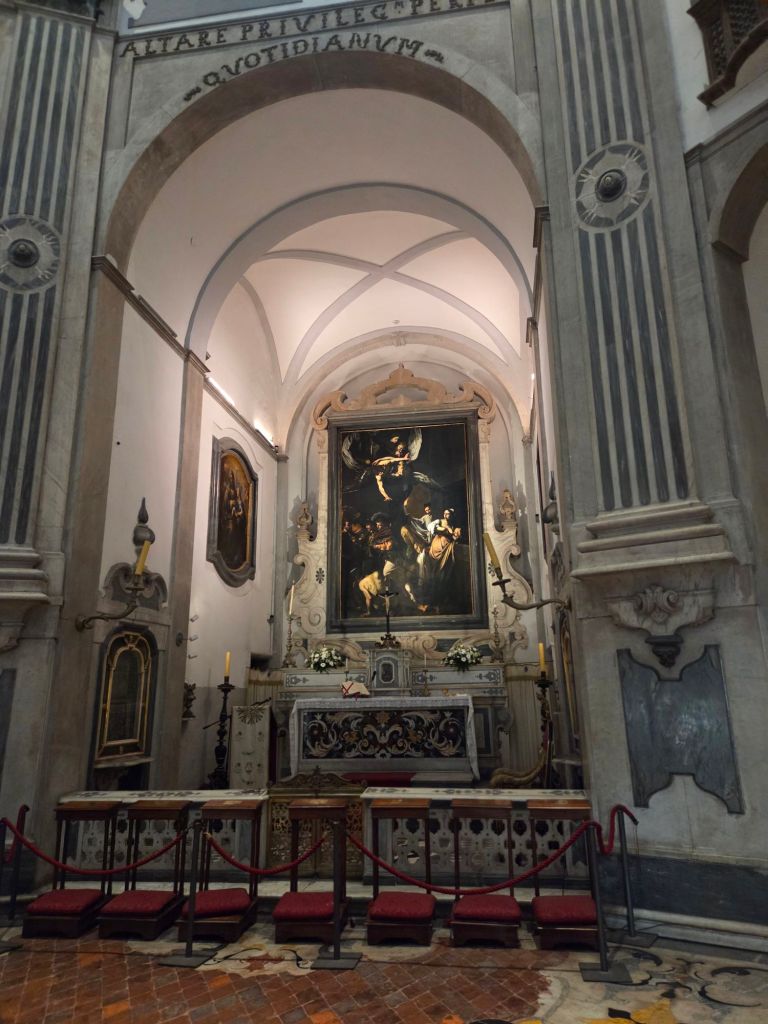
On our last day before leaving Naples for Rome, we visited the Pio Monte della Misericordia. This small chapel was the headquarters of a group of young seventeenth century noblemen who committed themselves to social and charitable action, as called by their Christian faith. Wonderfully, they are still active today, helping the poor and needy.
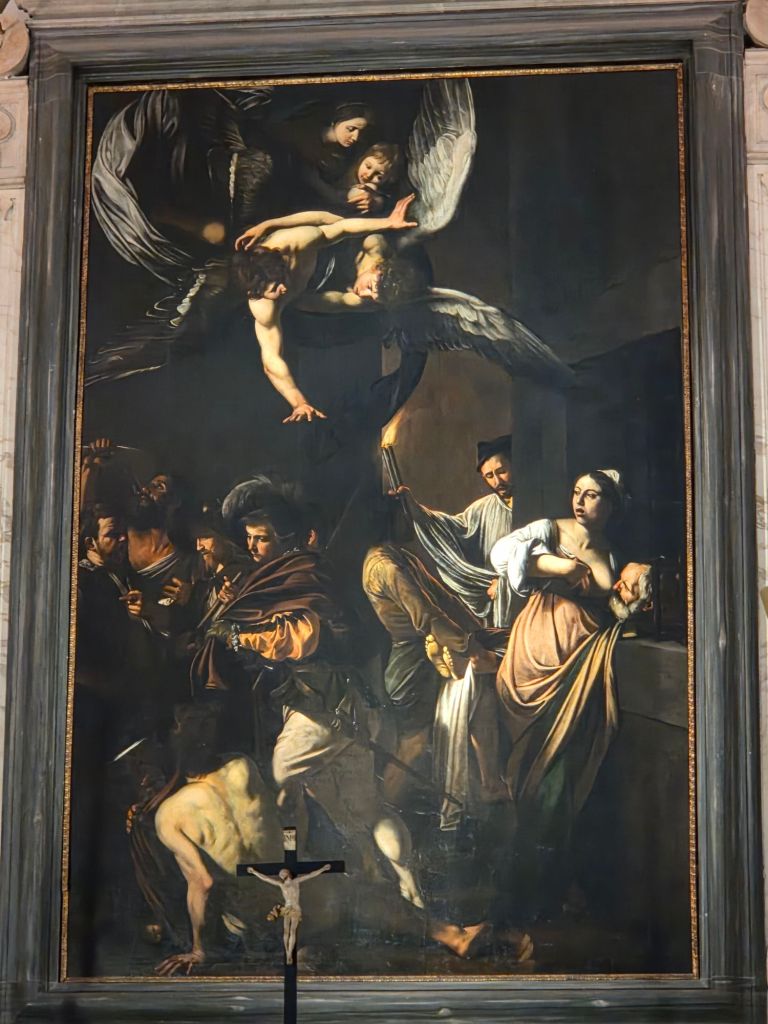
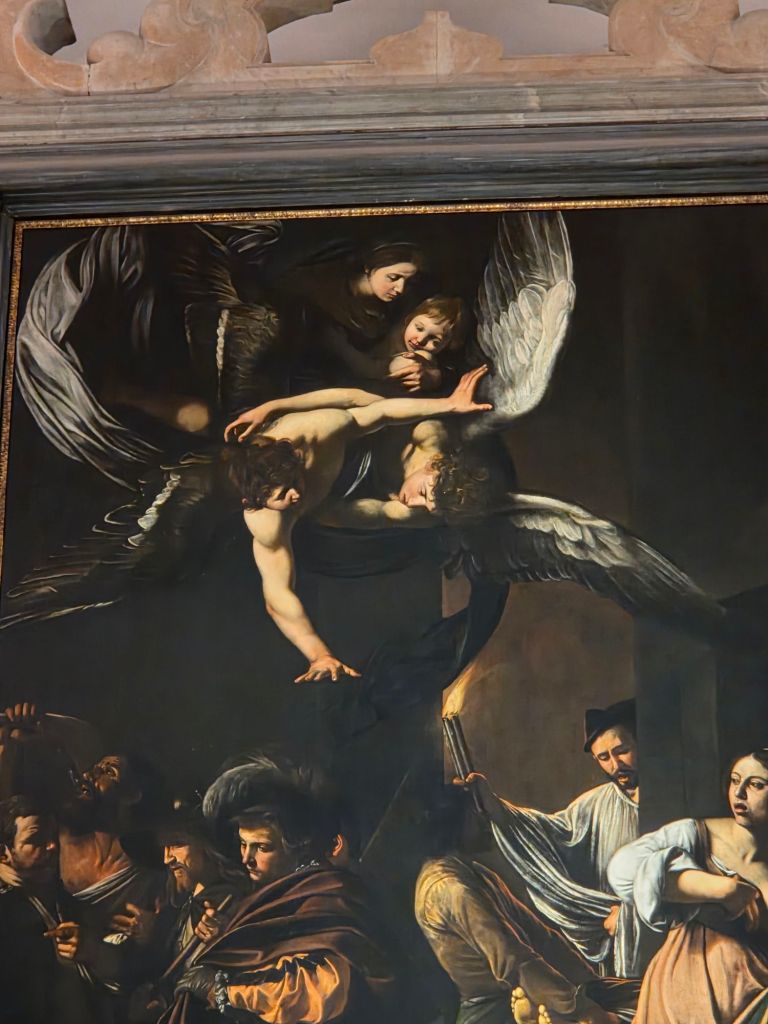
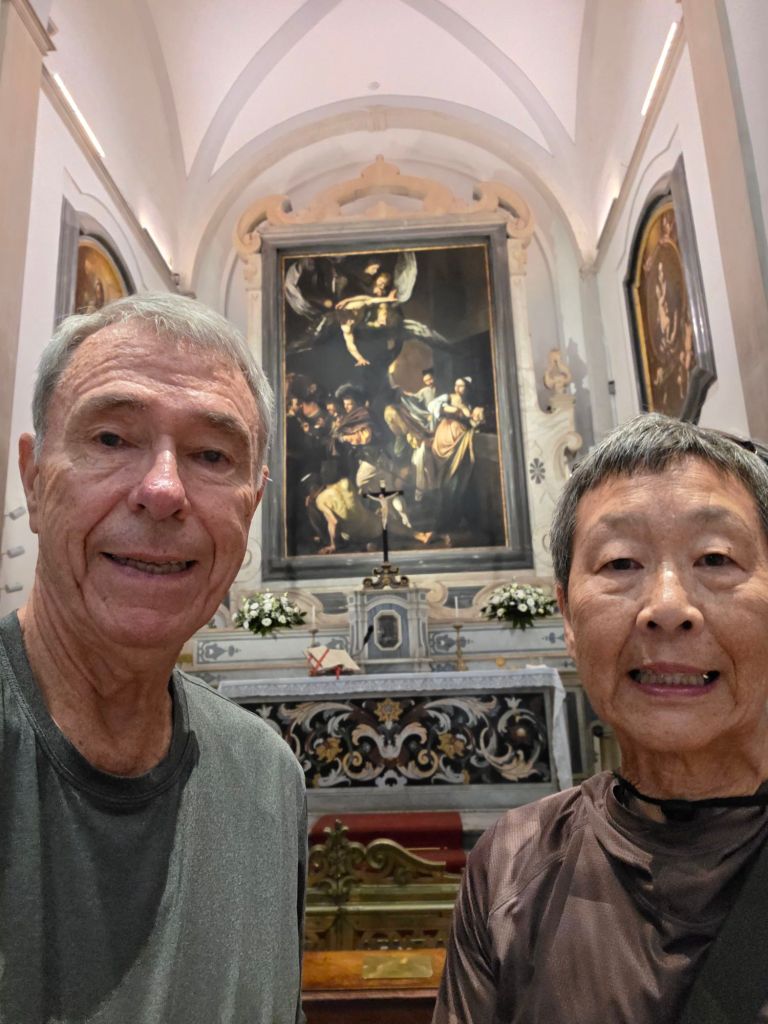
Interior of the Pio Monte della Misericordia in the Centro Storico (historical center) of NaplesThe Seven Works of Mercy (1607) by Caravaggio The Seven Works — Feeding the hungry, Giving drink to the thirsty, Caring for the sick, Clothing the naked, Visiting prisoners, Giving alms to the poor and Burying the dead — are depicted by a swarm of historical people in a crowded Naples alleyway in the dead of night. From above, tenderly compassionate Madonna and Child, borne by a whirling swirl of two young angels, enable the humans to engage in the works of mercy. Note there young Nan wearing a large hat at bottom left. He is Saint Martin of Tours dressed as a pilgrim of Santiago de Campostela (which we first walked in 2015). The Santiago scallop shell is on his hat.Ed finds the Seven Works of Mercy the most compelling of the 30 paintngs of our Camino.
From Naples we move to Rome, the city which presents the largest number of Carravaggios (20) in the world.
Dear Friends: September 2026 greetings! We are preparing to embark on what Ed has dubbed our “Camino Caravaggio”! But first, let us express our warmest gratitude to friends and family who have brightened our world in 2026, the 80th year since Ed’s birth on March 7, 1946.
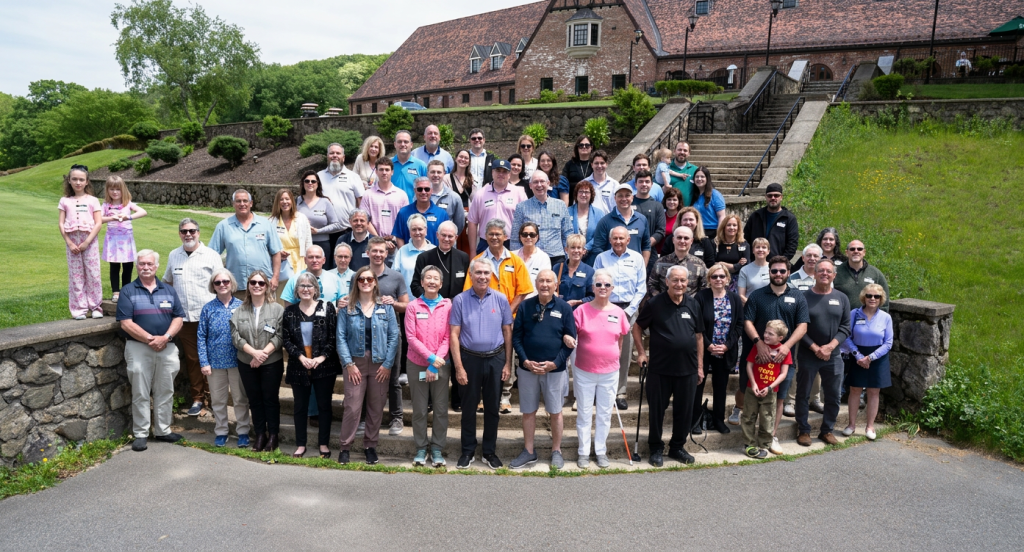
Ed, front row center, purple shirt, turned 80, with family and friends at Historic George Wright Golf Course.
Thanks to 65 friends and family who gathered for birthday cake and golf at the Historic George Wright Golf Course in Hyde Park (Boston), Massachusetts on May 31, 2026. This public course was part of FDR’s Works Projects Administration (WPA) to enable the country to begin to recover from the Great Depression and is only a mile or so from Ed’s boyhood home in the Roslindale section of Boston.
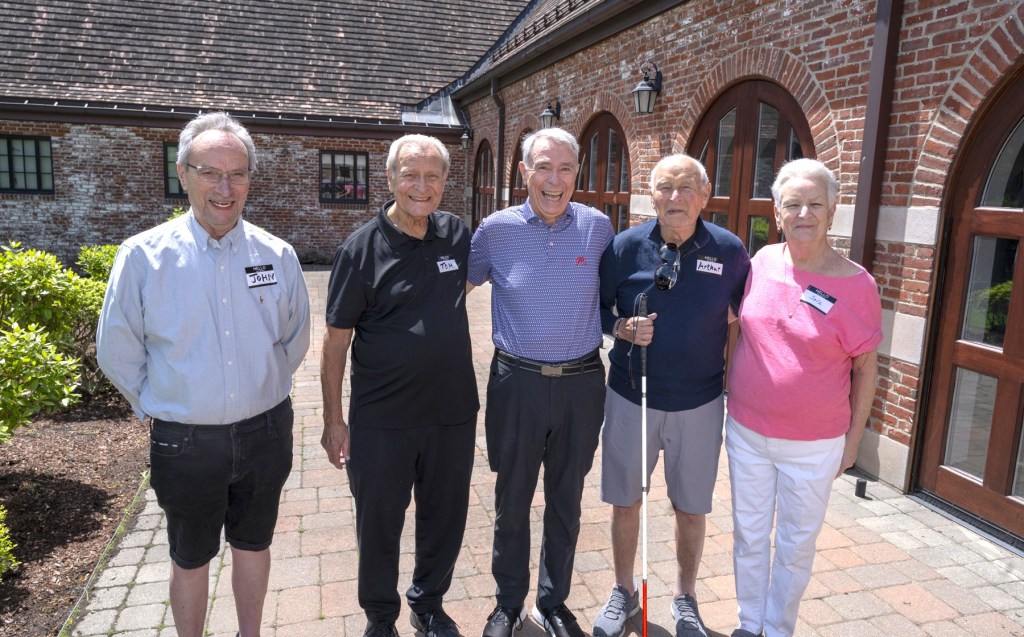
Siblings: from left, John, Tom, Ed himself, Arthur, Sara.
Five of the ten Muldoon siblings were present. Gone on ahead and always in our hearts: Leo, Margie, Mary, Dorothy, Bill.
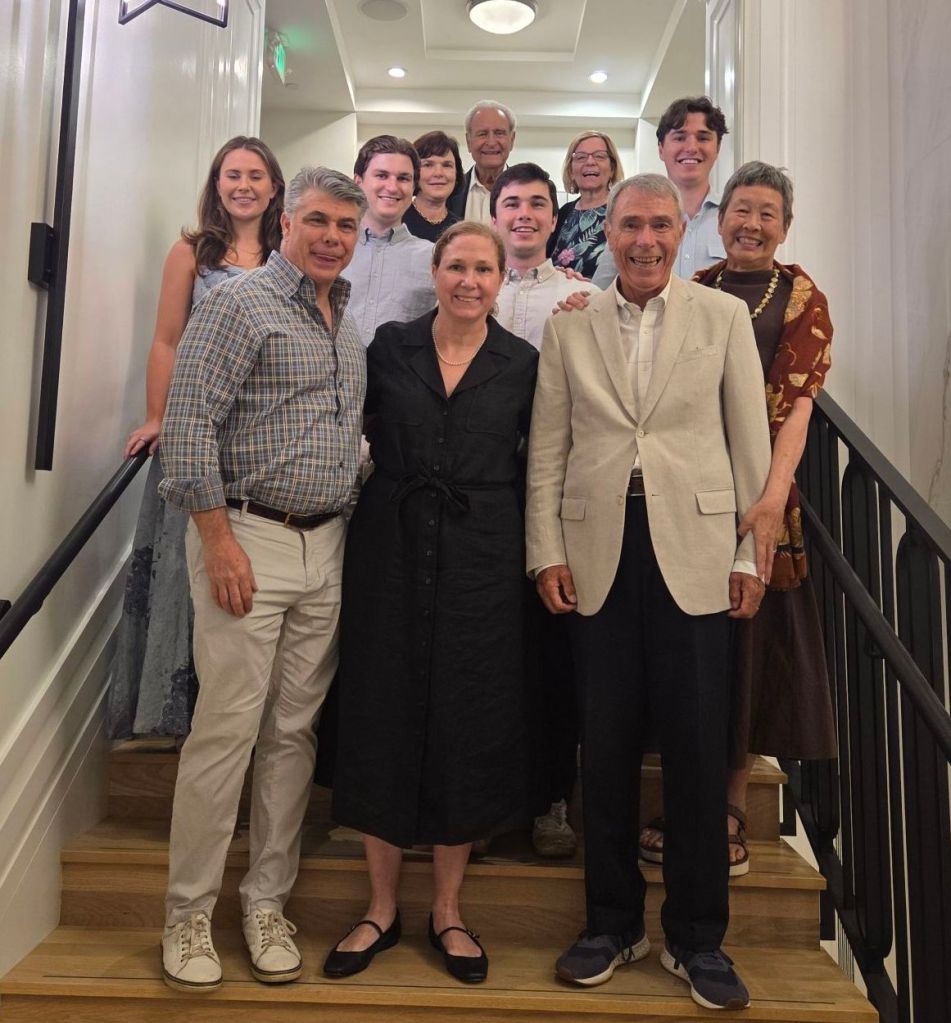
Ed also celebrated in Florida in March with (front to back, left to right) Bob, Lara, Ed; Chloe, Ryan, Owen, Anne; Molly, Tom, Donna, Jack
It’s been 12 years since Ed and Anne first walked the Camino de Santiago de Campostela. We started in St Jean Pied du Port in France, walked over the Pyrenees and 500 miles across northern Spain. We learned about this ancient pilgrim journey thanks to our friend, Father Tom Ryan (who is in the big group photo, above). Since then we have walked the Camino Portugúes, the Camino del Norte, which we started in Lourdes, the Camino San Francesco (Way of St. Francis of Assisi) through the Appenines and the Via Francigena (the last two in Italy). In 2024 a Camino was cut short due to Anne’s knee injury and in 2025 we walked an abbreviated two-week Camino before traveling to Ravenna, Dubrovnik and Budapest. You are invited to delve into the Archives on this blog to read about those experiences.
Challenges with Anne’s right hip (now replaced) and left knee have convinced them to reduce the walking-and-carrying aspect — but not to give up the searching-and-contemplating aspect of their travels. As a result, we embark on a different sort of Camino (“camino” means “way” or “road”), what Ed has called, the “Camino Caravaggio.”
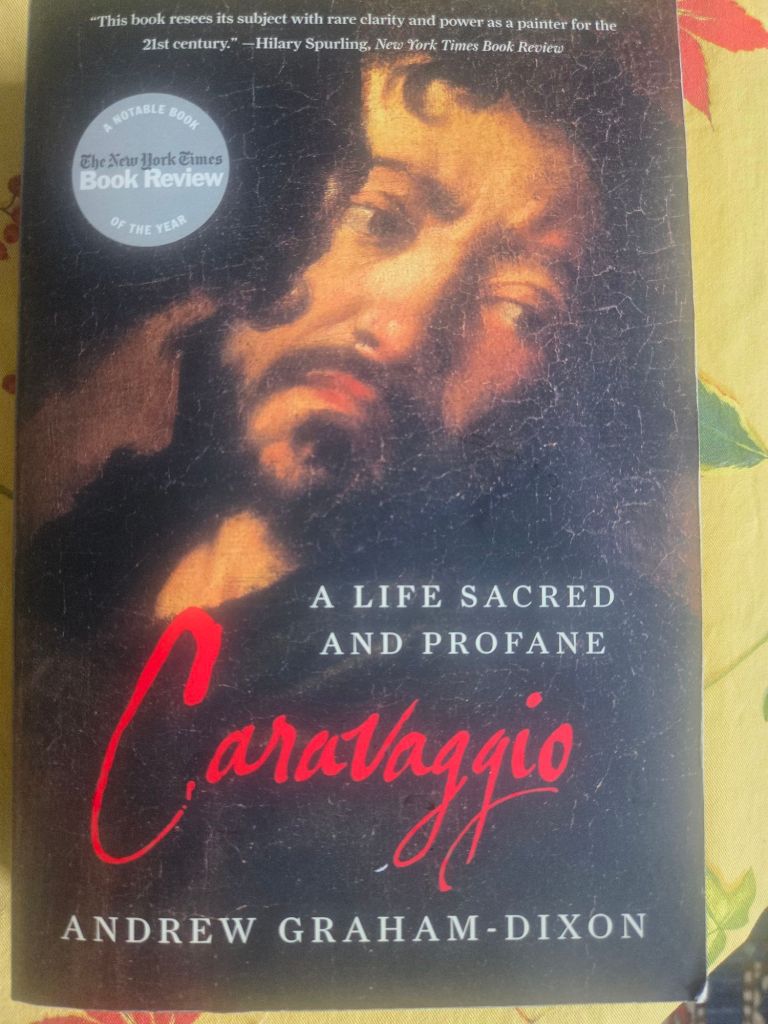
Our inspiration is a visit last year to Rome’s Galleria Borghese, which houses six (6) works by the artist in a single room! What a revelation! When we returned to the US we read Andrew Graham-Dixon’s 2020 biography, and the inspiration of this camino was settled.
Stay tuned for our detailed itinerary and adventures along the way. We begin on September 15, 2026 with an Aer Lingus flight from Dulles to Dublin.
Know that we carry your love and friendship in our hearts.