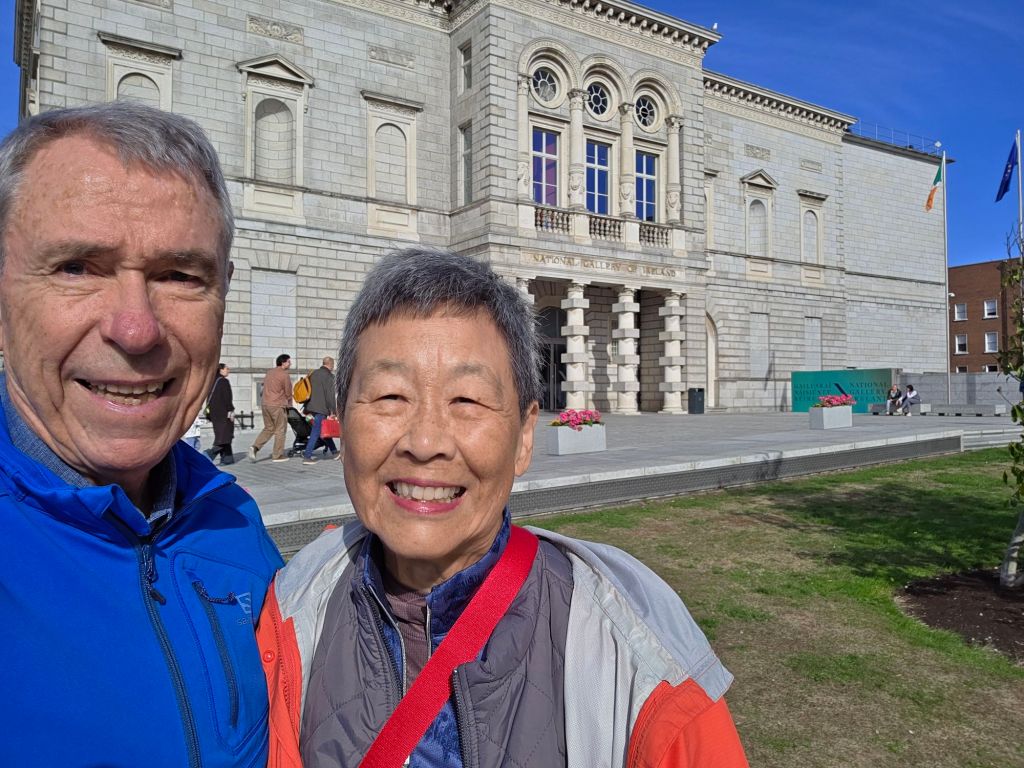
On a mostly sunny but cool Sunday morning we set out from our Dublin hotel across St Stephen’s Green to the National Gallery of Ireland, which holds Caravaggio’s The Taking of Christ (1610).

Never before have we “opened” a museum by being the first through the doors as they were unlocked in the morning at 11 am. We had a limited time window before catching a flight to Malta so we were ready to step through the doors when they opened. We were fixed on our mission. It was exciting and focused at the same time.
And there it was: near the corner of a large gallery of 17th century paintings from various parts of Europe.
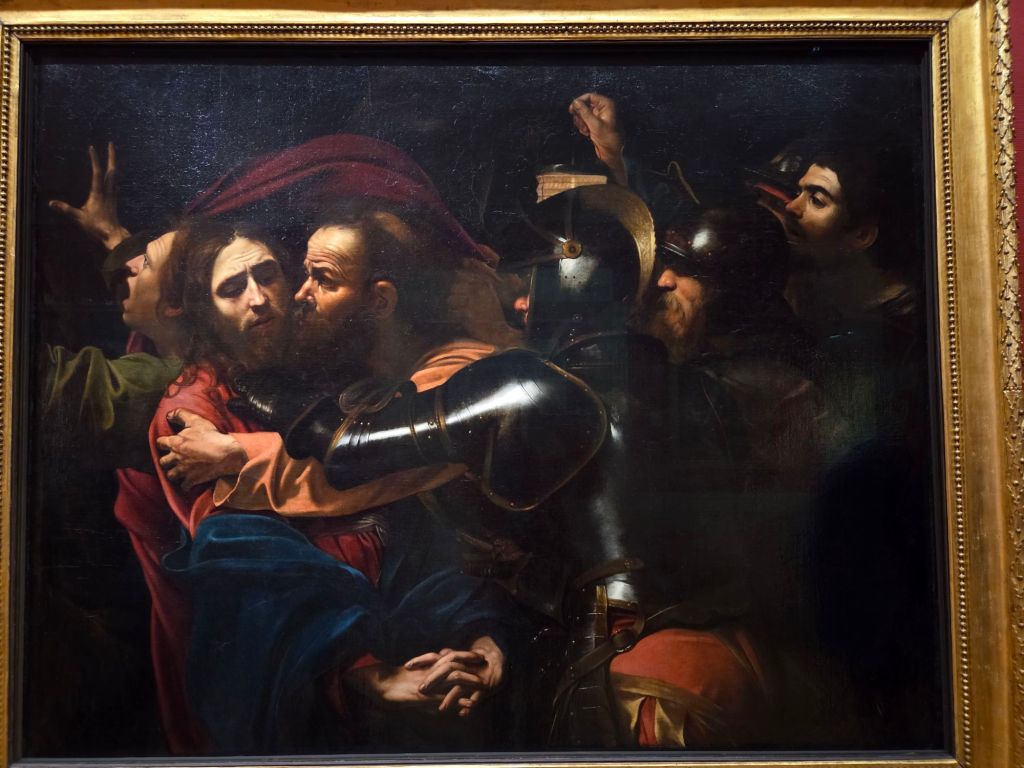
For money, Judas has betrayed Jesus to the authorities by revealing His presence in the garden and identifying him with a kiss. Jesus’ face shows immense sadness and his hands, clasped sideways, portray submission and more. Judas grabs at Jesus with dirty fingers while his face shows greed, insincerity and insecurity. Judas’ robe is an indeterminate color, like his motivations.
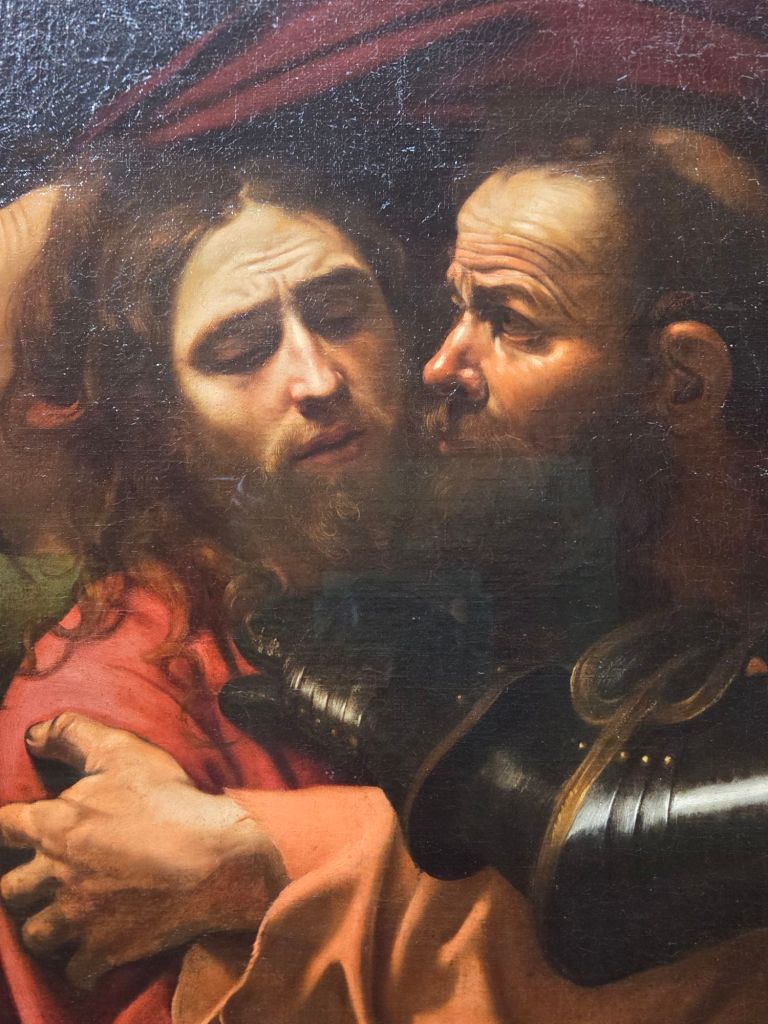
Two soldiers crowd in with brutal efficiency. The beetle-black armored arm of the first soldier aims like a pincer at Jesus’ undefended throat.
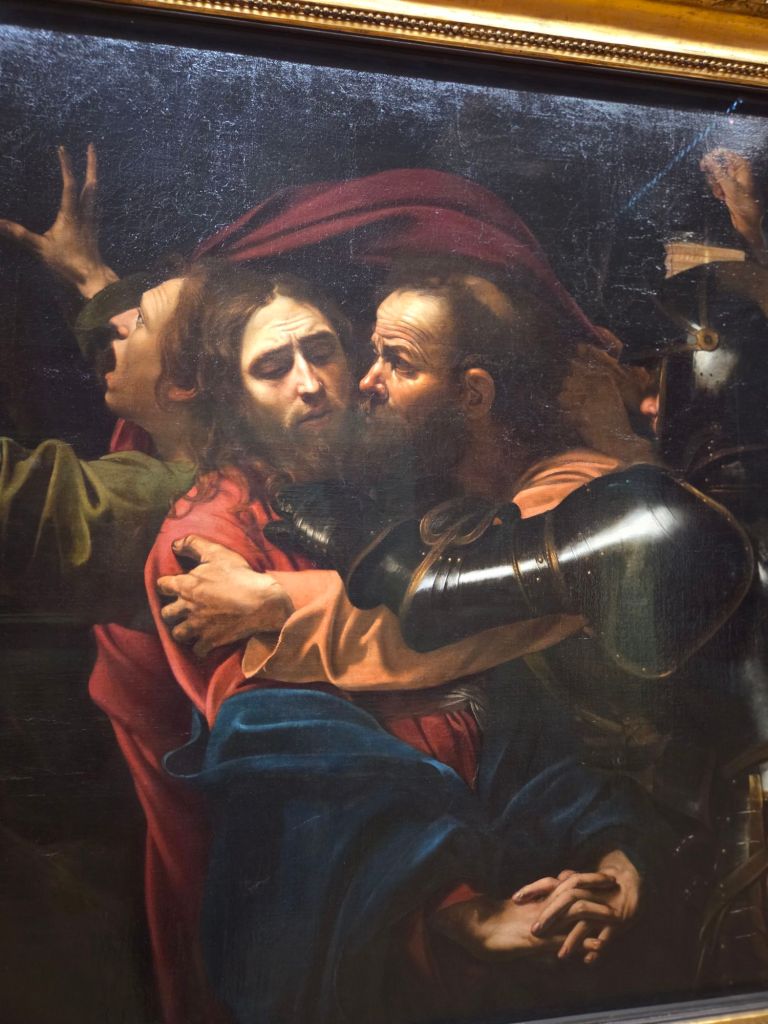
On the left the apostle John bolts away with a shriek of horror. On the right, a self portrait of Carravaggio holds a lantern that paradoxically sheds almost no light. The light instead seems to come from the viewers’ side of the painting, from somewhere at the bottom left. It lies across the armored arm of the soldier in a beam that seems modern in its mechanical coldness.
This painting has a very interesting story of how it came to the National Gallery of Ireland. It was commissioned in 1602 for a powerful wealthy Roman named Ciriaco Mattei, brother of a cardinal, but in passing through the generations since that time it was at some point misattributed to a Dutch artist and eventually landed with a Scottish art dealer. In about 1924 an Irish Catholic woman named Marie Lea-Perkins bought the painting and in the 1930’s she gave it to the Jesuit Fathers in Dublin in thanks for their help and counseling during the grief she suffered after her husband, an English Protestant officer in the British Army, was murdered by the Irish Republican Army.
Marie used the settlement she received for her husband’s death to pay for medical school, becoming one of only three women in her class. As a pediatrician, she became a prominent practitioner but her career was marked by serious controversy over alleged malpractice.
Meanwhile, the painting, darkening with age, hung for sixty years on the dining room wall of the Jesuit Fathers in Dublin until one day the Fathers requested an assessment of their art. A senior conservator from the National Gallery spied it as a long-lost Caravaggio and it was unveiled as such to the public in 1993. It now on permanent loan by the Fathers to the Gallery so it may be enjoyed by the Irish public and people of the world.
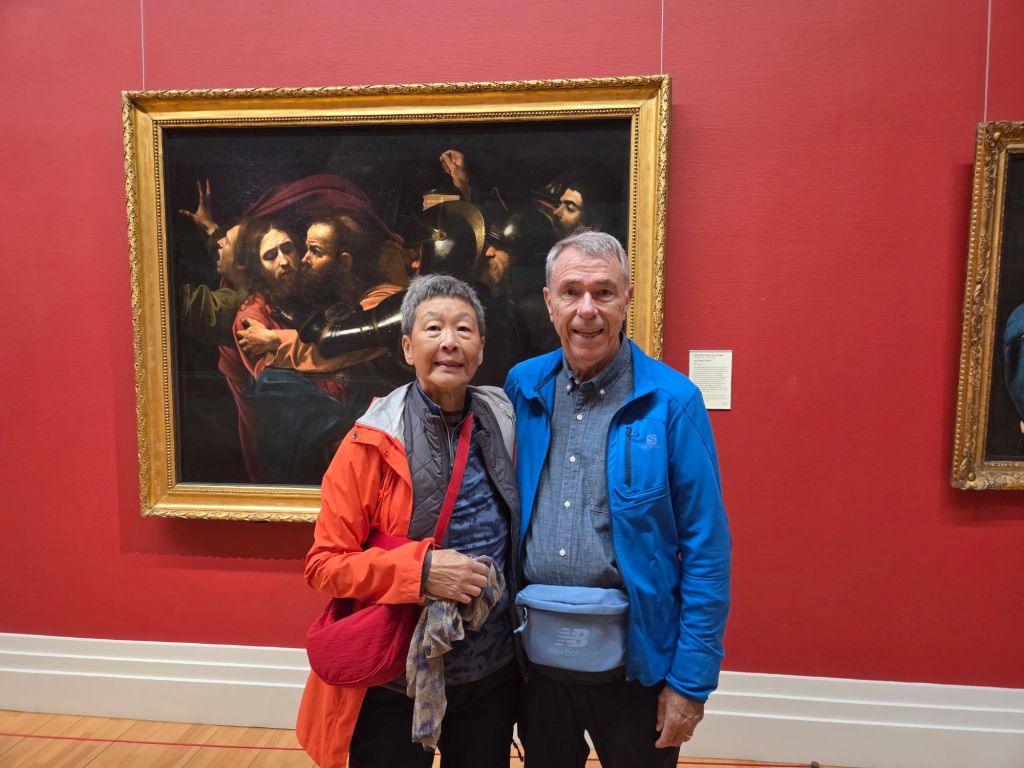
How fortunate we feel to have spent time studying and meditating before this stunning depiction of a world- and life-changing moment. The genius of the artist is a gift from God. It can illumine His goodness and nature for us.
Next, we are headed to Malta to see two Caravaggios in St John’s Co-Cathedral.