We are in the last phases of the post-pilgrimage section of our 2022 Via Francigena in Italy.
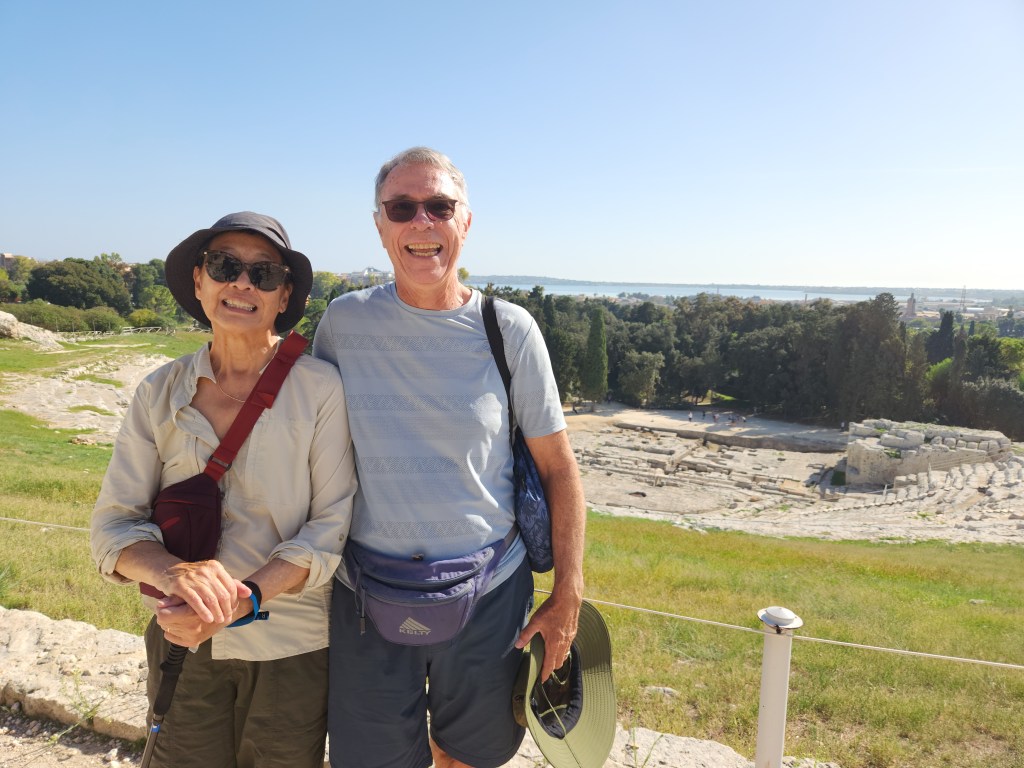
Yesterday we made a day trip to visit Siracusa (Syracuse), one of the great cities of the ancient world. A highlight was the Greek Theatre where Aeschylus premiered a play.
We will be leaving Sicily on Friday for three last days in Rome, and then spend an overnight at a Dublin airport hotel to prepare for flights back to Fort Myers, Florida, through Newark. We should be in the US on November 2nd after a late-night arrival.
If technology holds up, we’ll be able to receive calls and texts on our US numbers after November 2 (after we switch out our Italian SIM cards. )
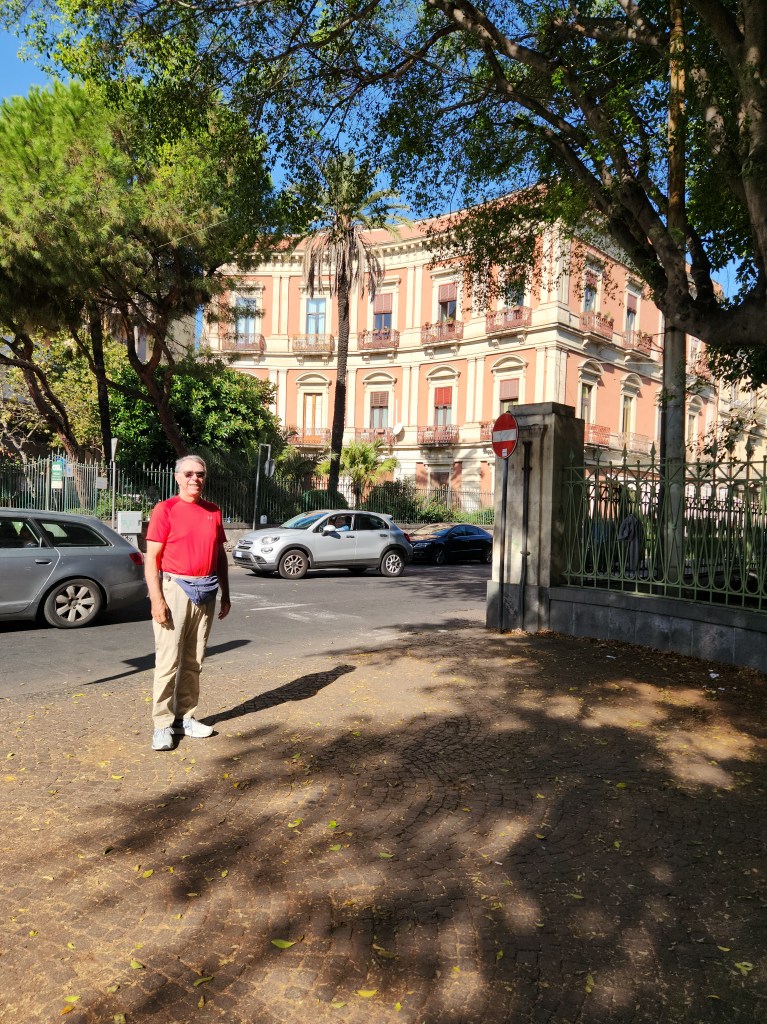
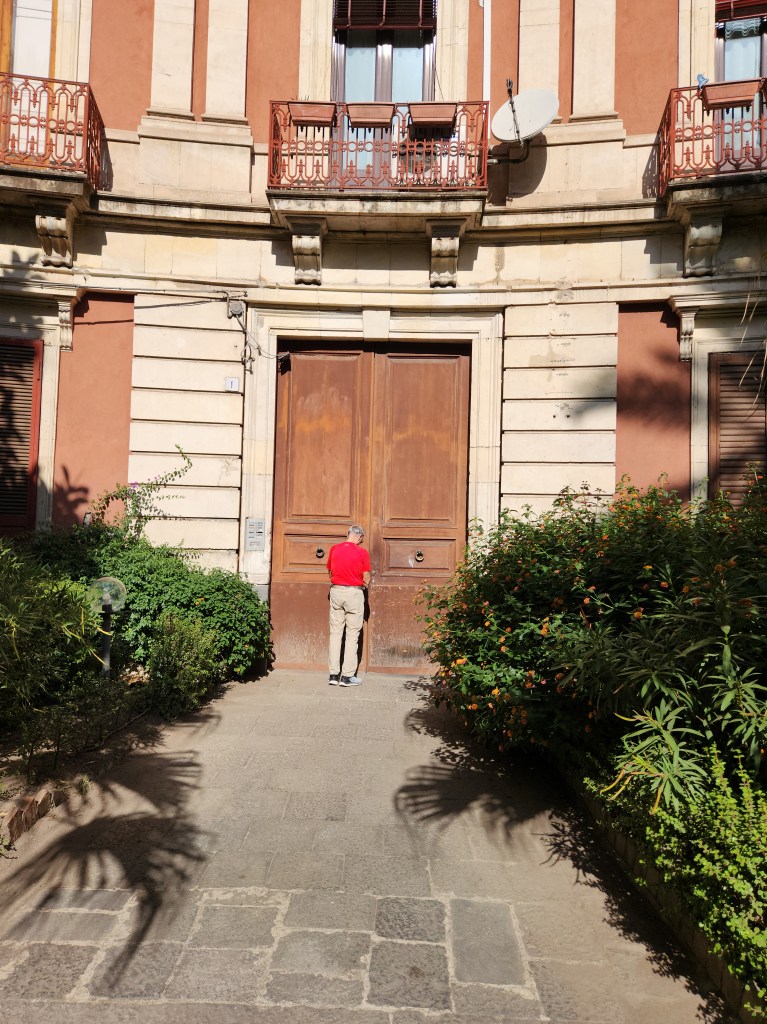
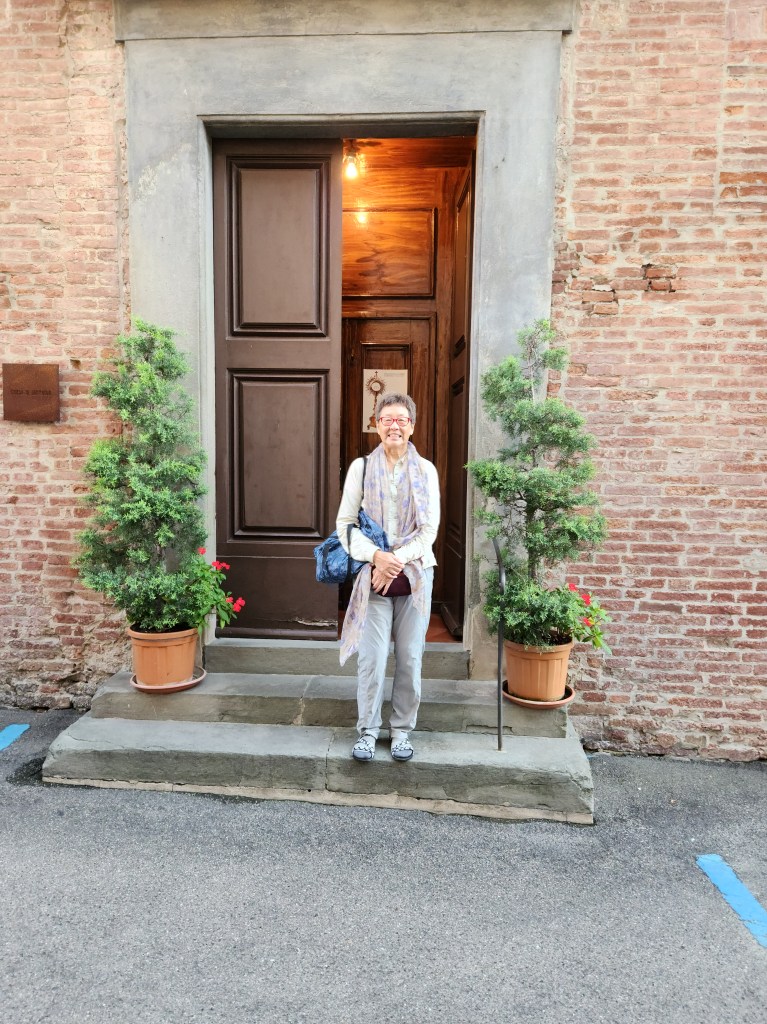
We’ve been staying in Catania, on Sicily’s west coast. Giuseppe Manzini, an author of Italian independence and unification, seems depressed. Our B&B is in the pink building, across from the Manzini sculpture park. The front door to our B&B was impressive. Once inside, first we find a motor scooter parking area — INSIDE the building. And beyond the motor scooters, a messy construction site. But our room was pretty nice.
Ed’s plan was to explore Sicily by rental car. Given the poor state of the roads and the aggressiveness of drivers and motor scooters, this is not an easy undertaking. On the third day, perhaps with not enough hydration and other factors, Ed didn’t feel well and we had an encounter with the Italian emergency medical system. Don’t worry: four doctors gave him two EKG’s and pronounced him ok. And he has been feeling fine since then. We decided to turn in the rental car and continue our trip by using local busses and trains.
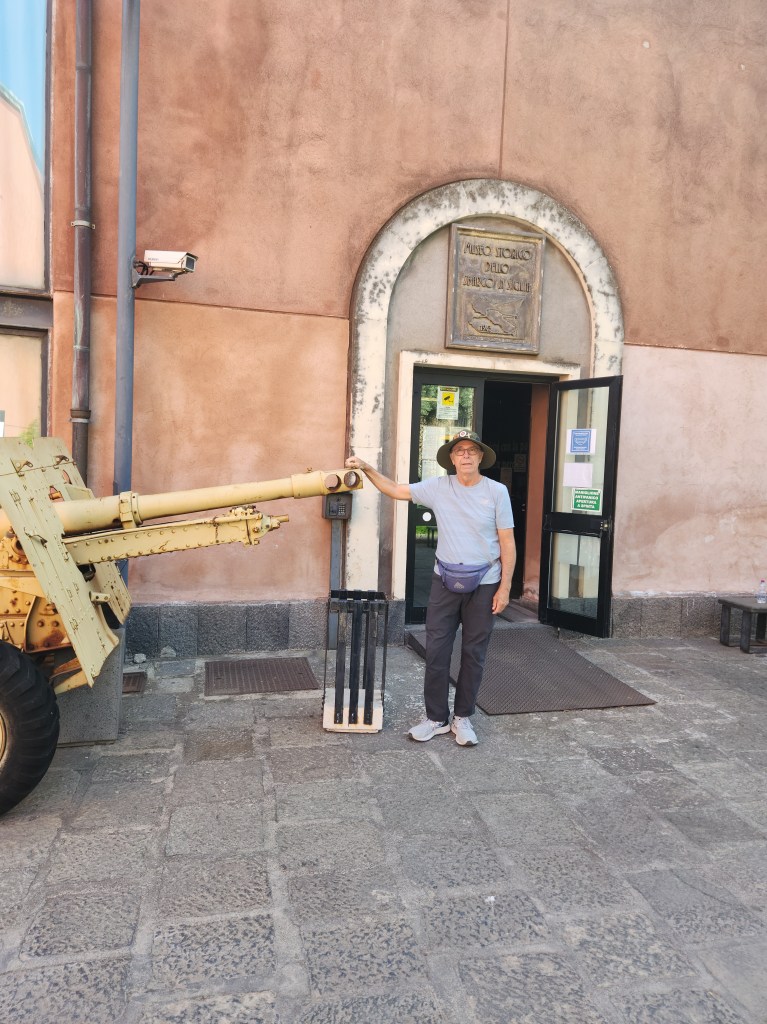
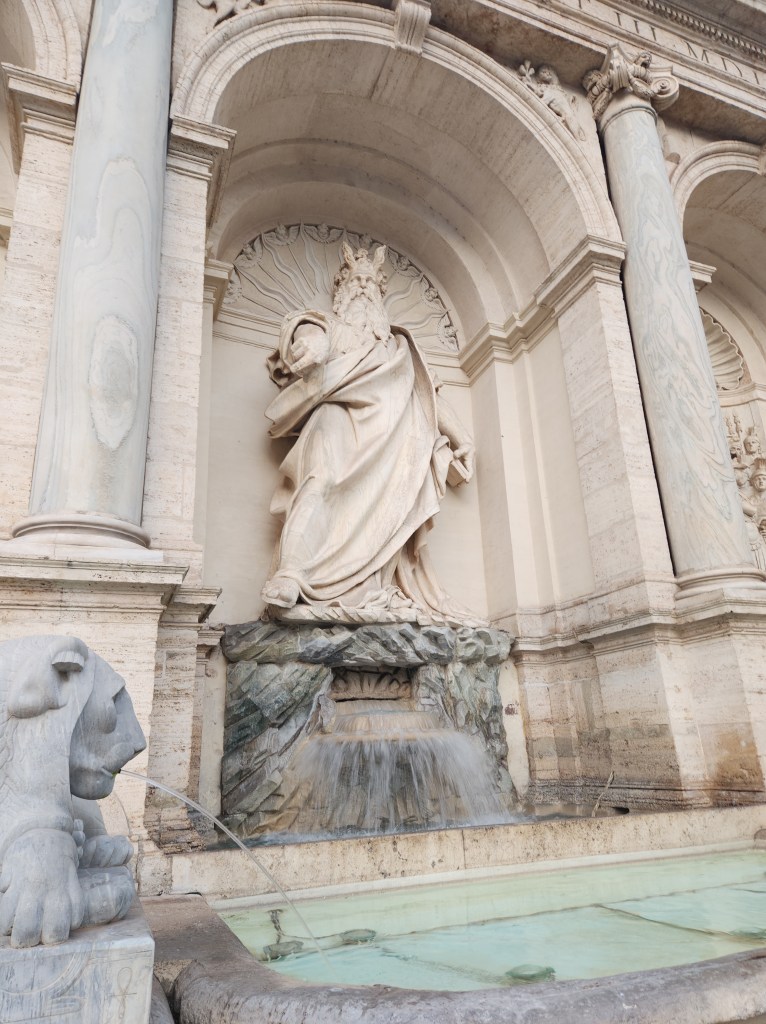
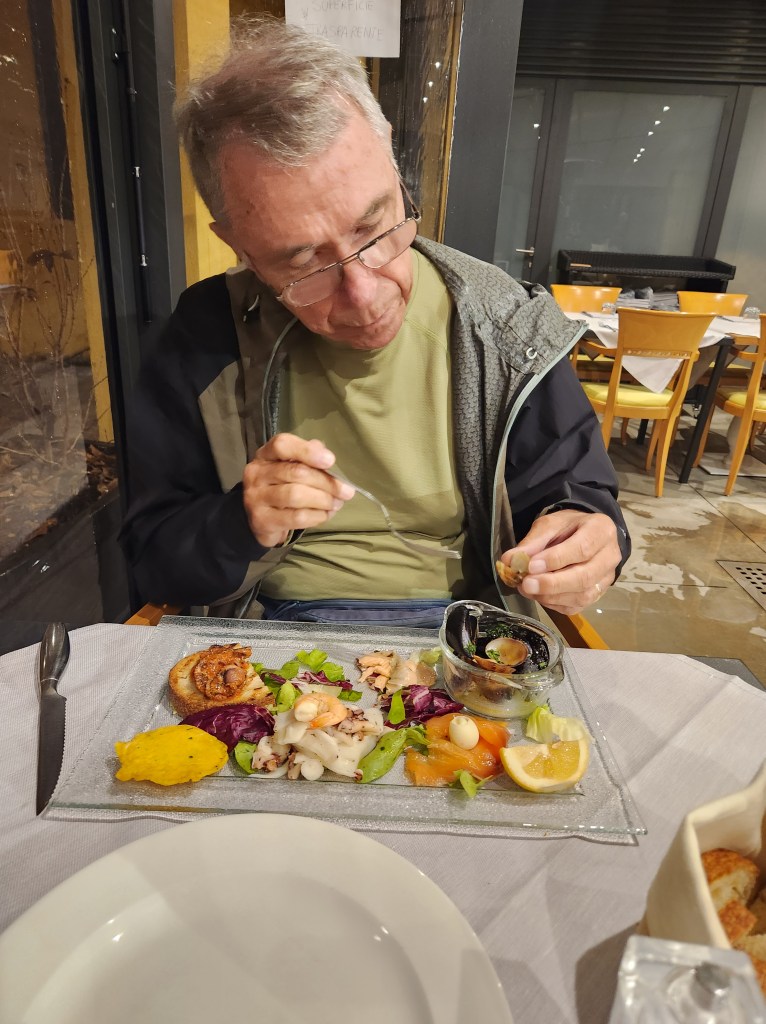
After the medical encounter, Ed feels fine. He’s enjoying Sicilian seafood and dolci (desserts). This photo is of cassata, which had alternated with cannolli as his local favorites so far (cake made with Sicilian lemons is also on the short list).Before leaving Catania for Palermo today, we visited the Museum of the Landings in Catania 1943, which tells the story of the US and British invasions of Sicily against Italian and German forces. Can we remember and comprehend the horrors of war so that we can avoid war?A couple of photos you might enjoy. This statute of Moses was sculpted by Michelangelo. We first saw it with Ed’s brother, Bill, when we visited Rome with him about eight years ago. Without planning, we stumbled across it a few days ago and remembered Bill with gratitude and affection. And this view of the Tiber, the Eternal City, and the sky.
We look forward to seeing you and talking with you when we return to the States. Meanwhile, we keep you in our prayers and ask for yours.
Ed likes to say that the impetus of this pilgrimage is a book called “Pilgrimage to Eternity” written by a Wall Street Journal reporter named Timothy Egan. The book was suggested by our cousin, Charlie, and given by me to Ed as a Christmas gift during the start of the Covid era.
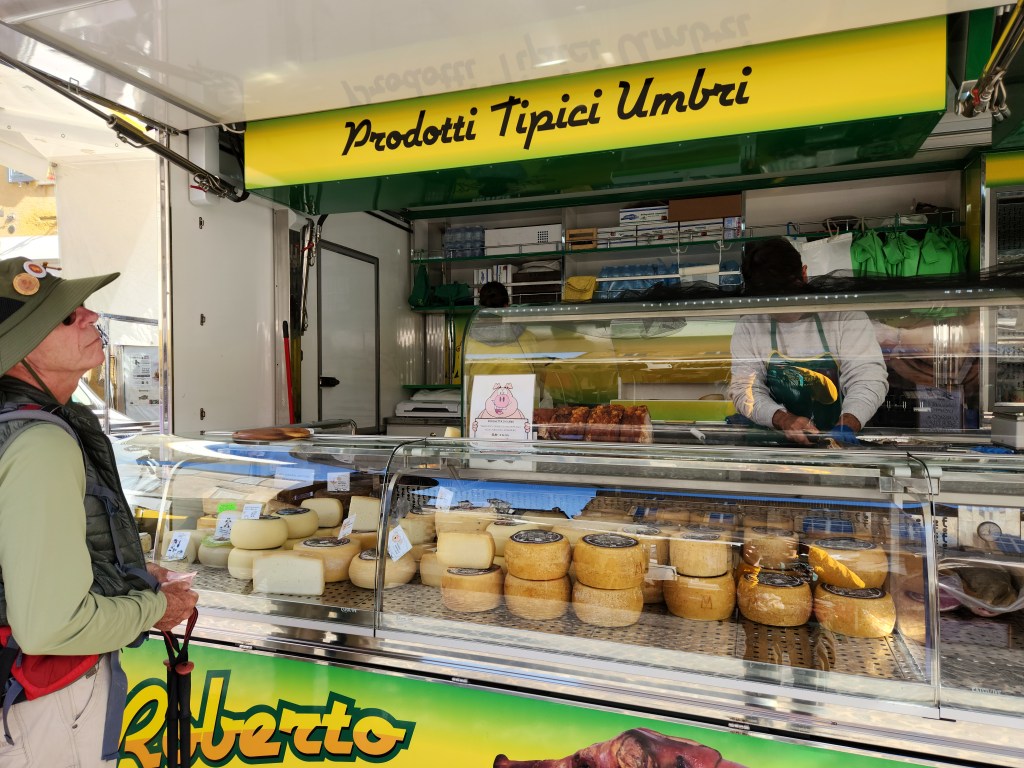
On a closing stage of the Via Francigena in a little town called Acquapendente. It has a big name and an austere Franciscan monastery. Keeping our strength up with adequate nourishment, in this case, a panina filled with porchetta and local cheese, was important on the way.
I actually didn’t care that much for the book, but the title, referring to the nomenclature of Rome as The Eternal City, caught our imagination. Ed was (correctly, to some degree) skeptical of my physical ability to walk this pilgrimage, but we were both motivated to try at least one more camino. Walking long distances to never-before seen (by us) places, day after day, with every-day cares and concerns put away, has been a set of treasured experiences for us that have shaped our lives of prayer and action.
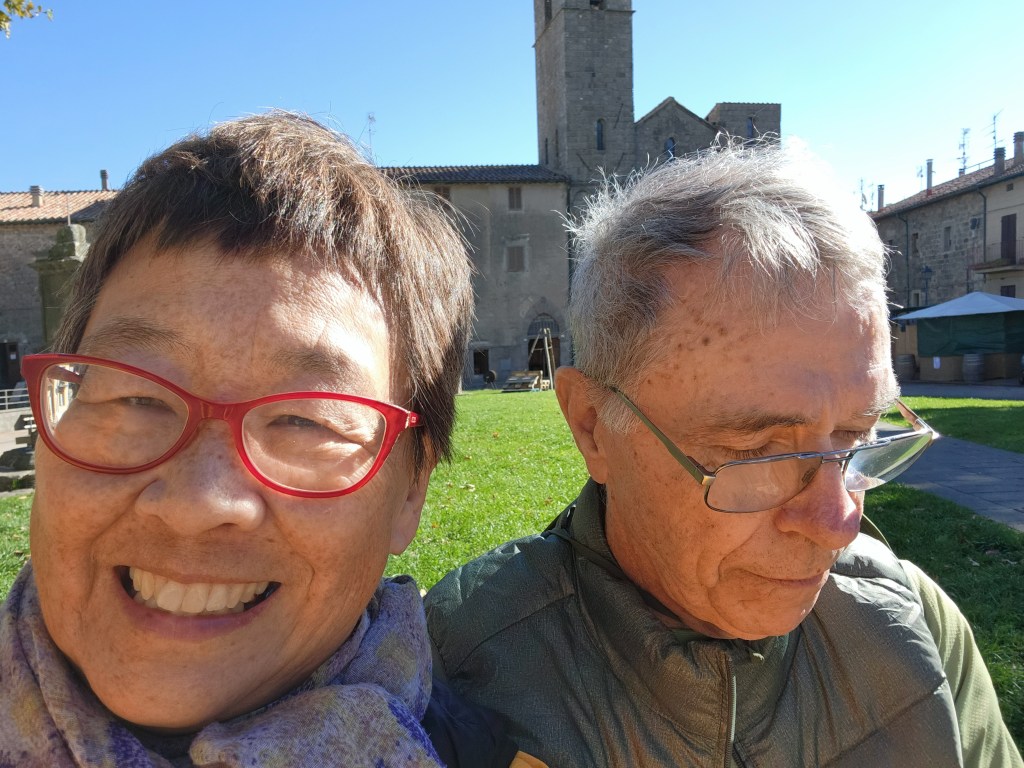
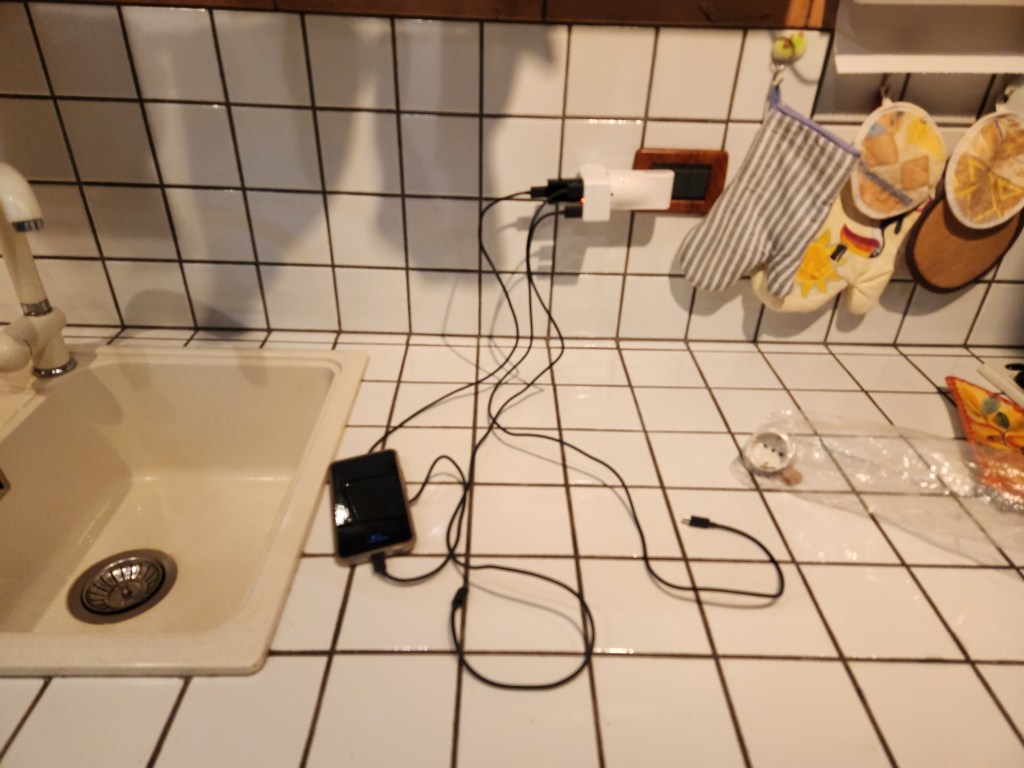
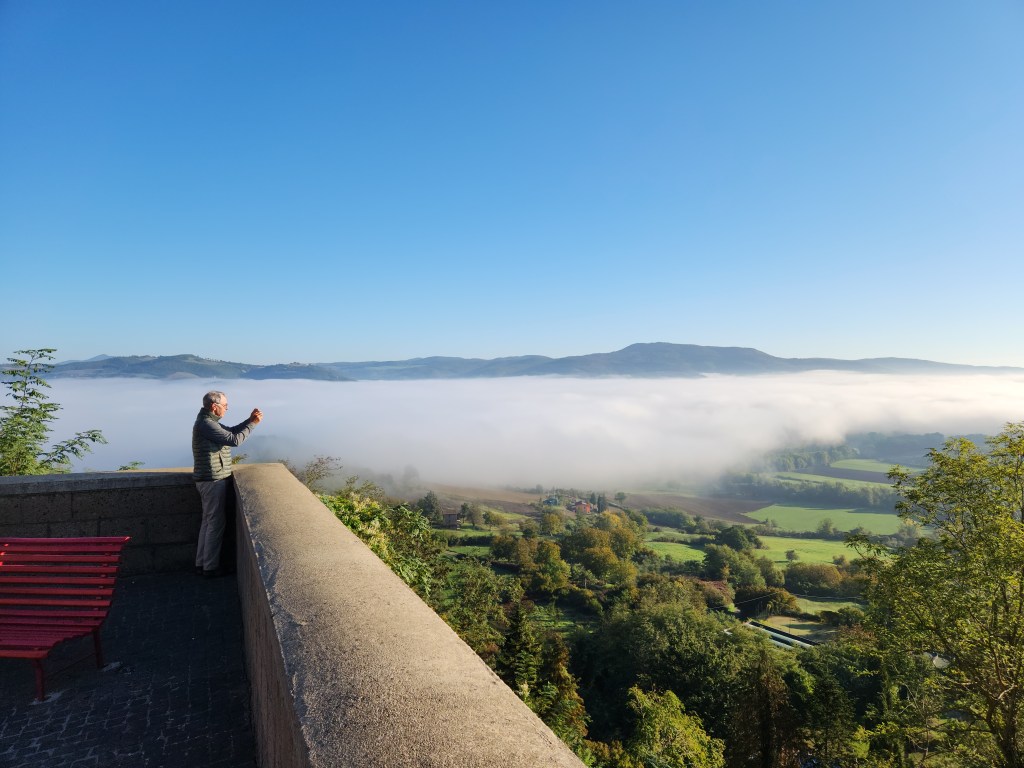
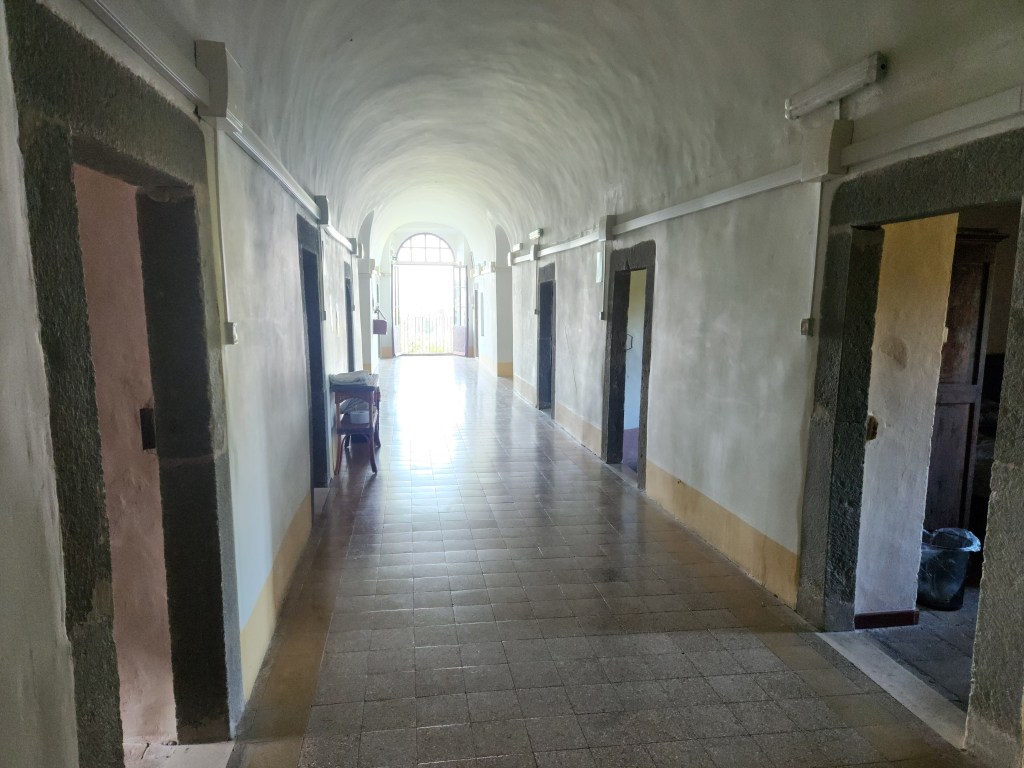
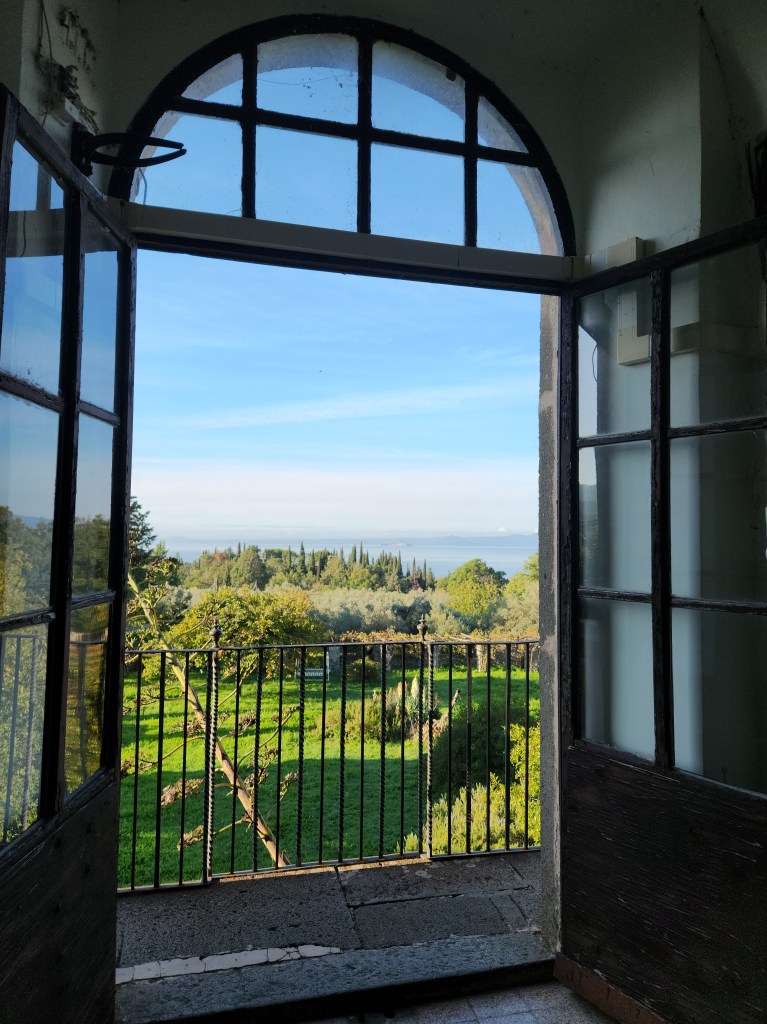
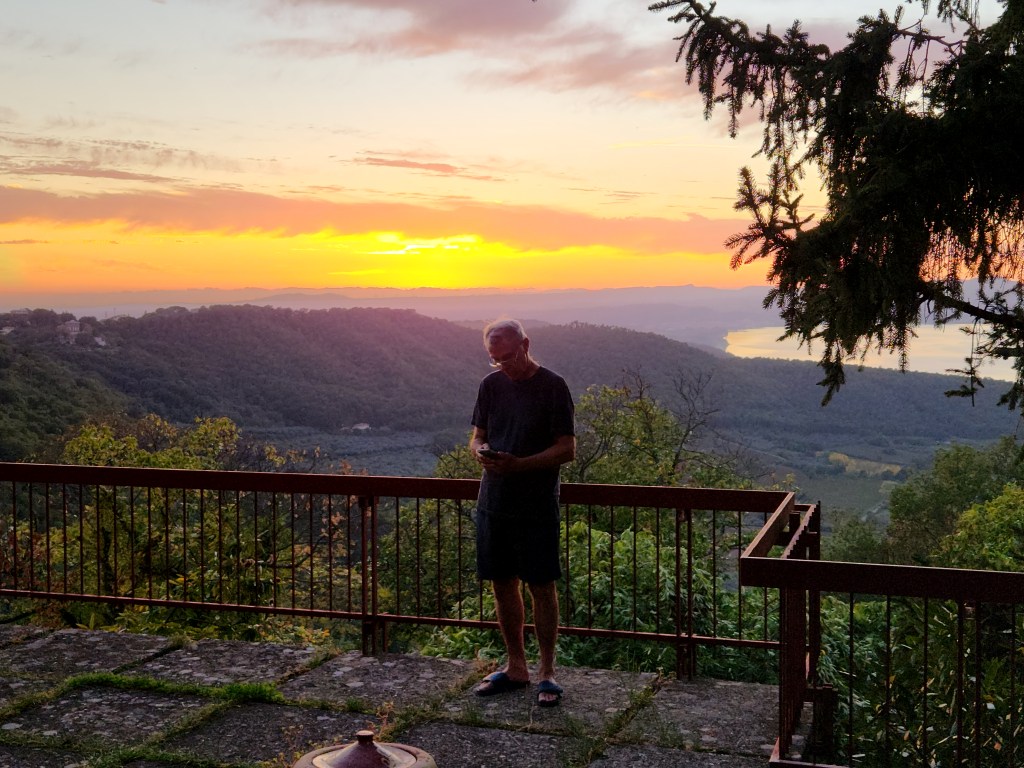
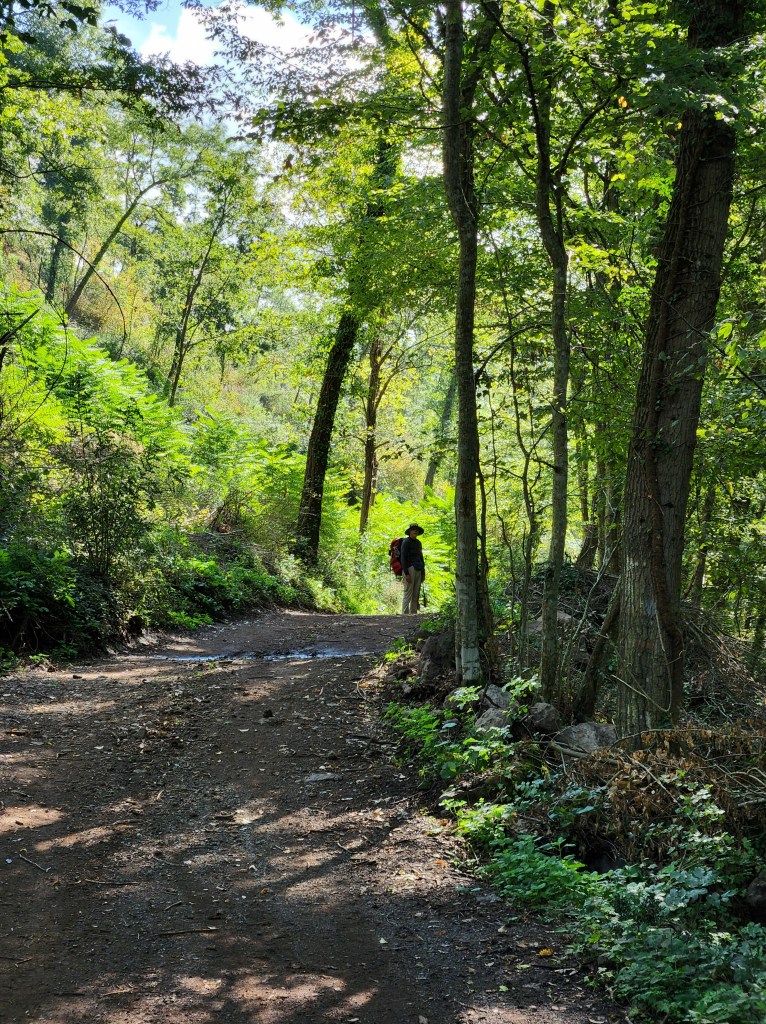
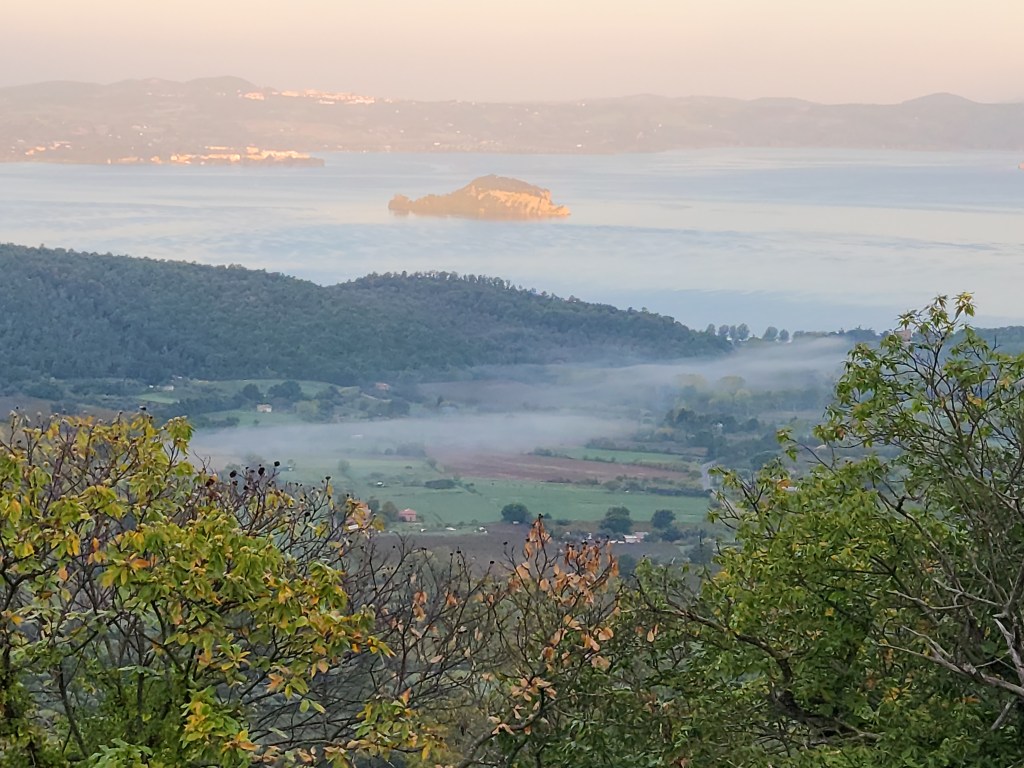
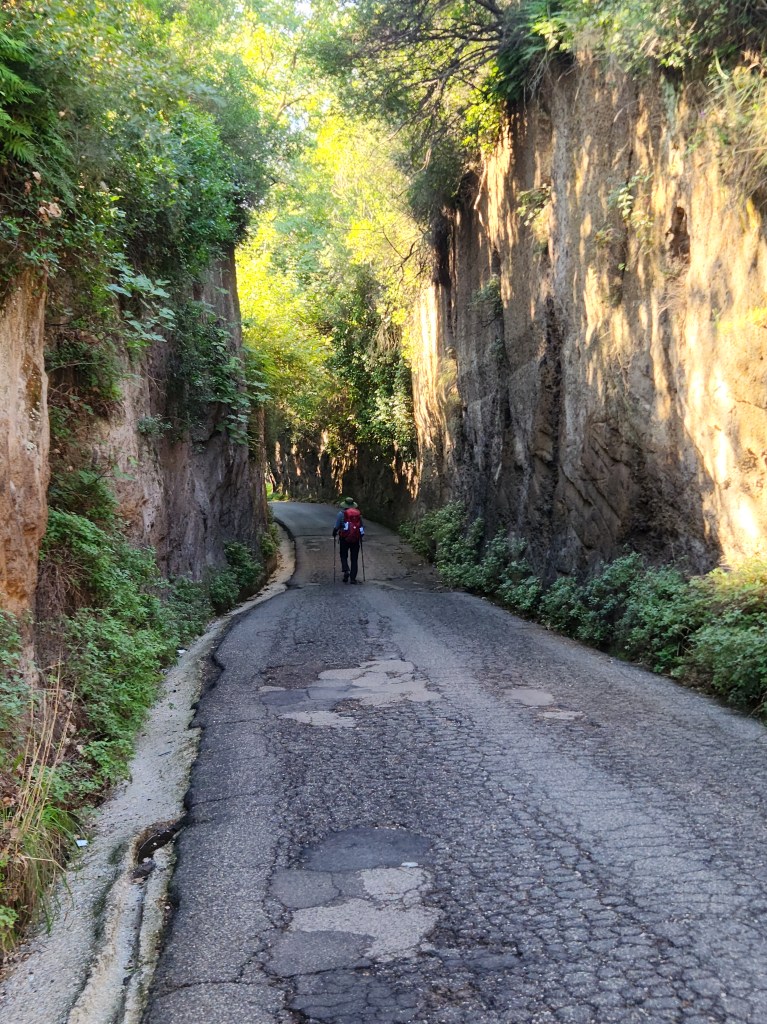
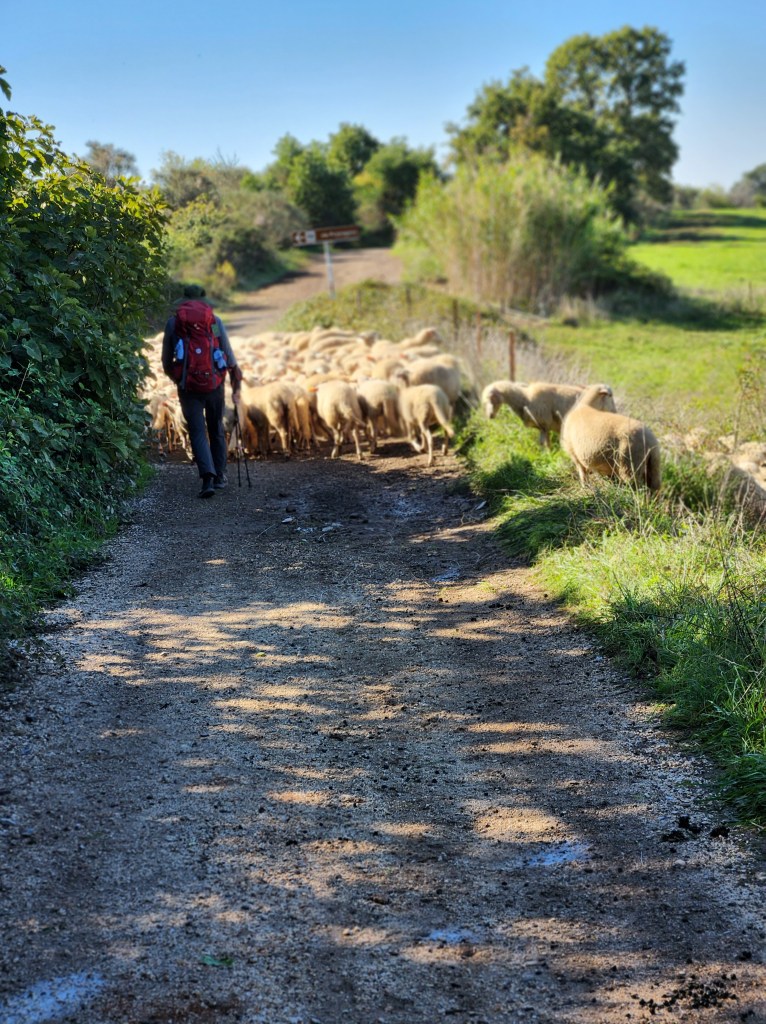
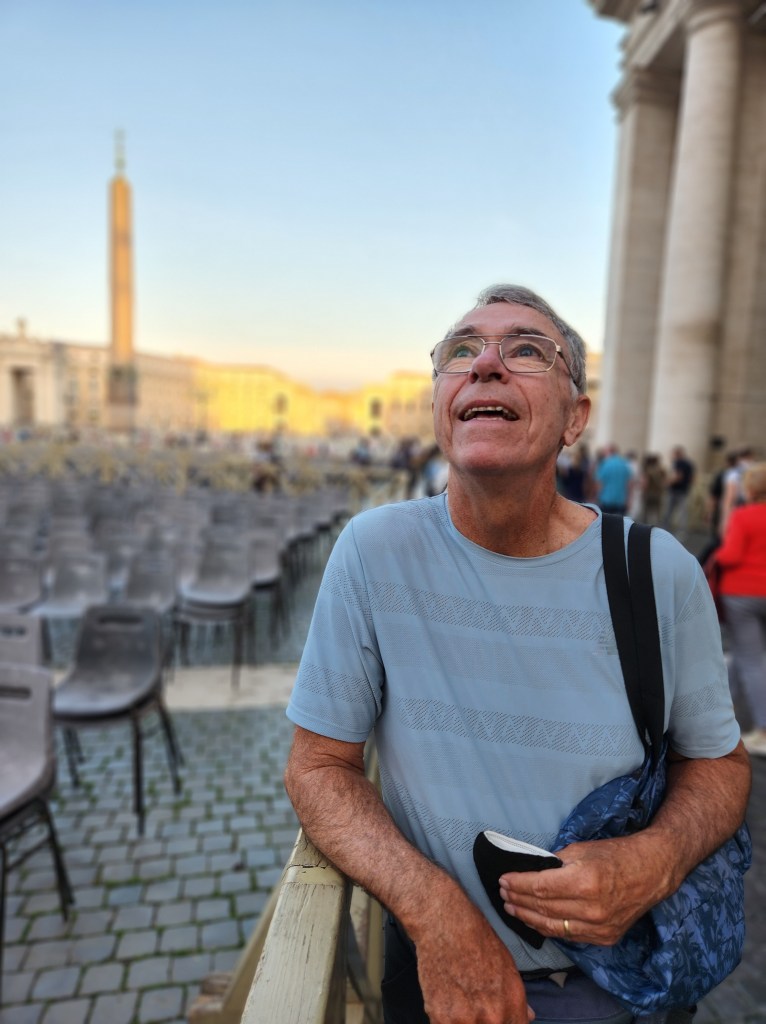
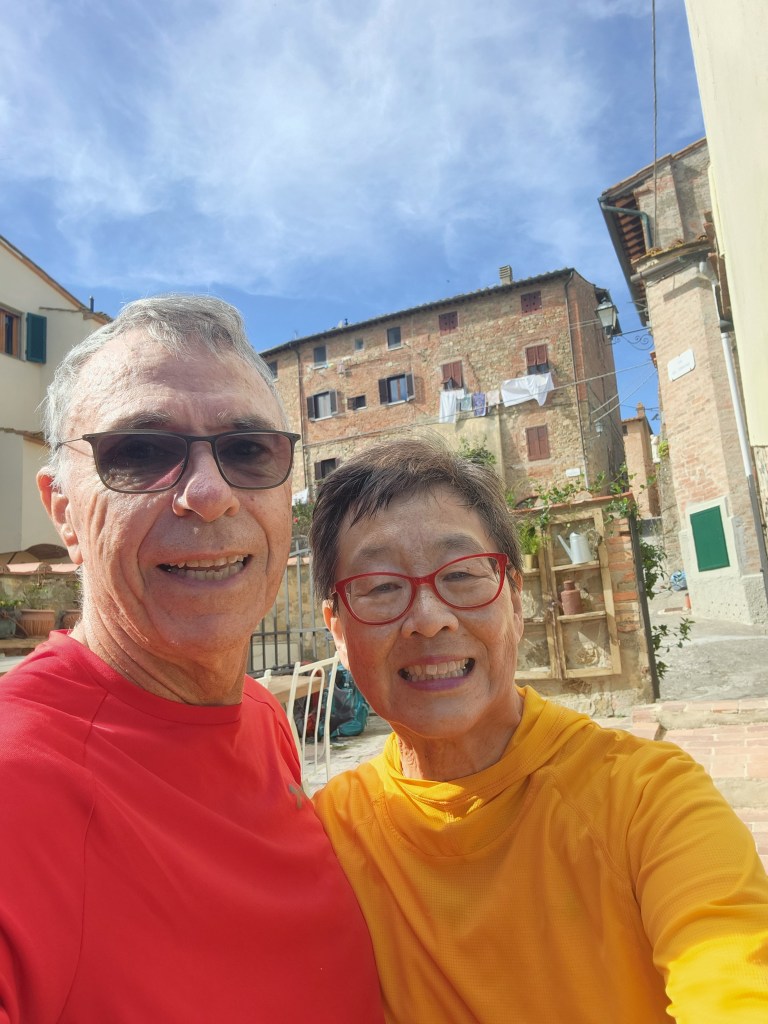
Ed carried the heavier load in his backpack, probably 18 pounds, including multiple electrical converters because every night the place we stayed had a different type of electrical outlet. Some were three plugs in a triangle, or three plugs in a straight line or two plugs, but not the same spread as US plugs… you get the idea. He acquired three new converters on the road (to add to the two he brought from the US). Often he had to plug one converter into another. The climb up to Porcena was steep and long and rewarded us with a glorious view the following morning. In Bolsena we stayed in a former convent where the cells of the former sisters could be detected. While the rooms were spartan, the convent offered the best view of Lake Bolsena, the largest volcanic lake in Europe.Sunset over Lake Bolsena.We will miss the quiet hours walking through woods and fields. Another lake view from the VF walking path from Bolsena to MontefiasconeOn our last full walking day, our path took us through a deep cut through volcanic “tufa” rock. Unfortunately, cars and trucks also used the road. Our last day also gave Ed an opportunity to play shepherd. And here we are at Saint Peter’s in Roma on October 20, a bit battered and worn, but content.
We will write again from our “vacation” in Sicily next week so you can track us until our return to the US (we are headed to Naples, Florida) scheduled for late on November 2nd.
Rome is the traditional end and apex of the Via Francigena, although some go on to the southern tip of Italy and even to Jerusalem. Ed and I are now within seven days of entering Rome. We feel some impatience to reach the end of the pilgrimage and also a tinge of regret.
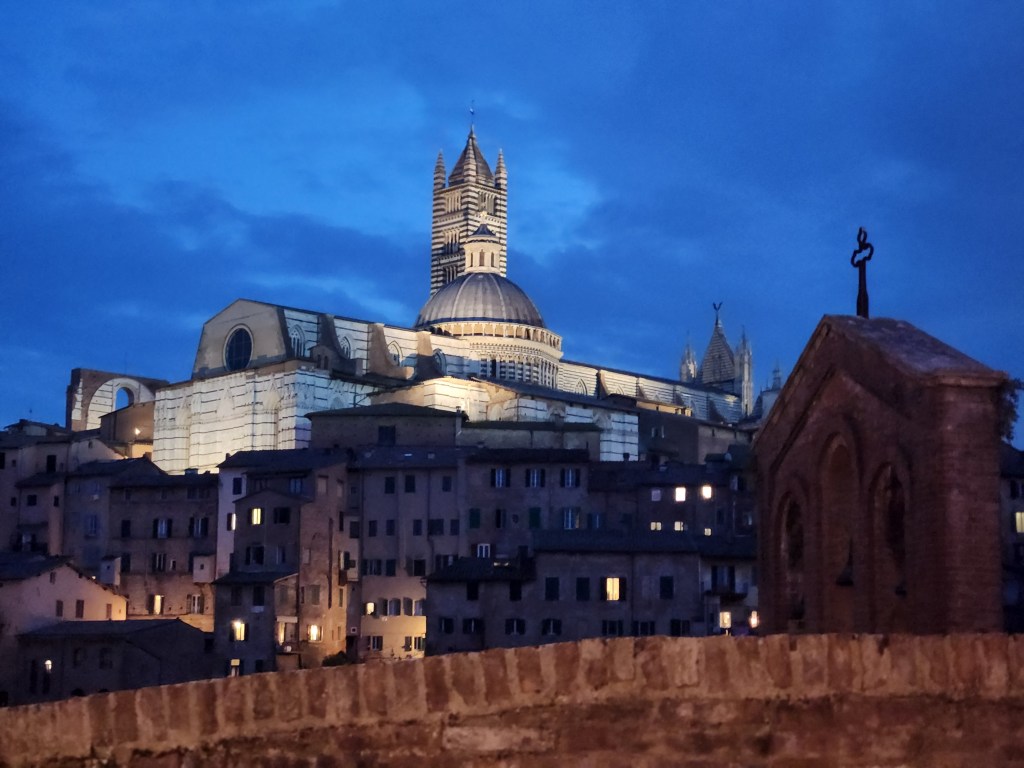
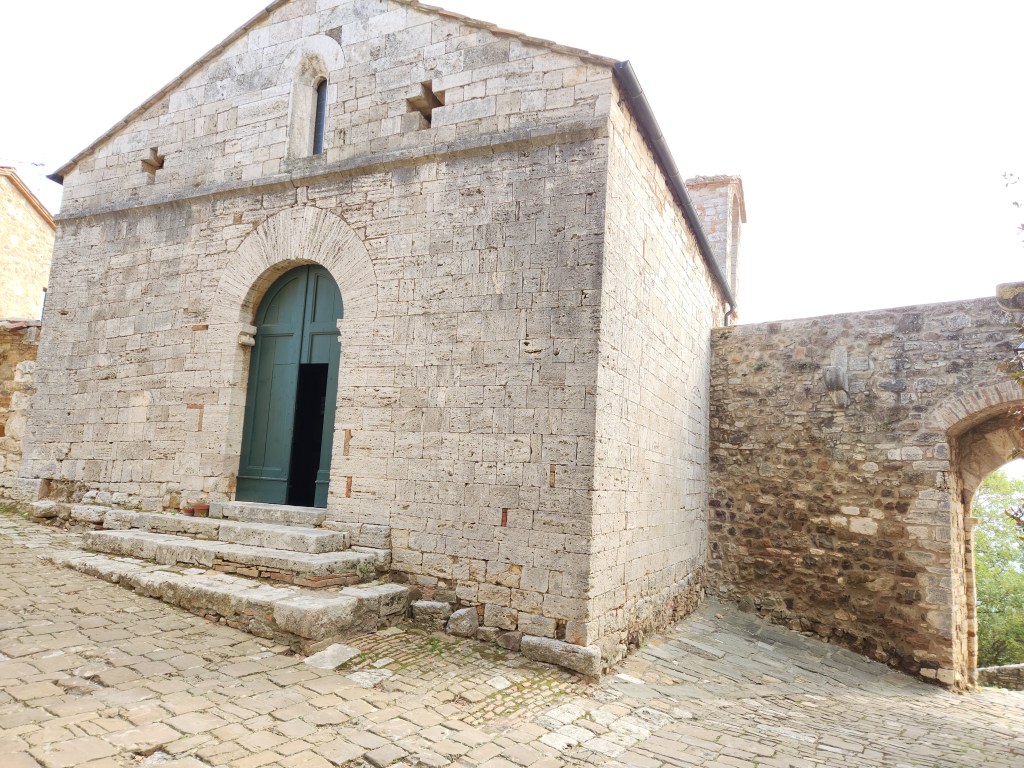
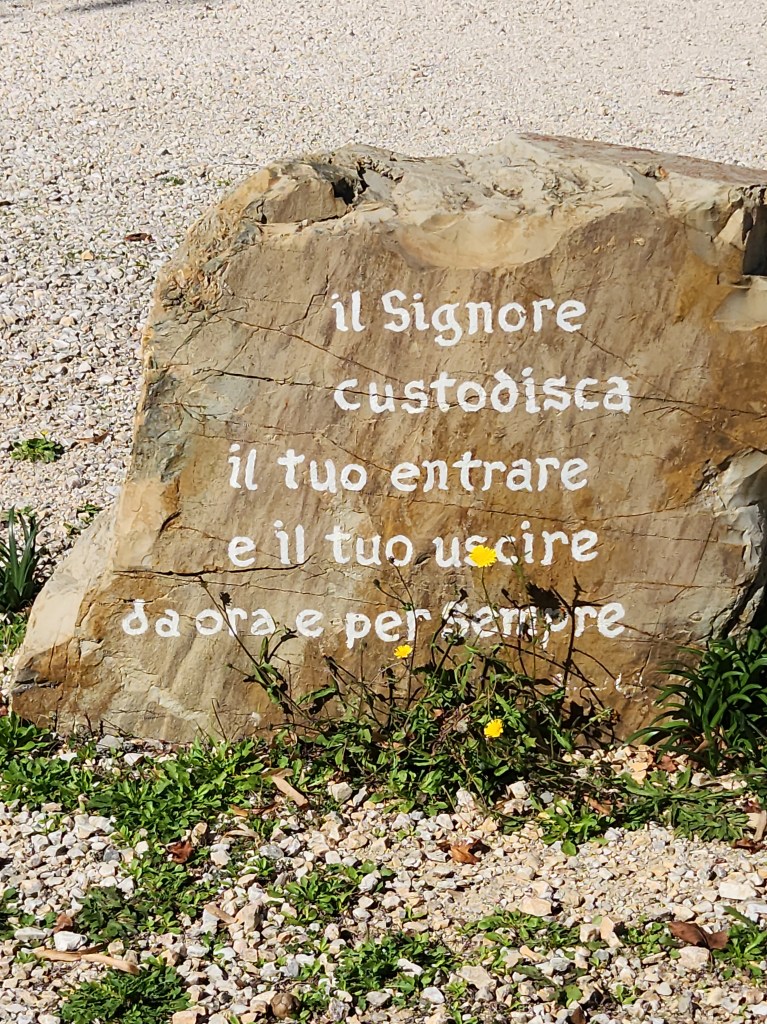
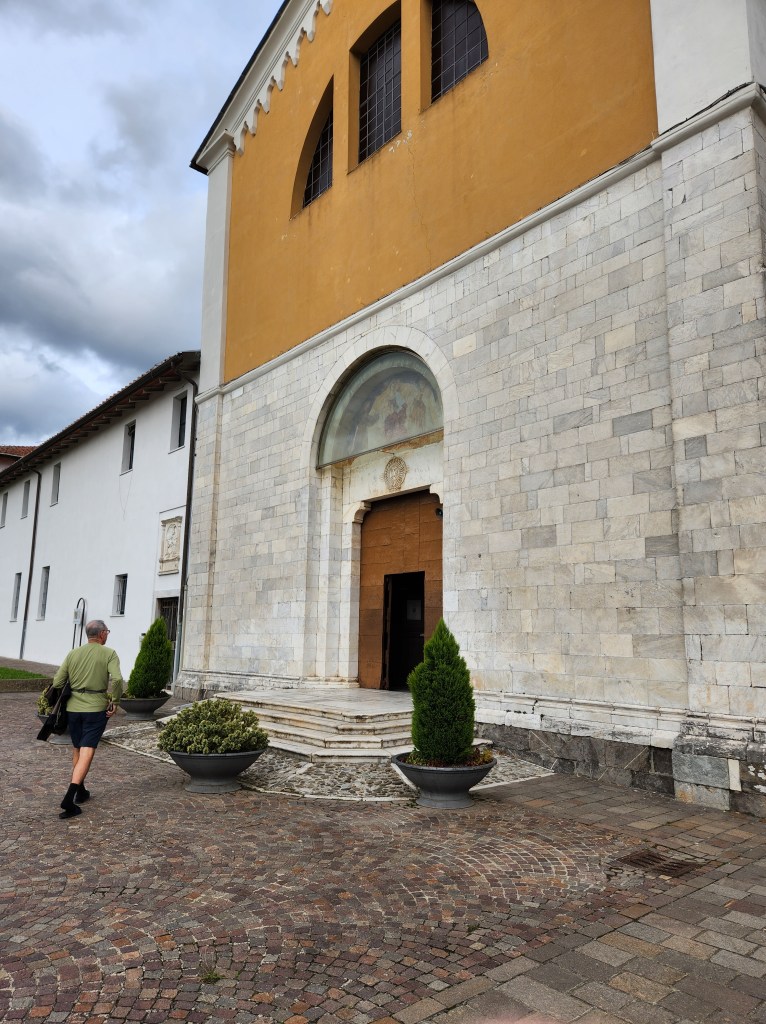
We walk through the ancient and beauty- filled landscape. Tonight we sleep in Proceno, another Tuscan hill town (yes, a big climb means a good night’s sleep).Fall colors remind us that we who are in the autumn of our life spans are called to spread light and love. Although the forecast predicted rain this week, morning mists have cleared to provide a series of gorgeous days with excellent walking temperatures. The Via Francigena has taken us by many stunning examples of human constructions built to glorify God. (Duomo of Siena, from our room in a former convent a few nights ago.) How can we humans glorify the One who is Creator of all?More than 1,000 years ago, villagers built this modest place of worship. We have received the Eucharist most evenings in places both grand and humble. Our universal church celebrates the same liturgy everywhere around the world, in every language, so we always feel at home. As we walked away from a Franciscan monastery on a Tuscan hill, we found this blessing to share with you: May the Lord watch over your coming and your going, now and forever.
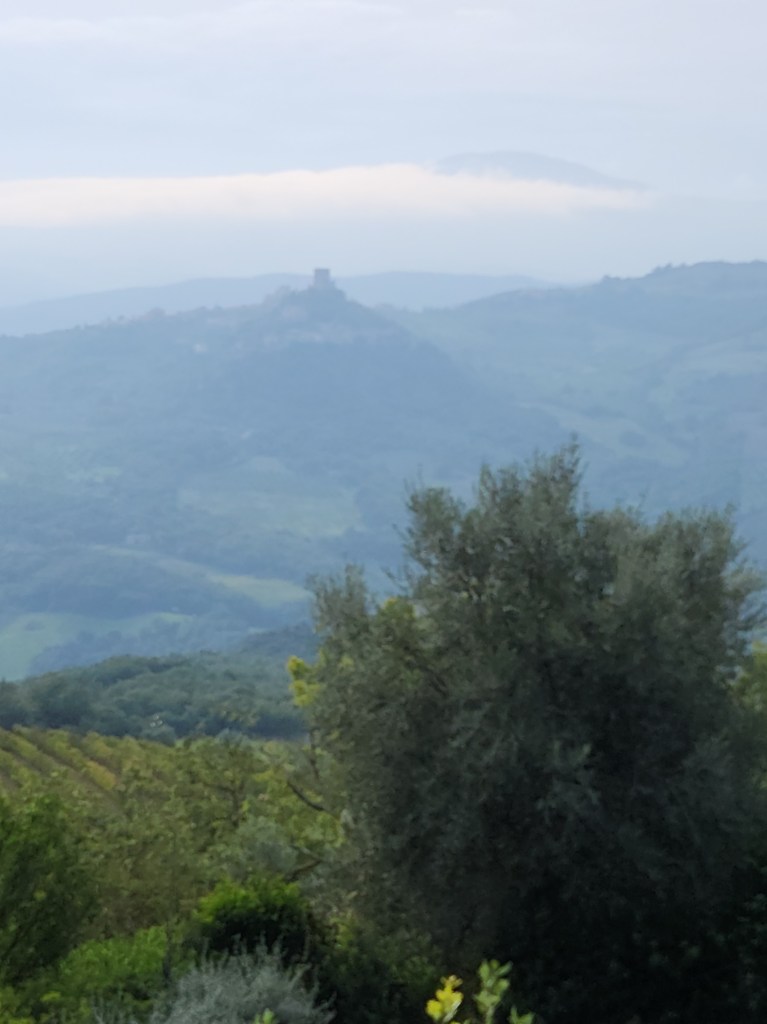
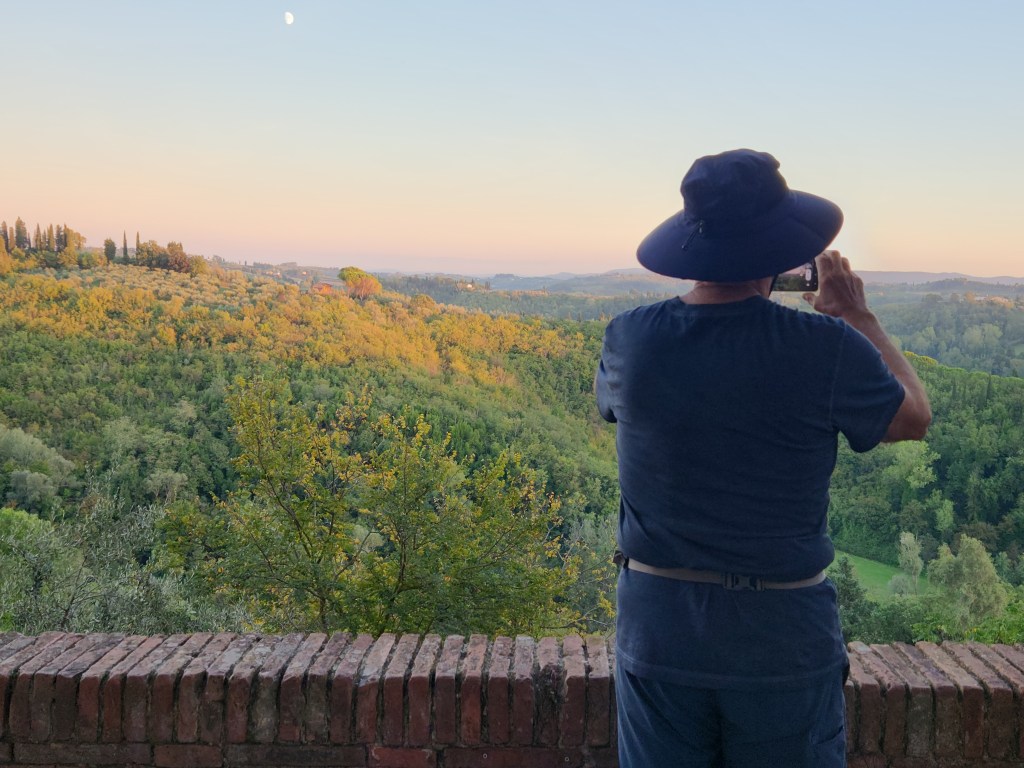
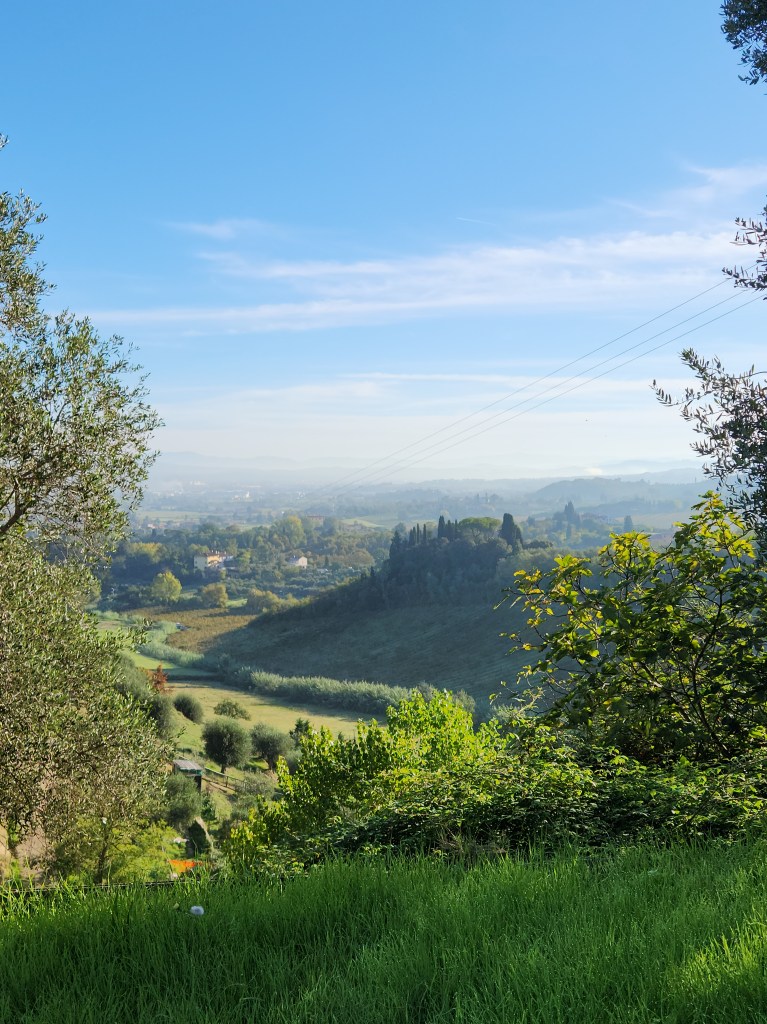
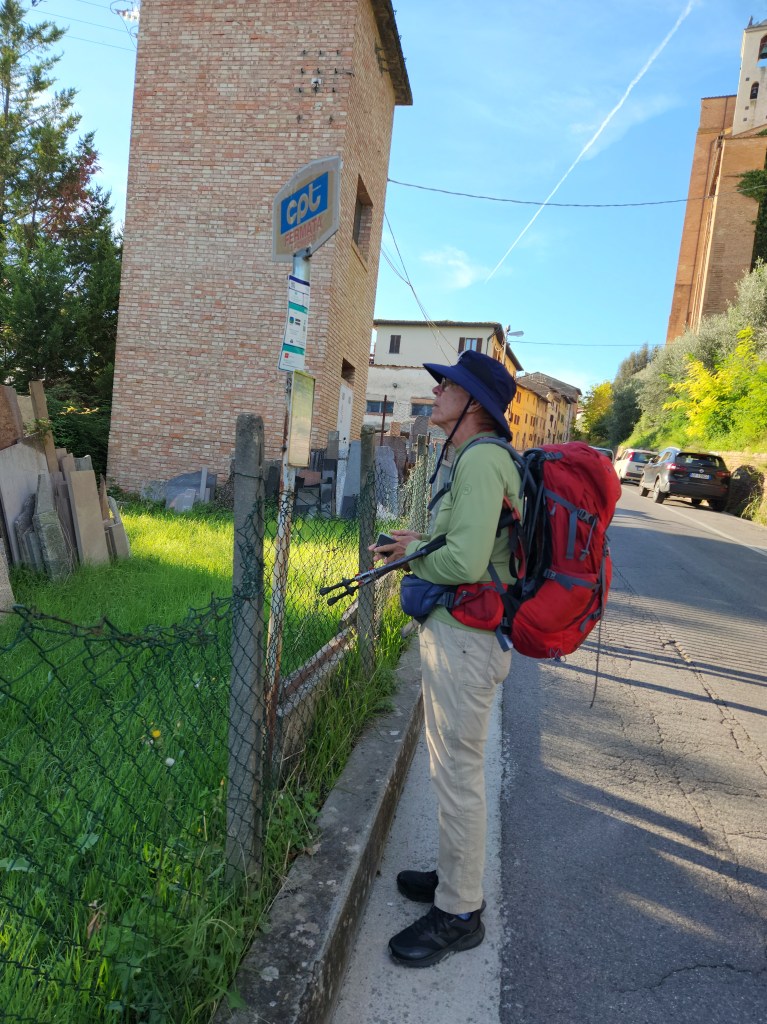
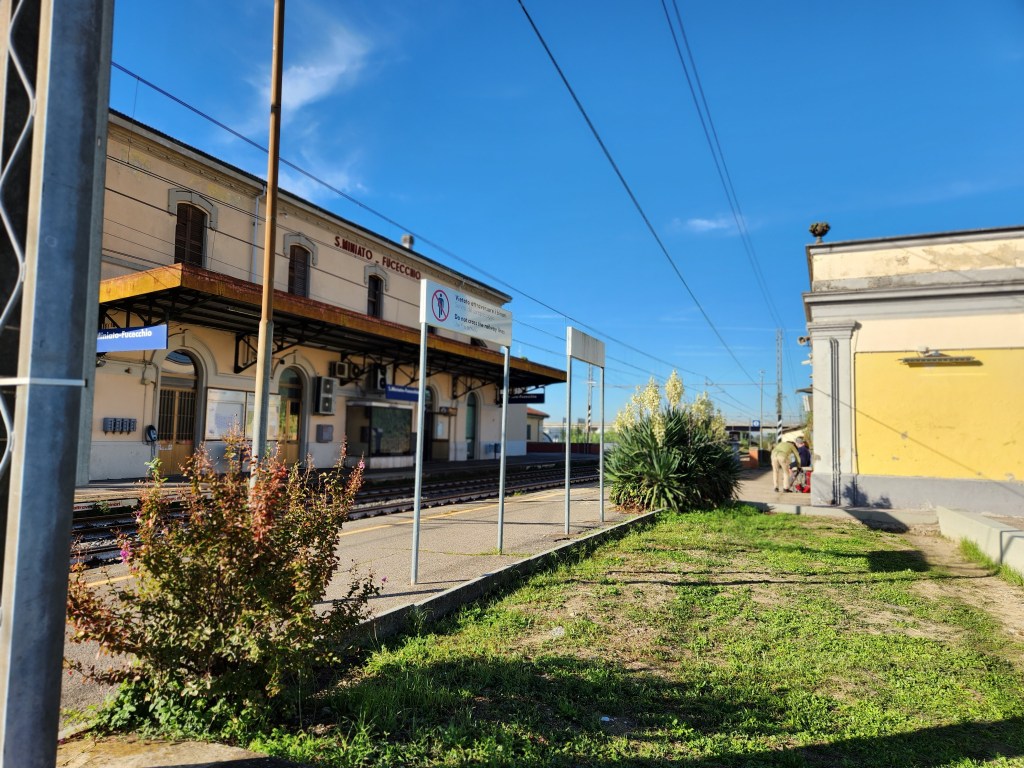
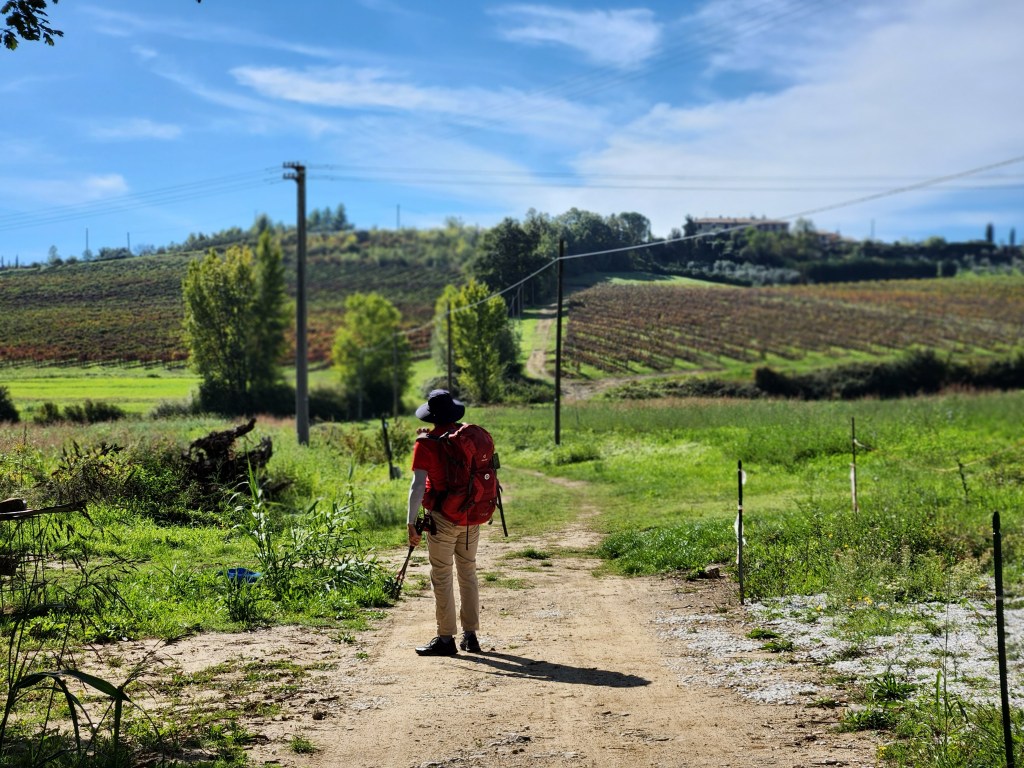
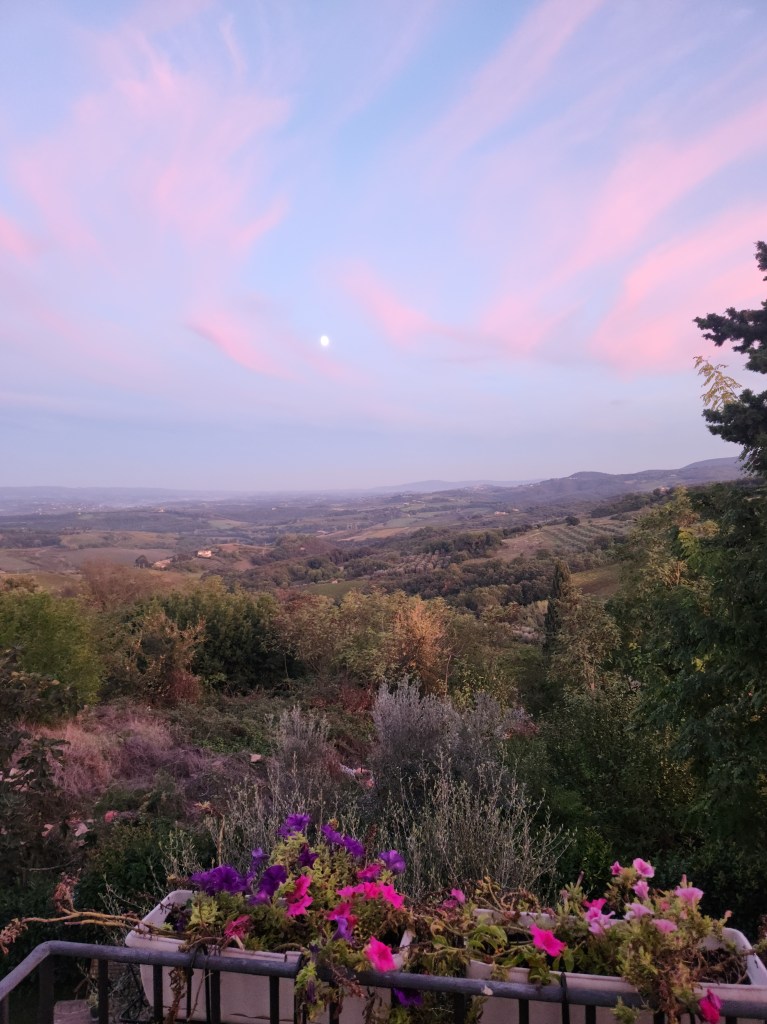
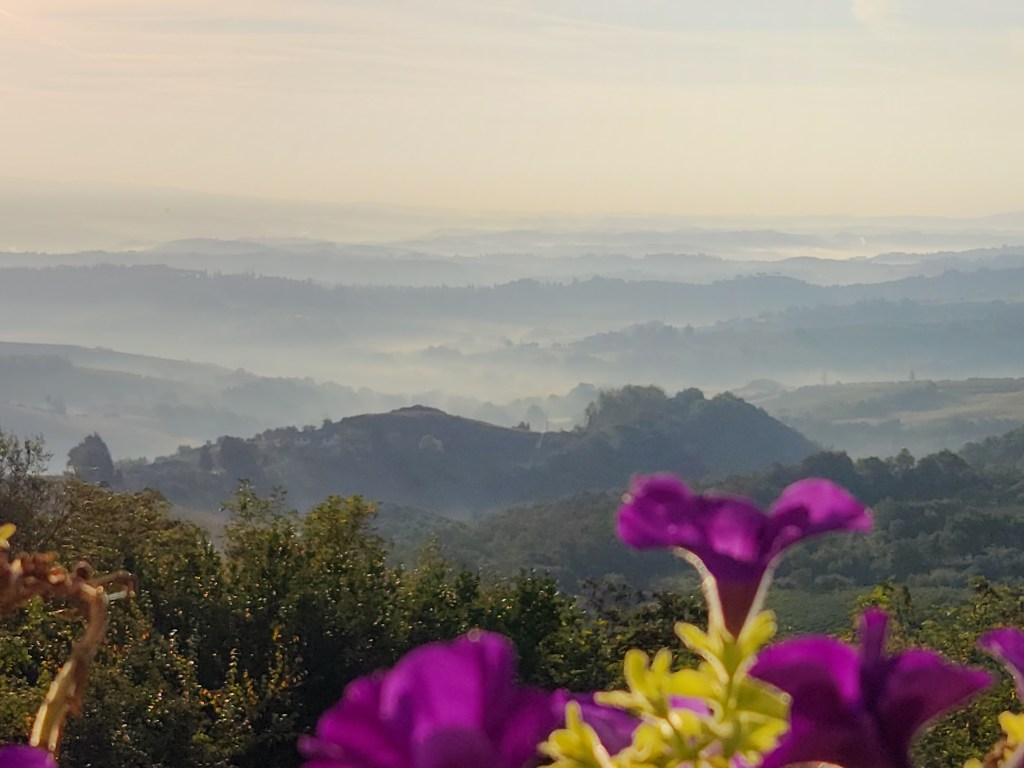
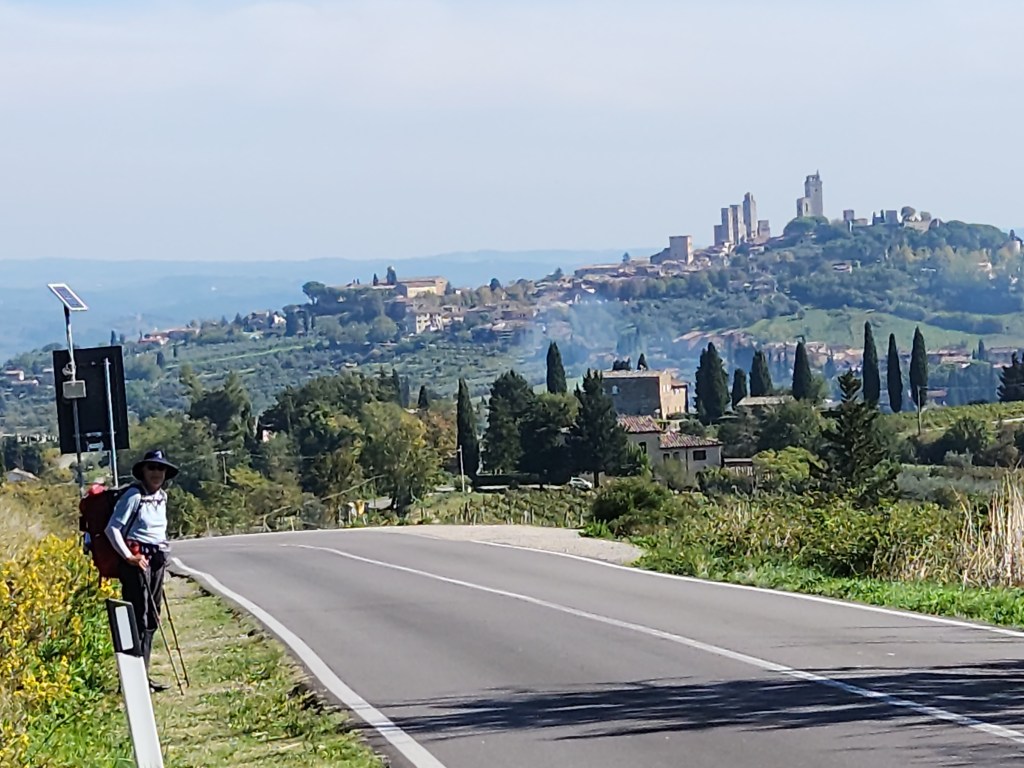
A view from a high place.Each time we take a bus, there are anxieties: will it come? Is this the right place to catch it? The blue sign Ed is perusing so intently indicates a bus stop, and yes, it did come. When we catch a train, we know where the station is, but still wonder if we read the schedule correctly. In the little towns where we are walking, there’s usually only one or two trains or busses per day. So far we’ve been very fortunate!Our reward is a manageable walk of 8 to 12 kms through the beautiful landscape of Tuscany, touched by the golden highlights of autumn.At the hill town of Gambassi Terme we prepared for the next day’s walk into San Gemignano.Evening light from our window.Morning mists from our window the following day. San Gemignano is famous for 71 towers (15 remain today) built to show off the wealth of their 12th and 13th century owners. The age of the town belies is New York City-like skyline. Occasionally we must walk along the roadway, which, given the speed and heedlessness of Italian drivers, is a hair-raising undertaking.Another famous hill town is Montereggione, built and fortified by Siena to protect Siena’s flank. The Canadian couple in this photo took a picture of Ed and me climbing doggedly up the steep hill toward the north-facing town gate (there are only two gates in the wall.)Here we are. The photo doesn’t really do justice to the steepness of the hill; maybe 30 degrees for 300 meters (my estimate).
I am writing this post on October 10 from Siena, a world class city of historical and artistic significance. We enjoyed our last “rest day” in Siena and tomorrow will begin a series of nine walking days before the final approach to Rome.
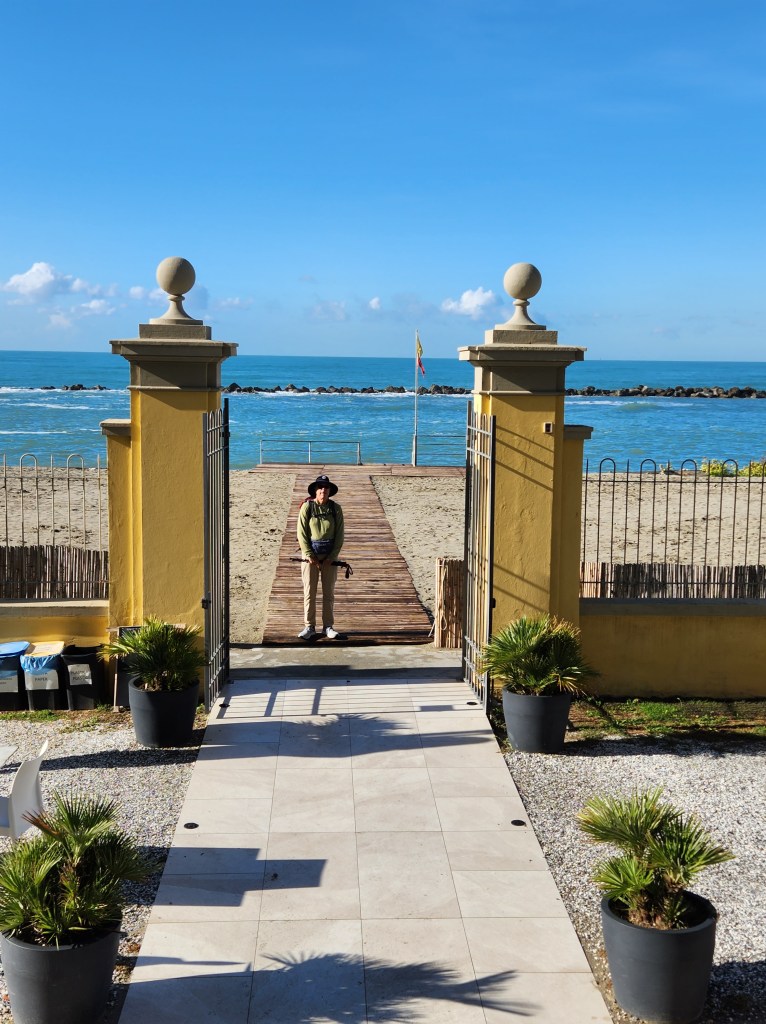
We started October by traveling from Maritime di Massa to Camaiore, leaving the Ligurian Sea to go back inland for the rest of our Camino.
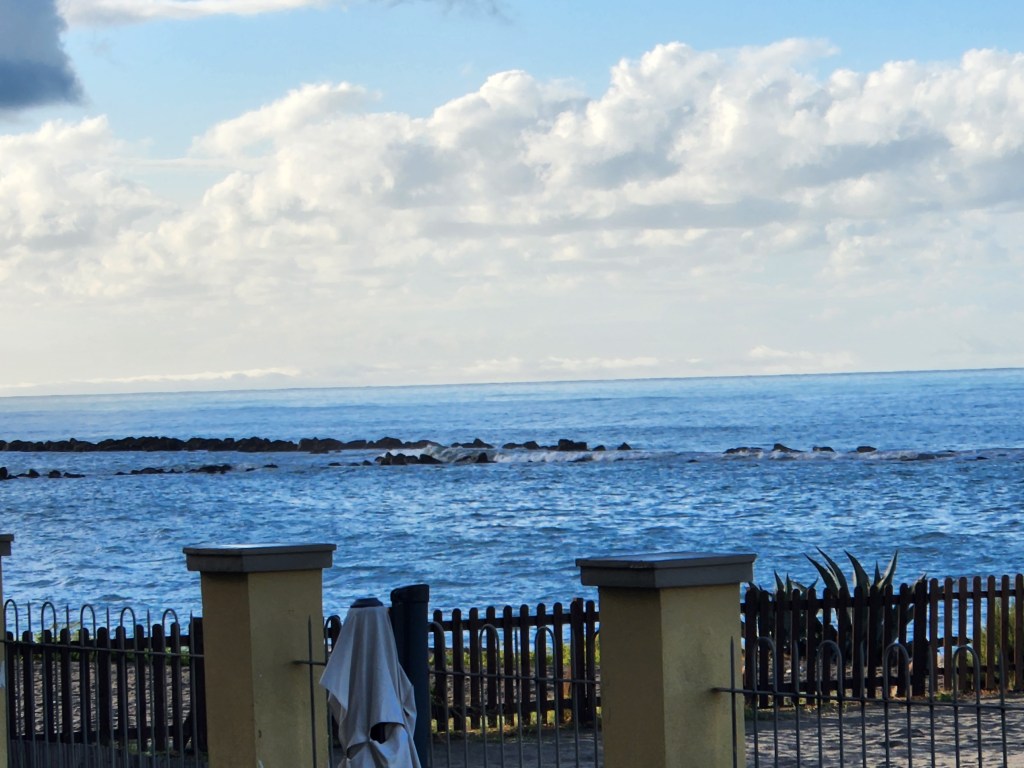
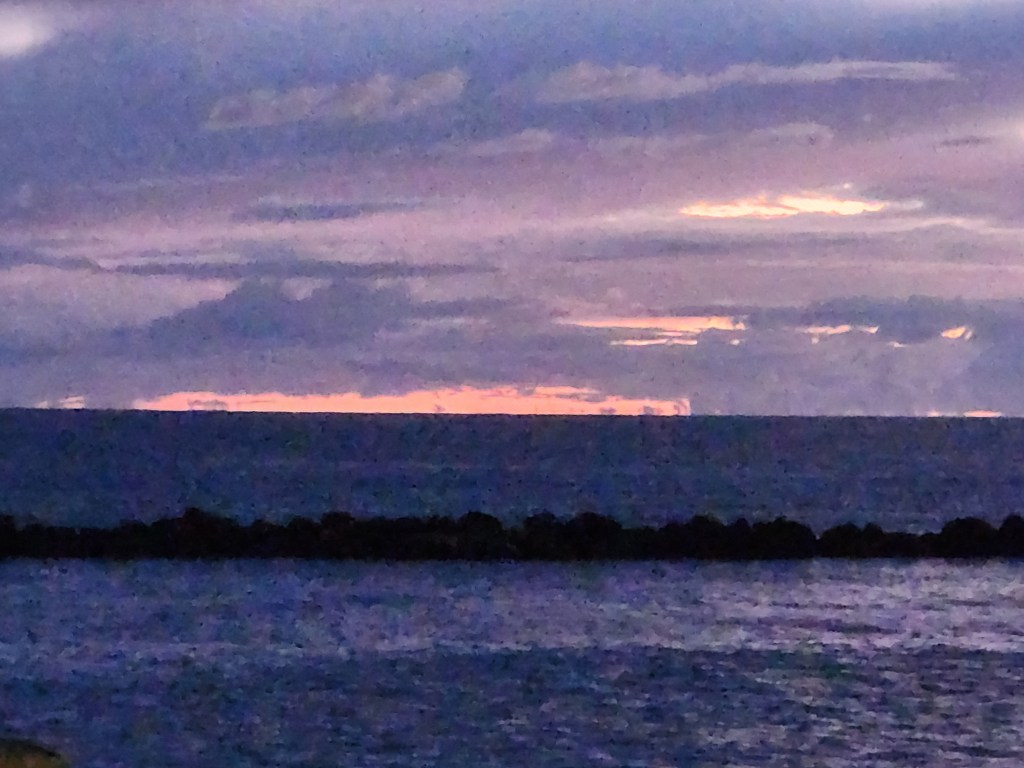
Our brief glimpse of the Ligurian Sea for one night showed a calm surface and a contrast to the mountains and forests we had been walking for more than two weeks.
To get to Maritime di Massa (Port of Massa) we walked through heavy rain that came an hour before predicted. We were soaked and uncomfortable, but luckily the next day was mostly clear and we felt ourselves again!
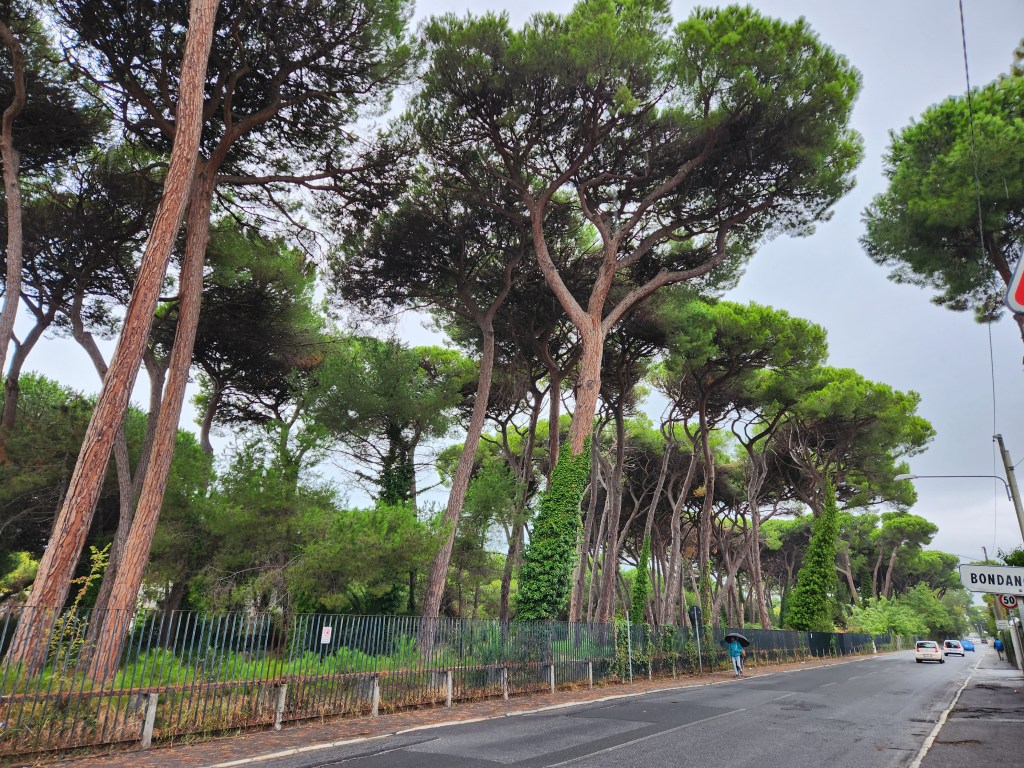
The only photo I took through the pouring rain was of a stand of beautiful umbrella pines.
On another rainy evening in Aulla, a town with ancient Roman roots and name, we made friends with two French pilgrims, Annelise and Simon. They are a delightful couple expecting their first child and spending six plus weeks walking the Via de San Francesco, starting with two weeks of tent camping through France to get to Italy! We admire their stamina and their enormous good nature and charm.
Our new pilgrim friends Annelise and Simon. (I can’t help but remarking on the similarity of Annelise’s name and mine.)
Highlights of the last few days: After the rain and wet we have been blessed with fine weather.
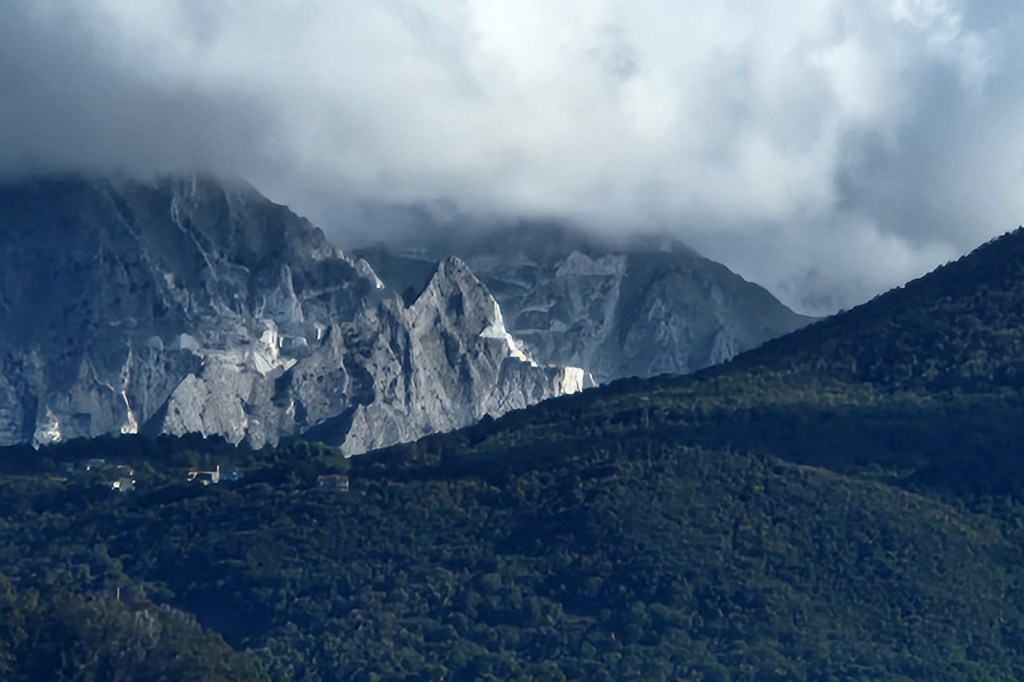
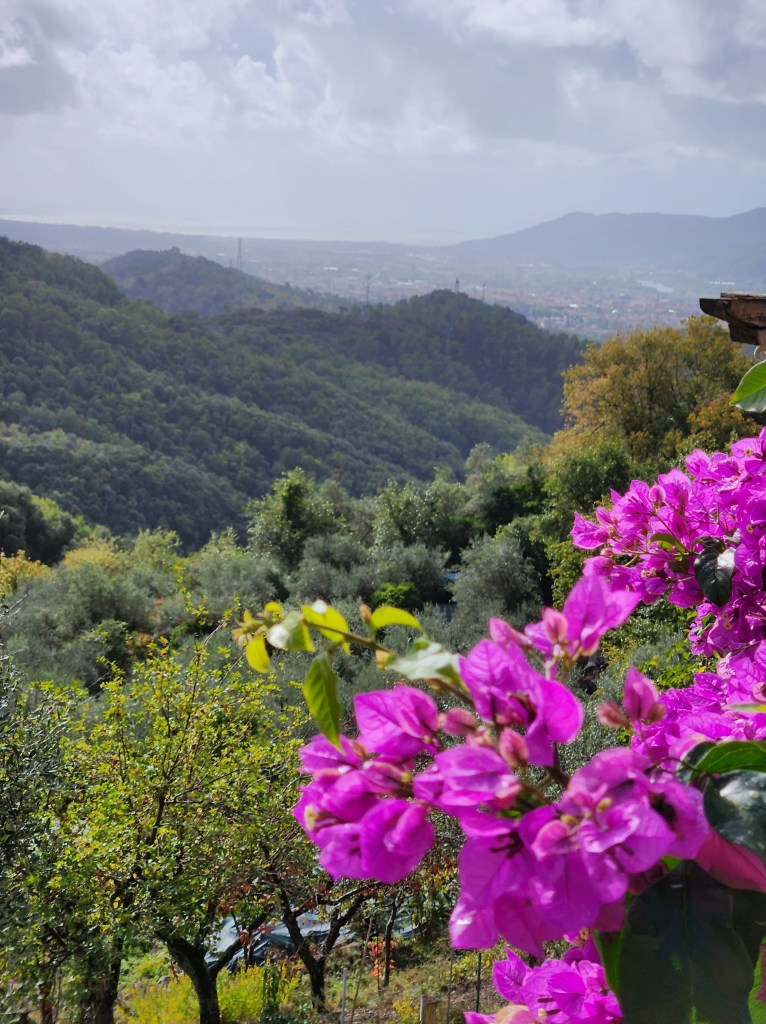
With only a little regret we left the mountains, called the Alpuan Alps, behind. There were some steep and slippery stretches, but so far, no more falls. Beautiful light at sunset from our window outside Camaiore.
When we reached the fabulous small city of Lucca, we treated ourselves to a “rest day” which means we actually spent two consecutive nights in the same place! Our last rest day was in Pavia, 11 days earlier. It was delightful.
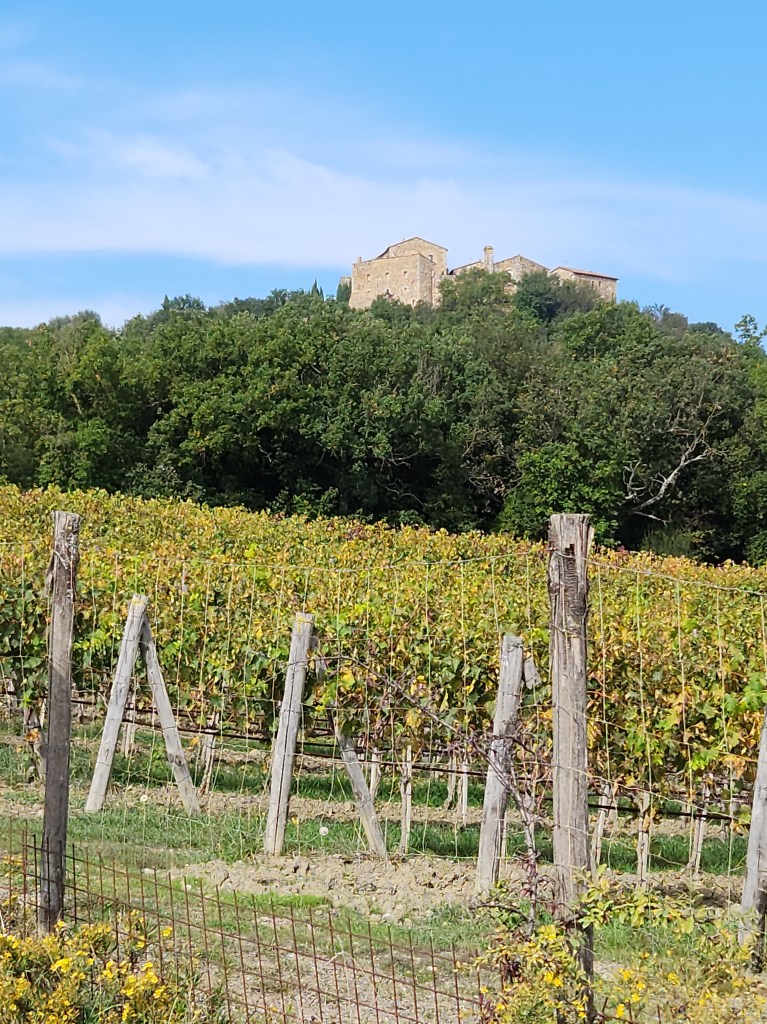
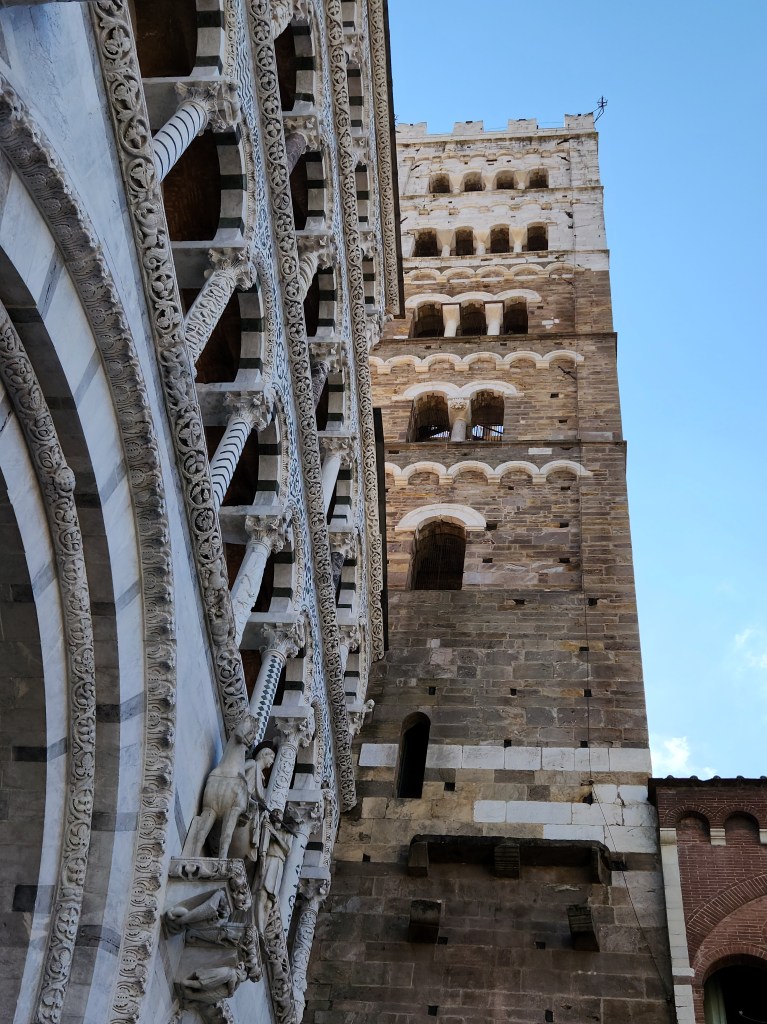
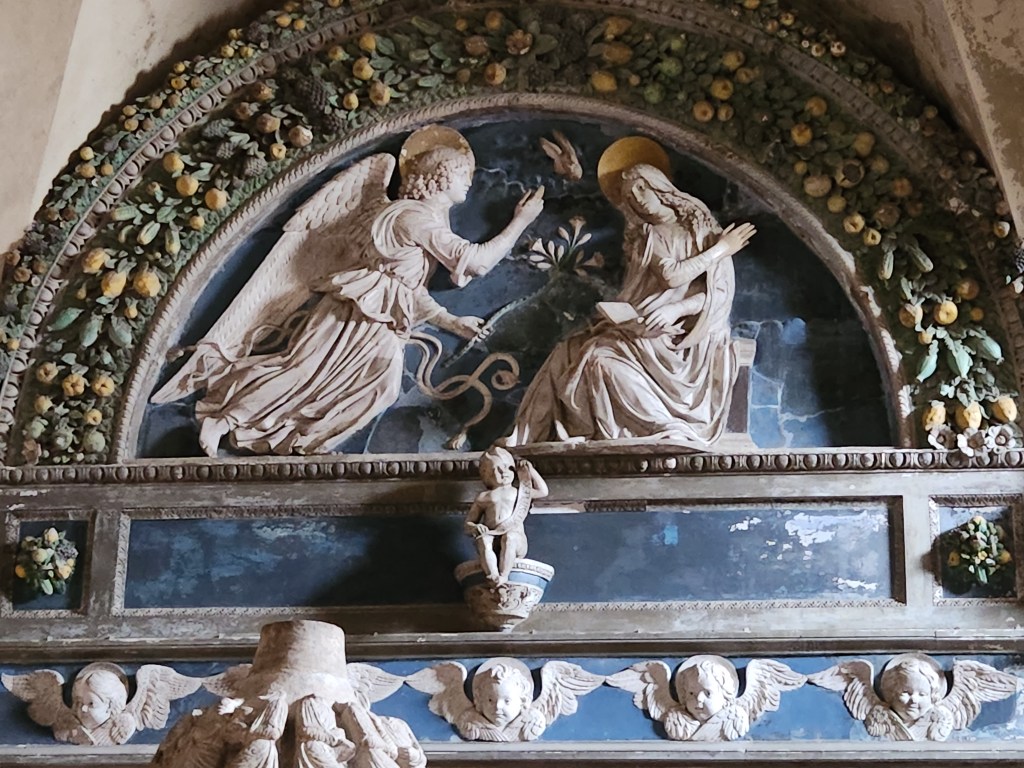
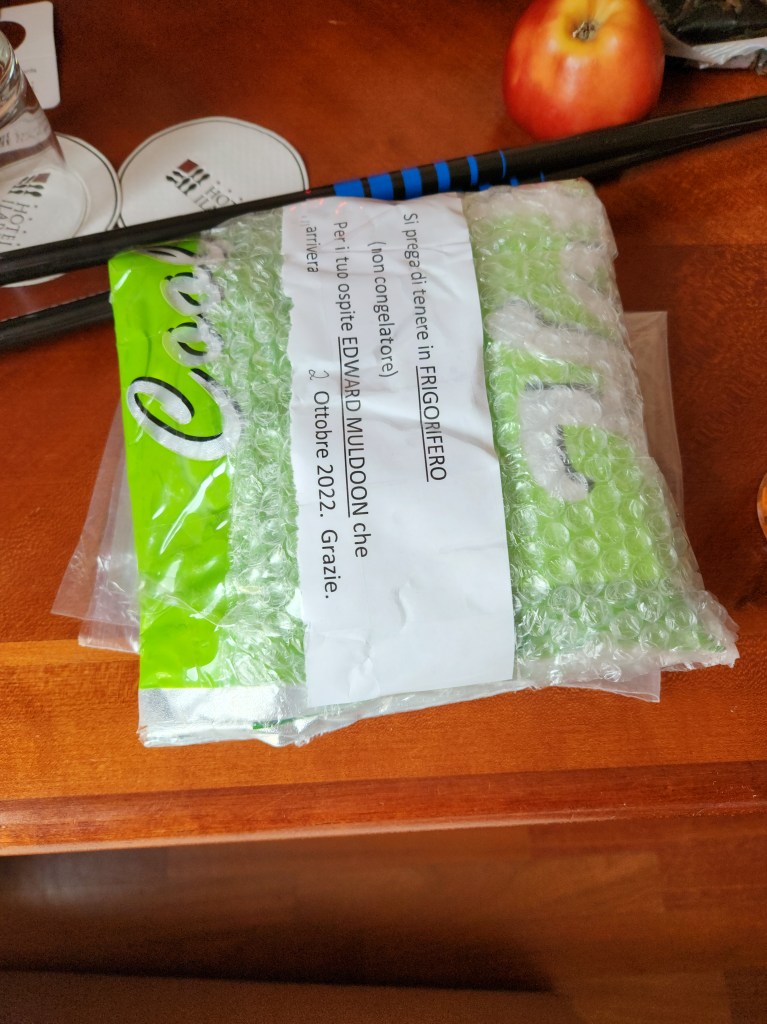
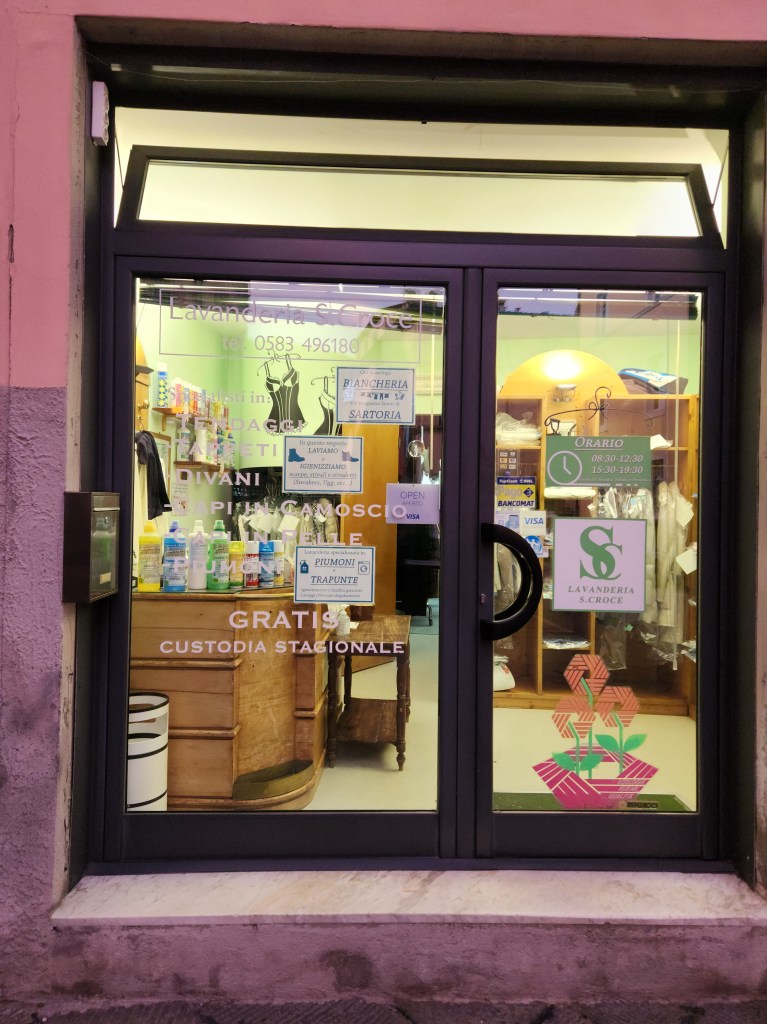
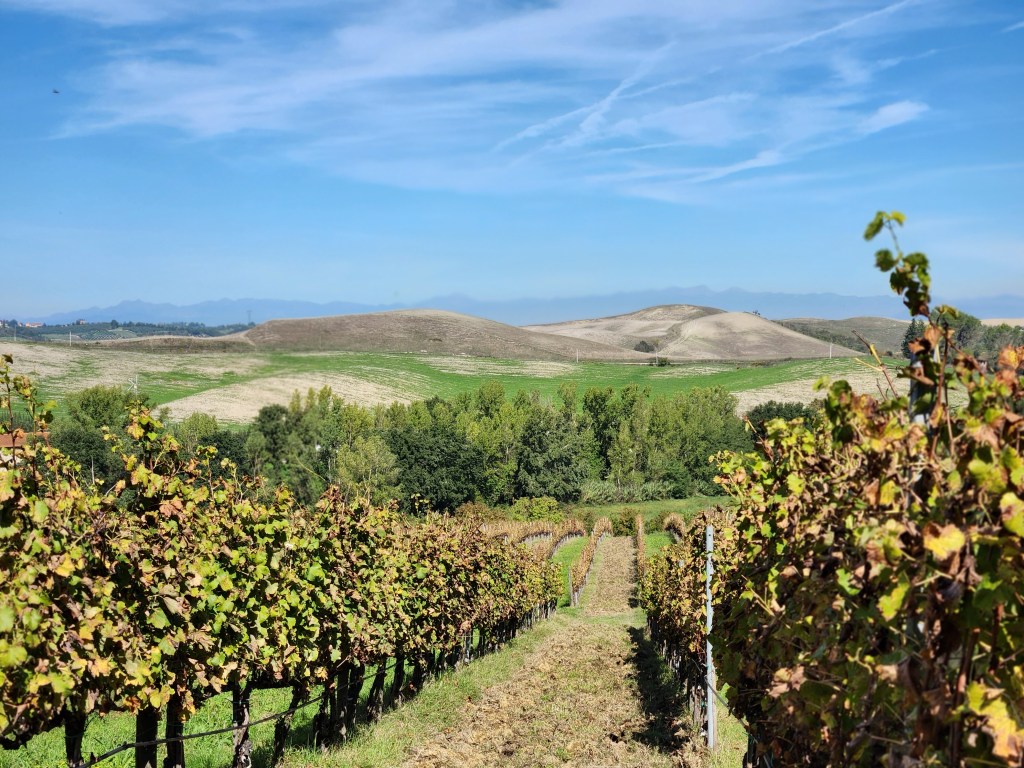
Duomo (Cathedral) of LuccaOne of the treasures inside Lucca’s Duomo is a tender Della Robbia of the Annunciation.Waiting for us in Lucca was the first of two shipments of my rheumatoid arthritis medicine that requires refrigeration. So far, so good.While Lucca’s Duomo was great, we also appreciated the neighborhood laundry for doing a same-day load for us!We had a front-row table at a Michelin-rated restaurant in Lucca’s Anfiteatrico, an elliptical piazza built on the footprint of its ancient Roman forum.After leaving Lucca, we climbed up to another Tuscan hill town. San Miniato. where we attended mass at the convent of the Poor Clares. There we also ran into our new pilgrim friends, Annelise and Simon.Vineyards after the harvest. As mentioned before, it’s been extremely dry this summer across Europe.
We continue to exercise Ed’s imagination and planning to use a combination of busses, trains and cabs to be able to walk about 10 to 12 km per day. This is less than our 2019 camino daily average of 15 km but appears sustainable. Ed can go longer and faster but is kind to adapt to my capabilities. Anne has two new blisters but the highly effective silicone patches sold in Italy work beautifully. Along the way, we are also becoming quite knowledgeable about the idiosyncrasies of Italian local public transport.
Yesterday I fell on my butt. It was going to happen, sooner or later.
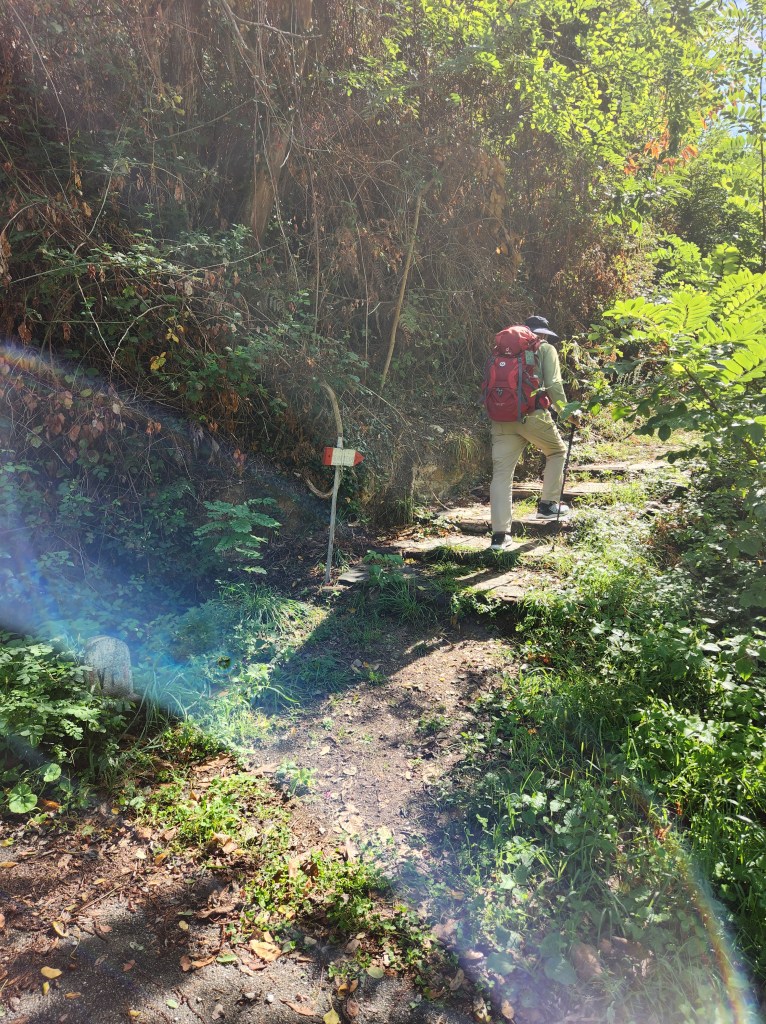
This is one of the easier downhills yesterday.
Luckily, all I got was some mud on my pants and a lightly bruised ego. After five days crossing the northern part of the Appenine Mountains, our legs are VERY tired from negotiating steep ups and downs.
Looking back and up at village we left 15 minutes earlier. Cloudy skies and spits of drizzle marked the last few days.
Thanks to Ed’s careful planning, utilizing local trains, busses, cabs and rides from kind folks, although we knew the mountainous section would be tough, we avoided the impossible (for me) bits and walked 8 to 12 rough kms each day. Damp underfoot made the rocks and mud slippery.
Mountains — and rough ancient paths — teach us to concentrate. Even a moment’s distraction and one finds oneself on the ground. Mountains teach humility, and love for a Maker who conceives of beauty beyond measure. Mountains cause us to treasure quiet, and the small, clear voice of a bird. And when we come out of the mountain path, we welcome reminders of human living like sweeping the floor and walking home from school.
Most evenings we are rewarded with mass in a local church, typically 800 plus years old, and a fabulous meal with fresh ingredients prepared in the locally “typical” way. We have made note of many variations in the presentation of the mass, length (or absence) of homily, etc. We are consoled to listen to the readings in Italian as we try to brush up on a few words.
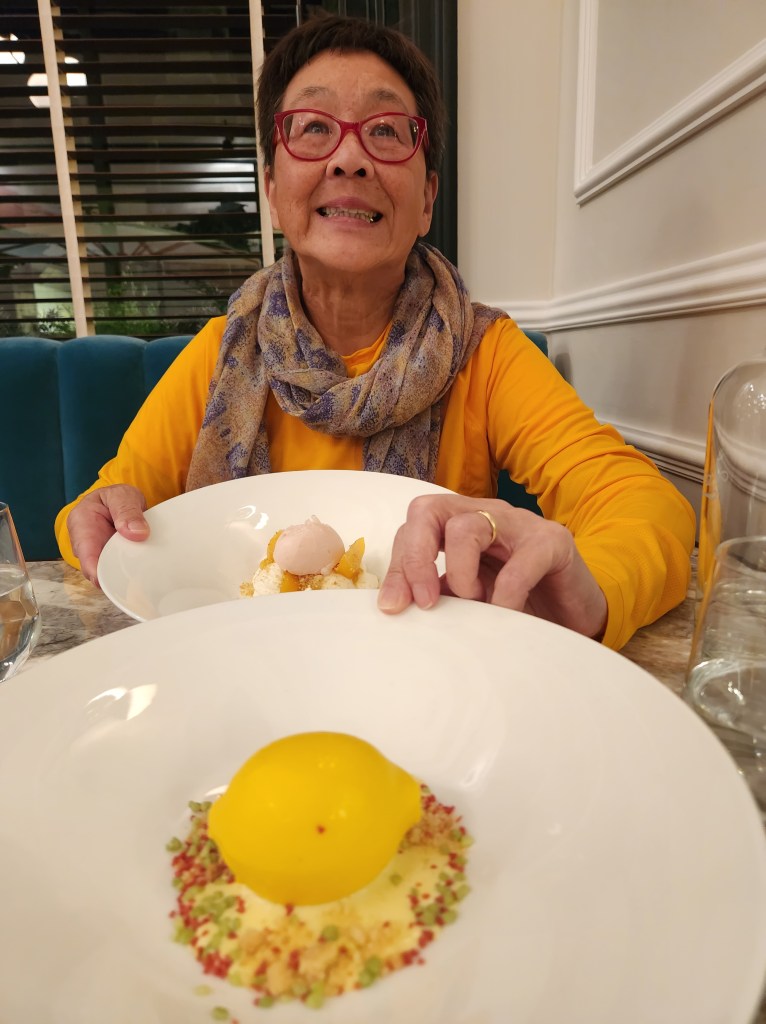
Tonight’s mass in Sarzana was in a church with a modest exterior believed to have been founded by St Francis of Asissi, himself, in 1225. As far as we could make out, the homily drew a parallel between Francis, often known as the Seraphic Father, and today’s Feast of the Angels, Saints Michael, Gabriel and Raphael.Even in the mountains, seafood is delicious and appreciated.The “lemon” in the foreground was a skillfully prepared white chocolate shell containing lemon sorbets. After walking, dolci (sweet dessert) is often in order.
HURRICANE IAN IN FLORIDA: We learned yesterday that the enormous Hurricane Ian caused great flooding and destruction in southwest Florida, including Naples where we have our condo. We are grateful for our friends and neighbors whom we have heard are safe, and pray for safety and recovery for all. The storm surge apparently reached to within a foot of entering our building’s ground floor (our unit is on the second) but overall it appears as though there was no significant damage. There had been flooding in the streets and not surprisingly the power has been out and is likely to be out for a while, which can cause its own issues, especially in Florida.
Partway up the steep hill above Fornova de Torno. How much further must we climb?
It started overcast and dreary, with rain overnight. Until yesterday we had enjoyed beautiful blue skies and warmth since our arrival in Italy on September 13, twelve days ago. However, our walking confidence had been shaken when Anne had trouble with her right hip and left knee against strong winds on out first full scheduled walking day leaving Milan.
Since then, Ed has patiently arranged for rest and rides, including a great deal of kindness from strangers (see posts “Struggling above rice fields” and “Encouragement and help.”) Then we gradually tried walking 6 km one day, then ten km, and yesterday, 16 km.
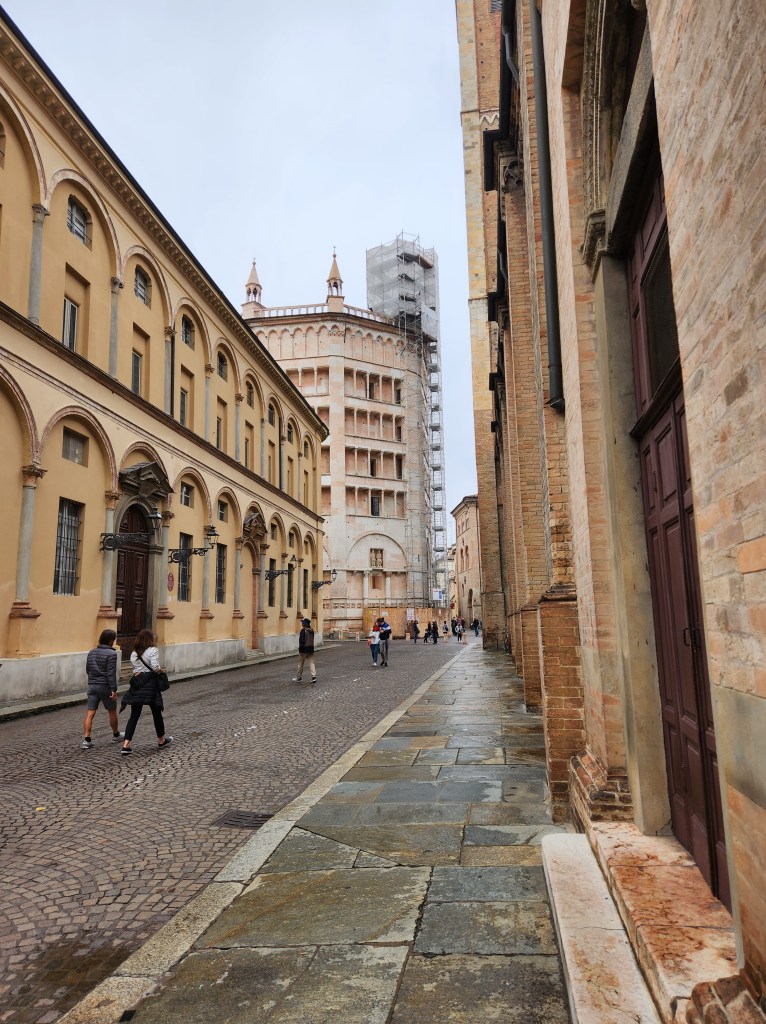
Today we took two local trains, breaking our journey to look around Parma, famous for outstanding ham and cheese, as well as a Benedictine monastery (more on that in another post) and a beautiful pink and white Baptistery next to the cathedral.
Baptistery of Parma clad in pink and white marble is full of marvelous sculptures, frescos and paintings. There is a restoration scaffolding temporarily abutting it.Western Europe suffered a serious drought this summer. It is startling to see the bed of the River Taro is mostly dry sand with almost no running water. Many rivers, including the Po, the Danube and others, are also dry.
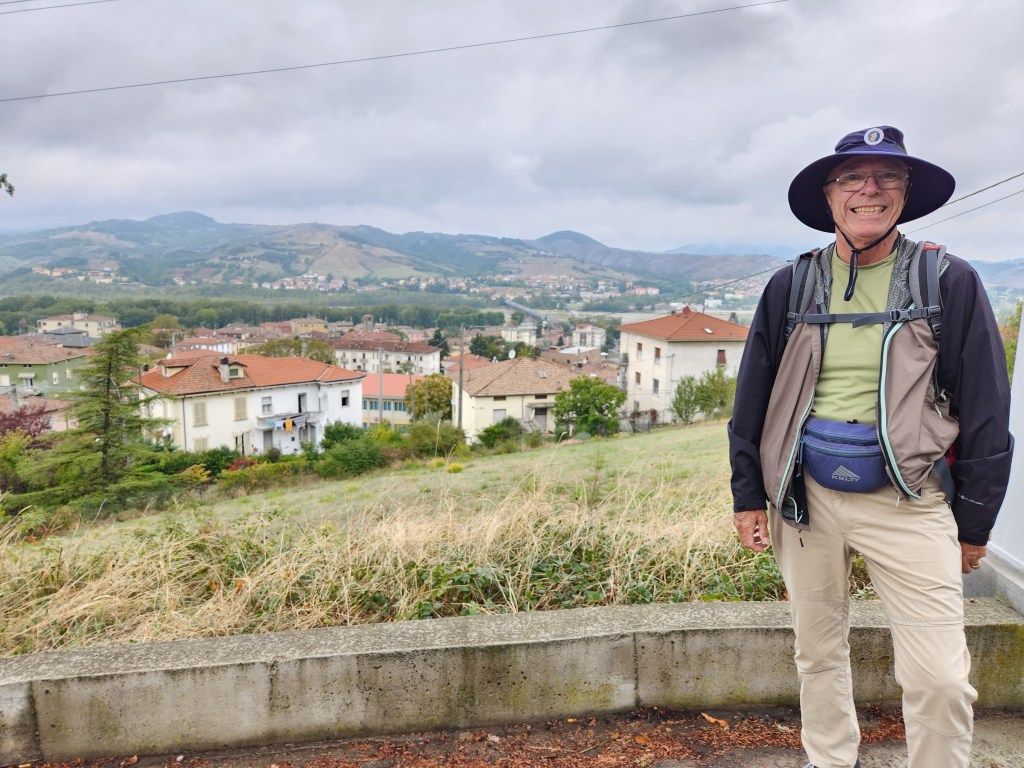
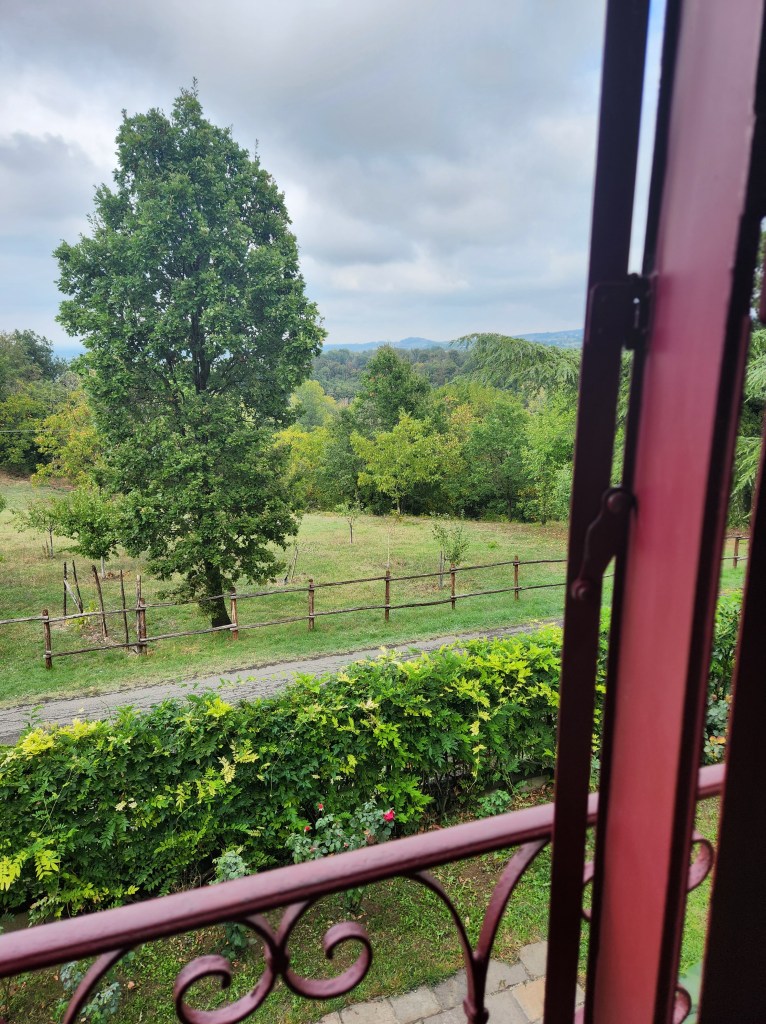
Disembarking from the second train at Fornovo de Taro, we faced a lengthy uphill climb of an hour to our B&B La Vecchia Quercia (“The Old Oak”) with dramatic views over the almost-dry Fiume Taro far below. It is a charming old farmhouse and our hostess, Manuela, is sending delicious aromas out from the kitchen as we wait for dinner. (Thank goodness we don’t need to go down and up the hill to eat!)
View over the valley from our bedroom at La Vecchia Quercia.) It’s high up here, and quite chilly but there is no central heat, of course.
Tomorrow’s forecast is again for cool temperatures and showers. We look forward to a steep uphill climb for ten km. Ed says he figures that tomorrow will be our most challenging day for climbing. “We shall see,” he says. We shall pray. Stay tuned.
AGAIN we share news of a loss of which we just learned: Paul Hullar, a son of Ed's oldest sister, Margery, passed away unexpectedly a few days ago. He was only 60 years old. Paul's mom, Margery, known as Margie, was named after Ed's mother. Margie was the first of the ten siblings in Ed's family to pass away (from ovarian cancer, 20 years ago). With Bill's recent passing, only five of the ten siblings are still living.
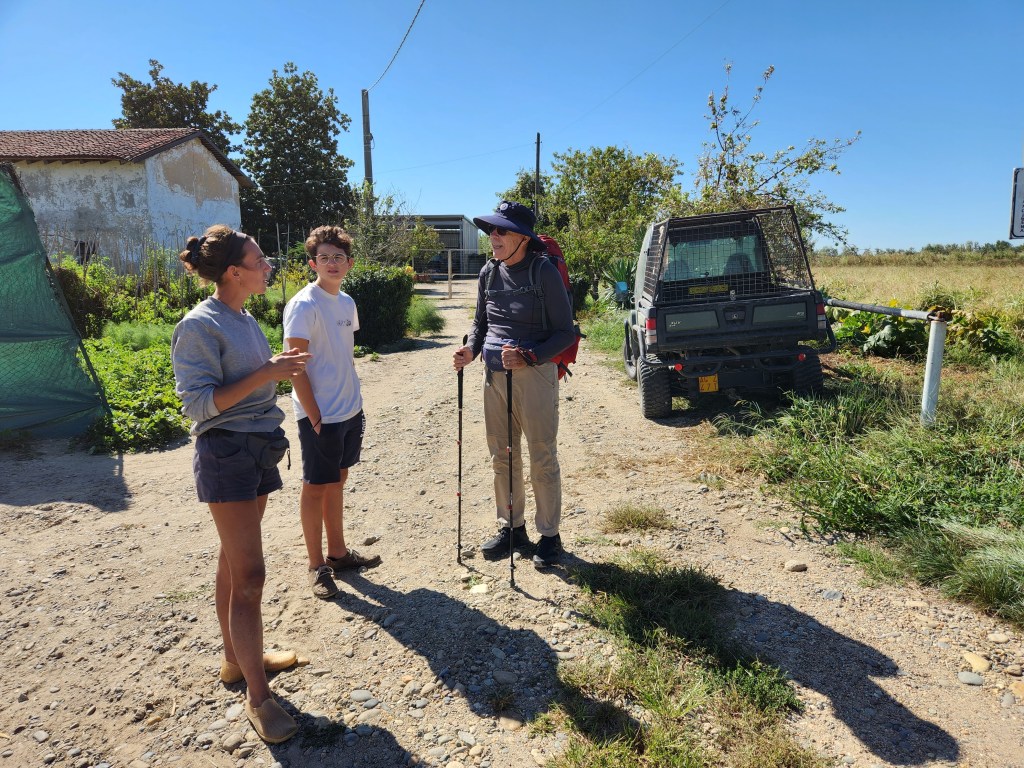
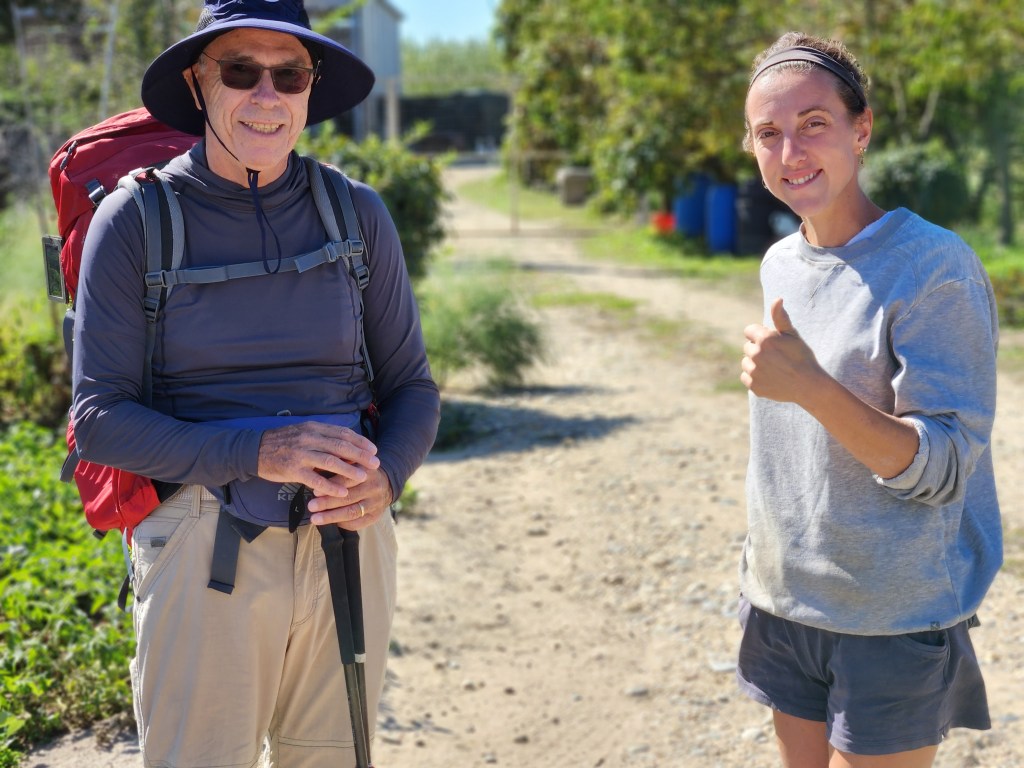
Our new friend, Carla, and her friend, Andrea, live in the rice-farming country outside Milan.
Our first, very windy day, was a struggle for Anne. Our last Camino was in 2019, and of course, she hoped that she could climb back onto the Camino track, walking 15 km a day, without missing a beat. We made no Caminos for the next two years due to covid. But during that time, arthritis, a knee with worn-out meniscus and neuroma in one foot have made themselves known.
So the walking was not so easy for Anne. But the day was brightened when we met Carla, who is on Instagram at young_farmer_girl. Full of vivacious energy, and possessing very good English, her curiosity and good humor made us feel special, putting a bit more vim into Anne’s step when they continued on the path.
Going slower and slower, Anne was caught up by Jinhie, a young professional from the Bay Area. Jinhie had walked on the Via Francigena OVER THE ALPS by way of St Bernard’s Pass — a marvelous accomplishment. She courteously slowed her pace to walk with me for a bit, while she told me of her recent graduation and a new job waiting at the approaching end of her Camino.
Happy generously gave us a ride from Robbio to Mortara.A beautiful and charming person, Happy interrupted her Sunday afternoon to help us.
We were stuck: after struggling for five hours in the wind the day before, Anne needed to rest for a day from walking. But we were in the tiny hamlet of Robbio on a Sunday. The single Sunday train and single Sunday bus had both already left early in the morning. There were no taxis, said the bar keepers (in Italy, bars serve coffee as much or more than liquor) but they asked someone who knows English to speak with us.
That someone was Happy, a beautiful young woman from Taiwan married to a local from Robbio. She was at the bar as a Chinese tutor to the owners’ children. When she learned of our plight she offered to return after lunch to drive us where we needed to go. We learned about her life in many parts of the world, included Texas and Louisiana, and we made a new friend.
Lesson from the Camino: adversity and vulnerability create encounters in which others respond with kindness and friendship.
Our first full day of walking was highly anticipated but proved to be unexpectedly challenging.
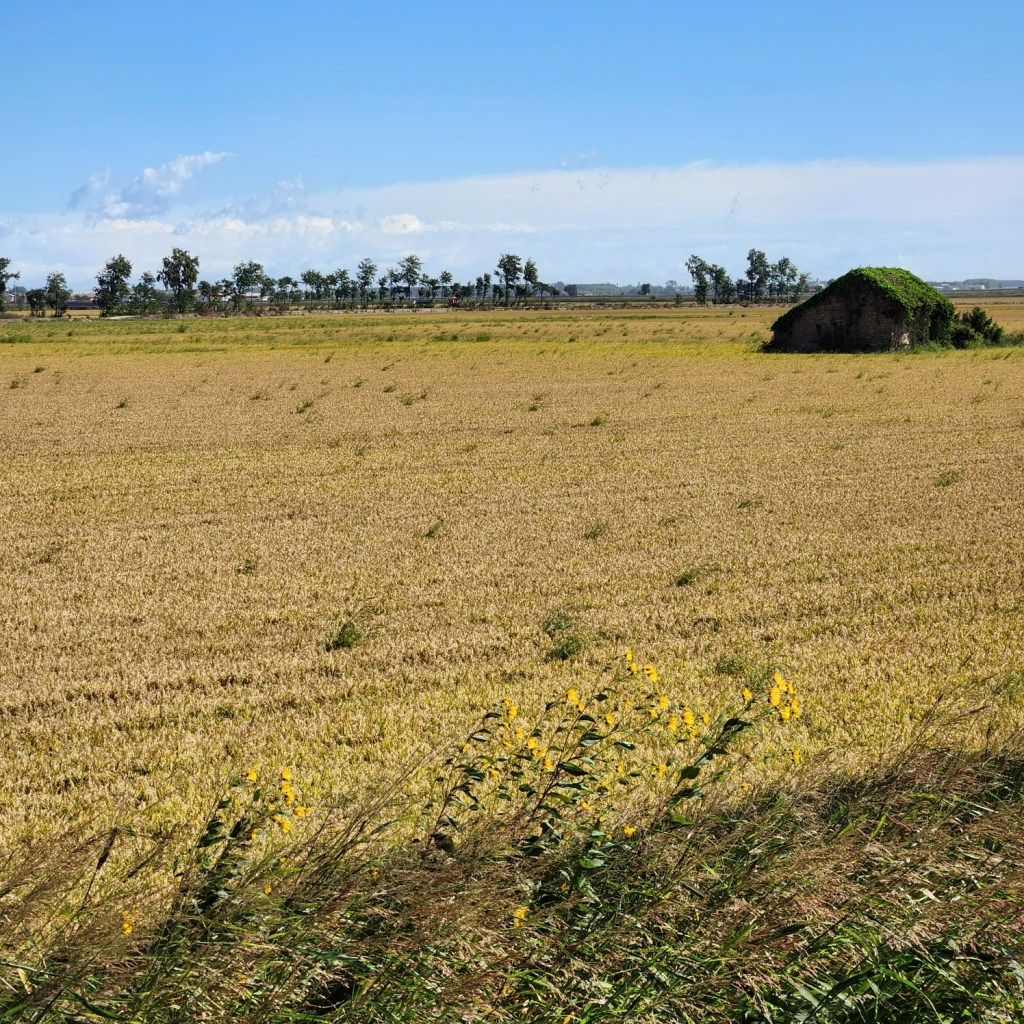
Strong wind blowing left to right over rice stubble fields.
We left Vercelli enjoying sunshine and temperatures in the 70s. Soon, however, we were walking on top of the high dike above flooded rice fields.
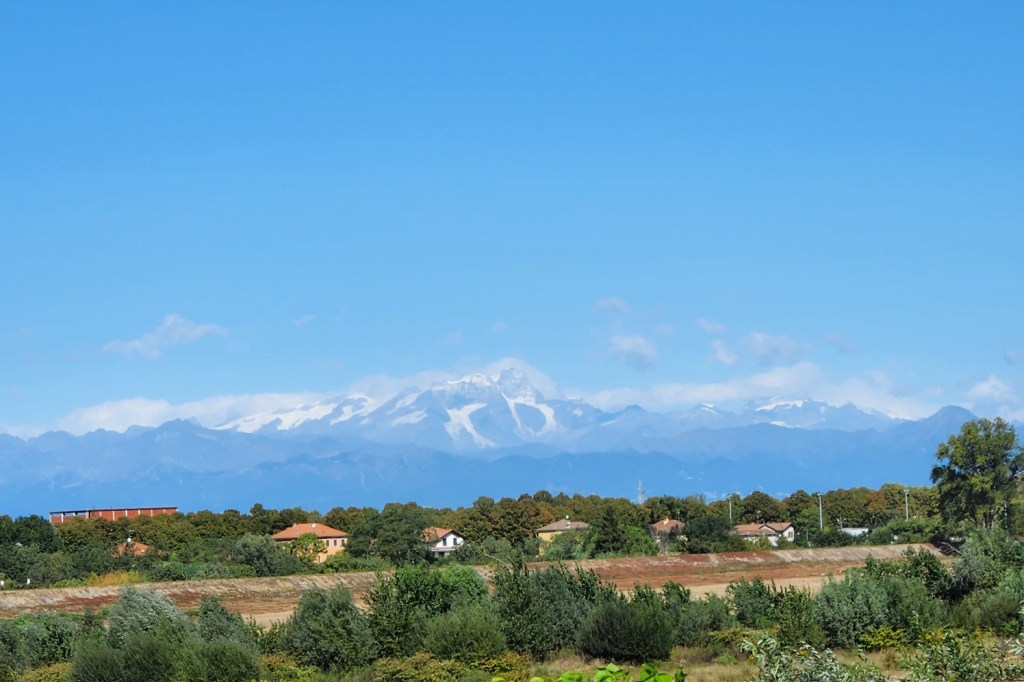
Alps over our left shoulders were the source of cool, gusty winds with no wind breaks for hundreds of kilometers.
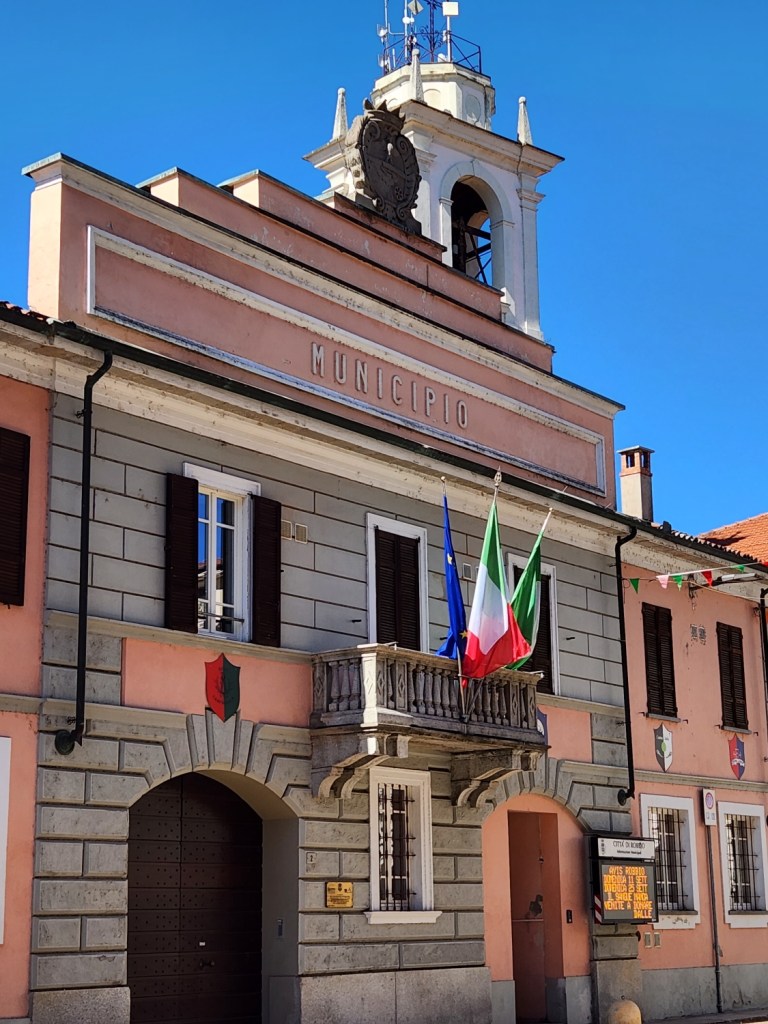
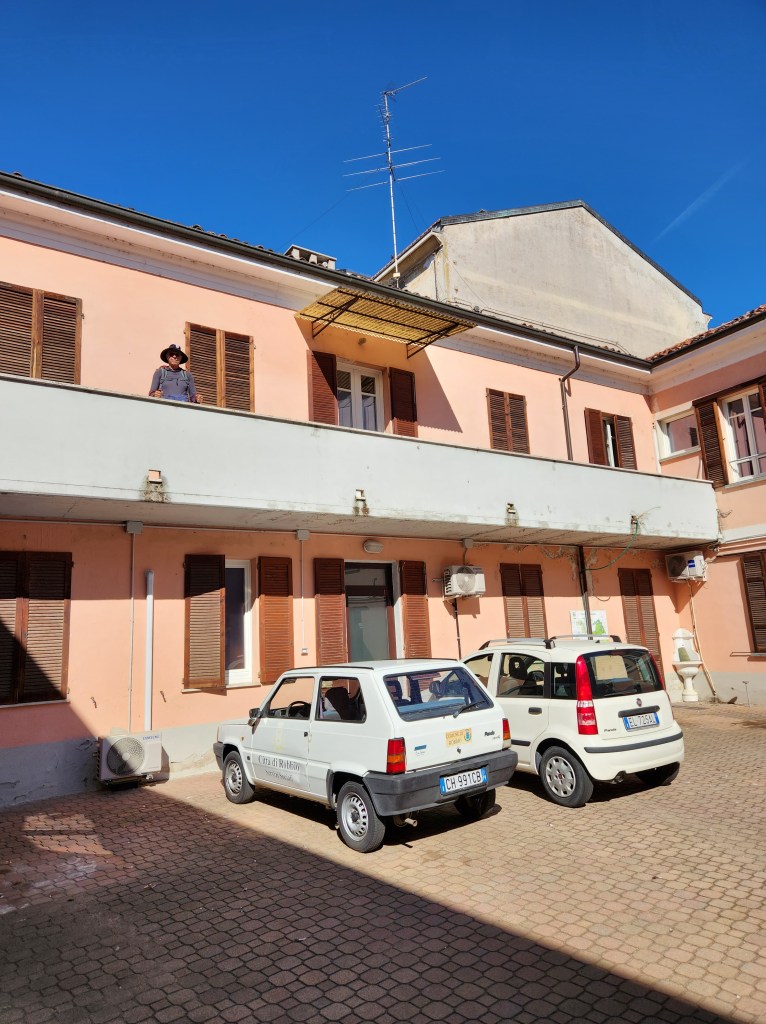
Anne struggled against the wind and didn’t have her backpack adjusted correctly, which made her pack act like a sail. With the hurting wind, we only managed ten kilometers in almost five hours. We took a local train for the final eight km to Robbio, where the only accommodation was the municipal hostel, sharing space with police and fire vehicles.
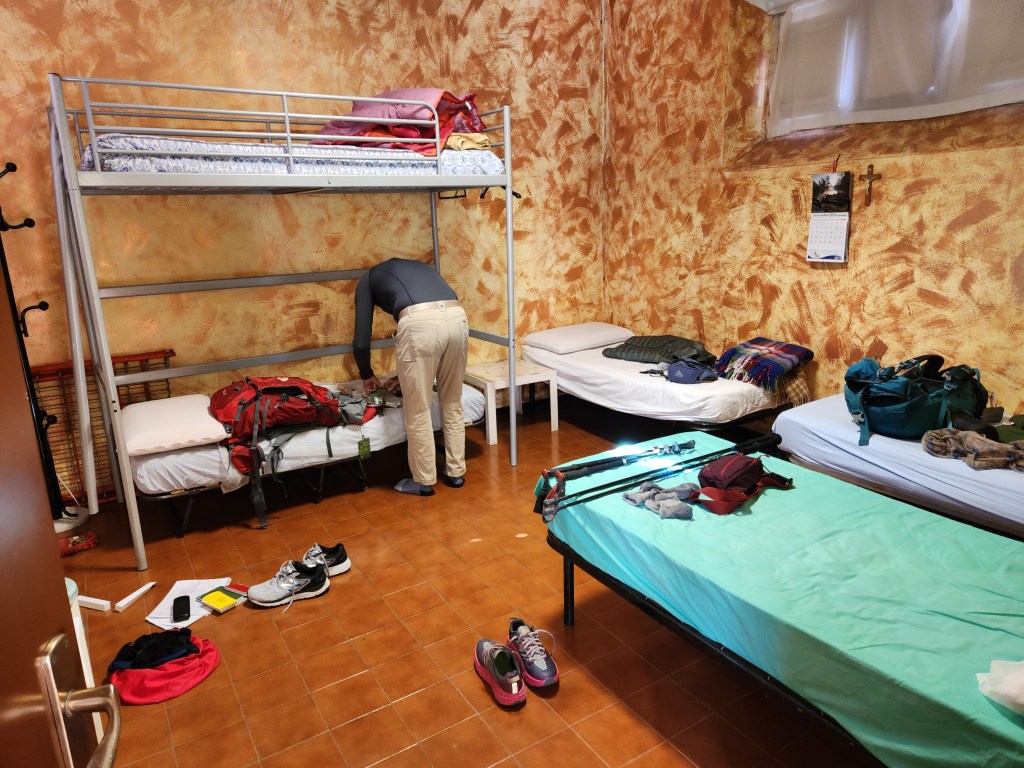
After a phone call and a short wait, the caretaker arrived to let us in through the arched brown door.Hostel was above parking for municipal vehicles. When we heard a siren we were told that we did not need to evacuate: it would be notice for the pompiers (firefighters).Dreaded bunk beds… but luckily there were no other guests that night and we each had a bed on the floor; no climbing required.
When we went to Saturday vigil mass at Santo Stephano in Robbio, we chatted with some locals, one of whom turned out to be the priest in mufti. At the end of the celebration, he introduced us as pilgrims to the congregation, so we became mini-celebrities for a few minutes.
We feel asleep listening to the pigeons.
CONTACTING US AS WE TRAVEL: Our US telephone numbers (voice and text) have been disconnected. You can email us at our regular Gmail addresses. Wifi here is sporadic. It may take a while for us to respond. Currently our time zone is six hours ahead of US Eastern Time.
It started in Portuguese (bem-vindo=welcome) with a seven hour flight on TAP out of Dulles to Lisbon and another two hours to Milan. Listening to the sibilant-gutteral tones of the attendants’ announcements reminded us of our 2017 Camino Portugueś to Santiago de Campostela, our third Camino, when we walked north from Lisbon.
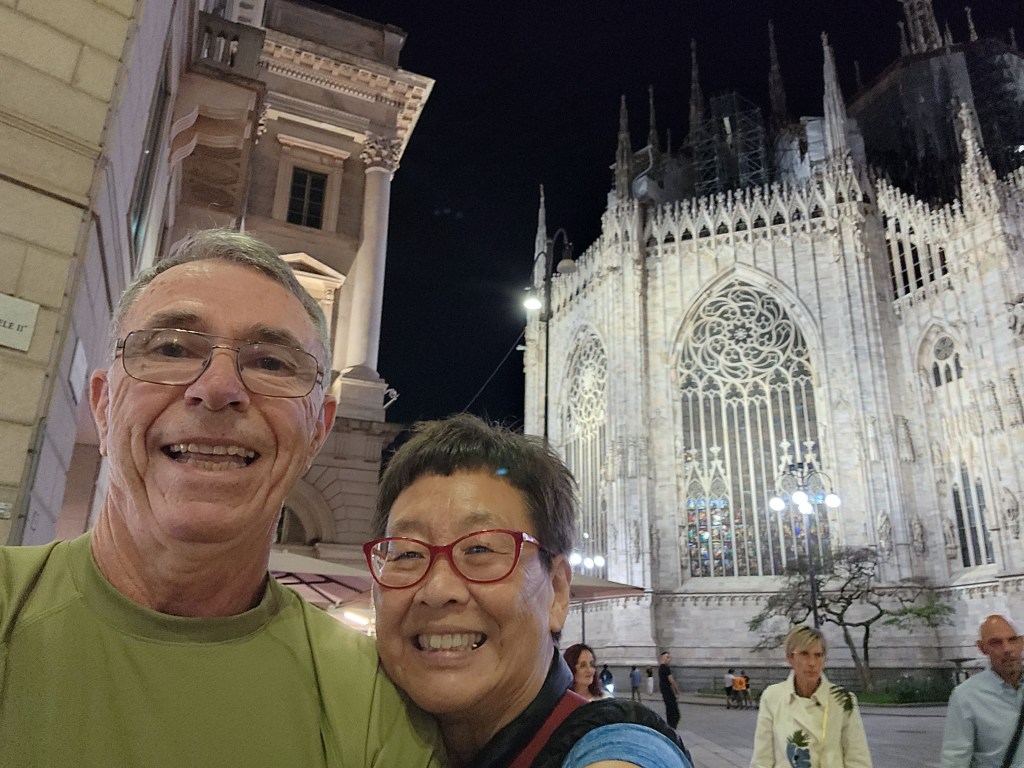
Happy to be in Milan
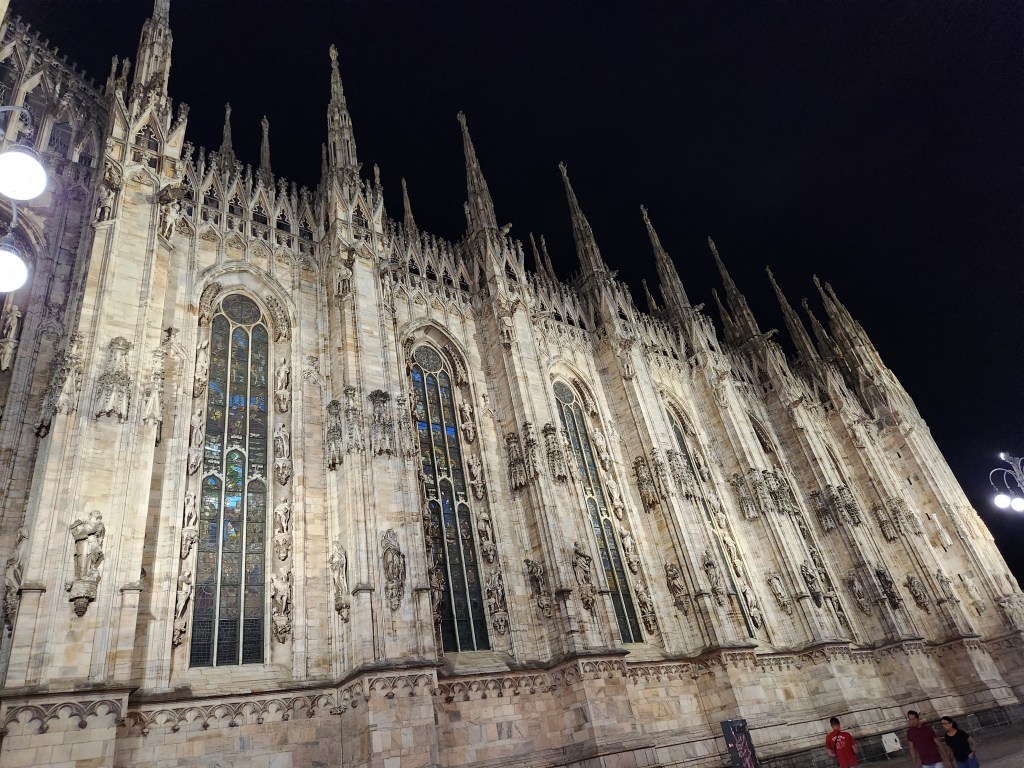
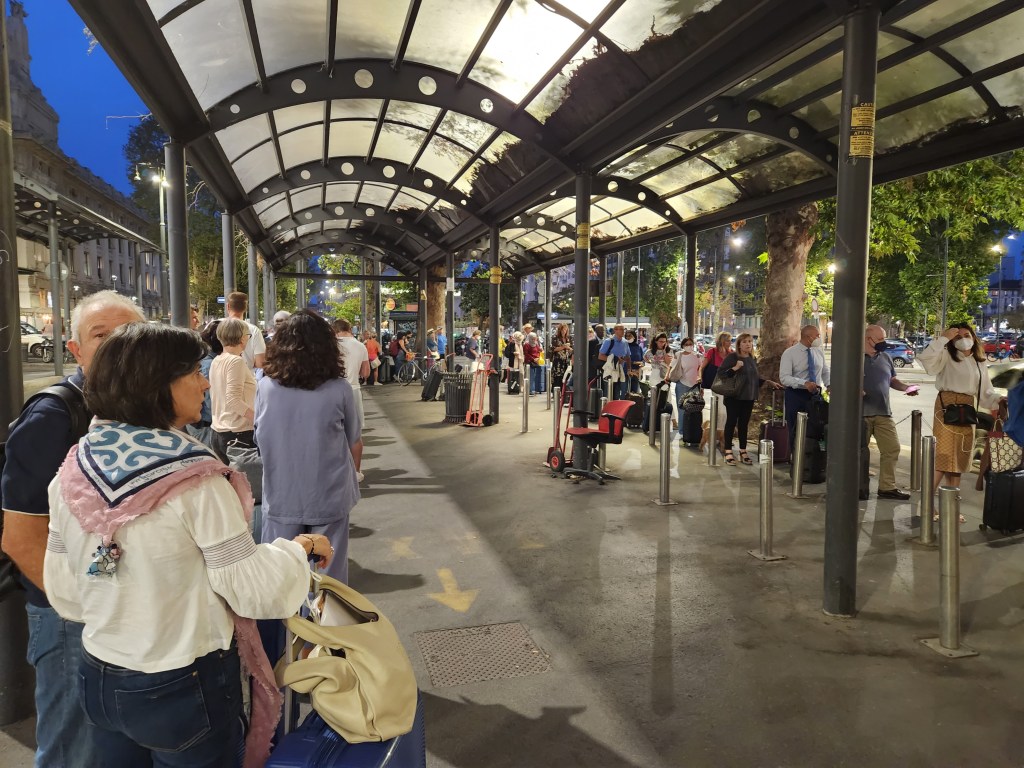
Milan, on this, our first visit, impressed us with its beauty and vibrance at night. After weathering a long taxi line, we found out hotel only steps from the Duomo (thanks to the BEST travel agent, Ed), with an energetic crowd strolling and cycling at high speed, listening to street music.
Stunning Duomo di Milan (Milan Cathedral) at nightTaxi line at Milan’s Centrale train station. Evening weather was very pleasant. Locally recommended pizza was our first dinner on arrival in Milan. Then we crashed.
On our first day we took care of various tasks, the most significant of which was securing our Via Francigena (VF) pilgrim passports. Caterina, a charming VF volunteer, and her vivacious cat, also helped us with local information. A one-man ferry over the Po River has recently resumed operations after the summer’s drought forced water levels catastrophically low.
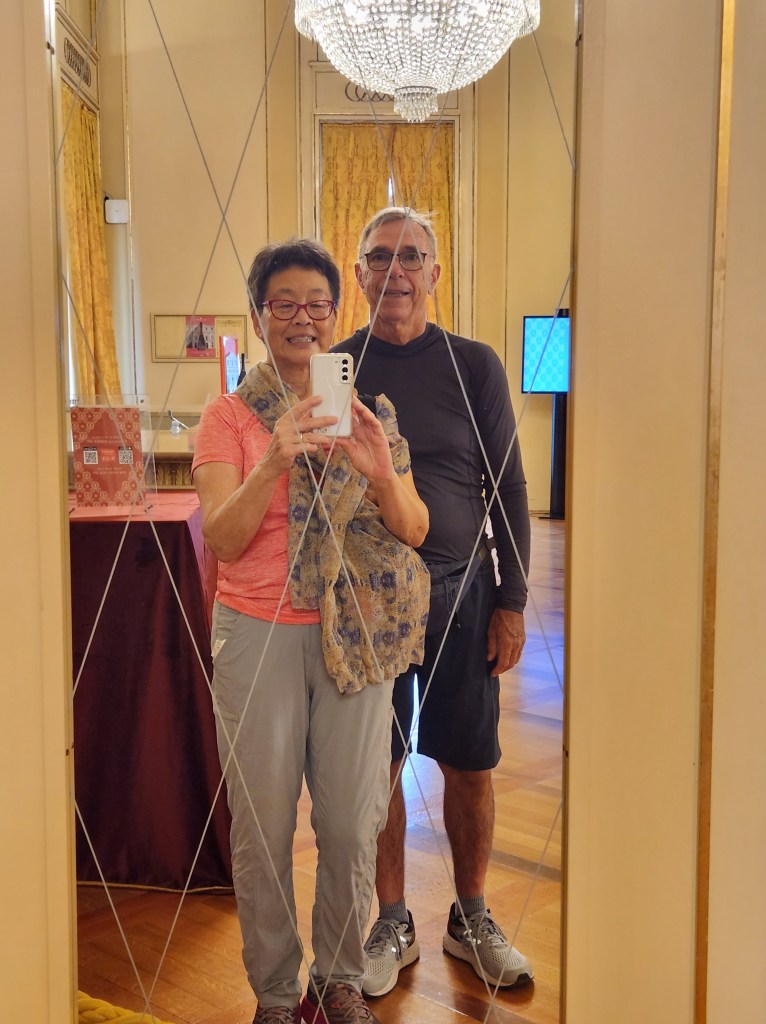
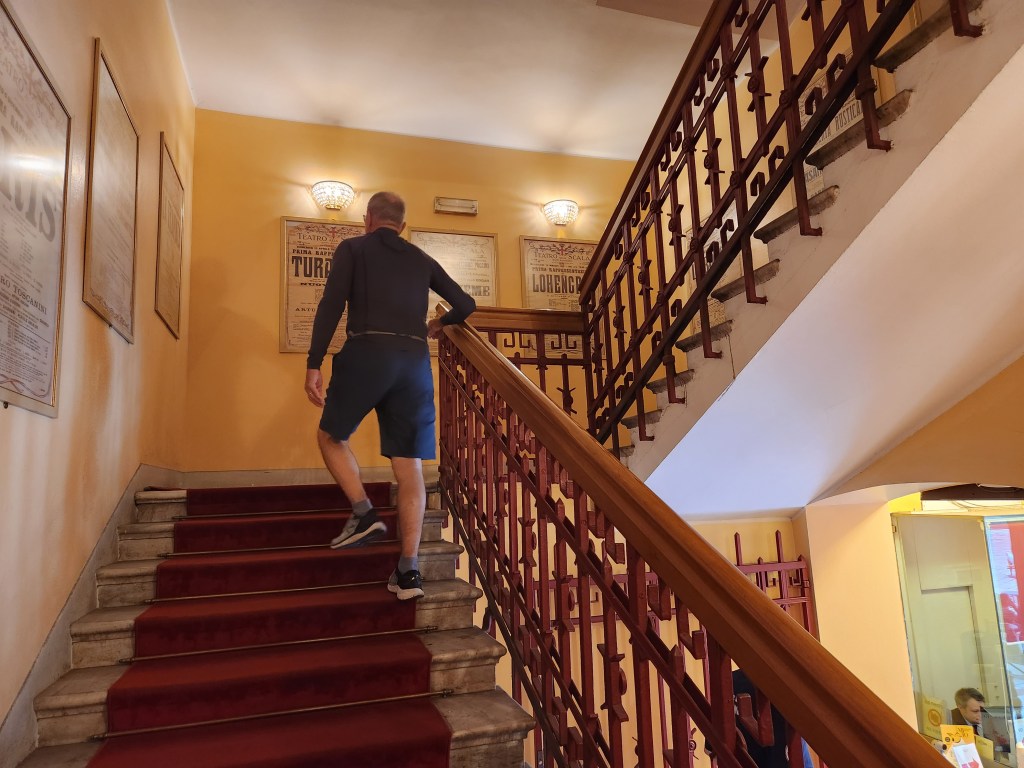
La Scala is all mirrors, crystals and velvetTreading the musically sacred steps of La Scala Opera House
We also squeezed in a bit of sightseeing. A thrill of pleasure ran through our bodies as we visited La Scala Opera House, scene of first performances of Aida, Don Giovanni, and countless beautiful works. Sadly, we are too early for the season to begin so cannot attend a performance, this trip at least.
PLEASE NOTE: BILL MULDOON’S FULL OBITUARY CAN BE FOUND AT KESSLERMAGUIRE.COM and shorter versions will be published on September 18 editions of the Boston Globe and St Paul Pioneer Press.














 Anne and Ed Blog