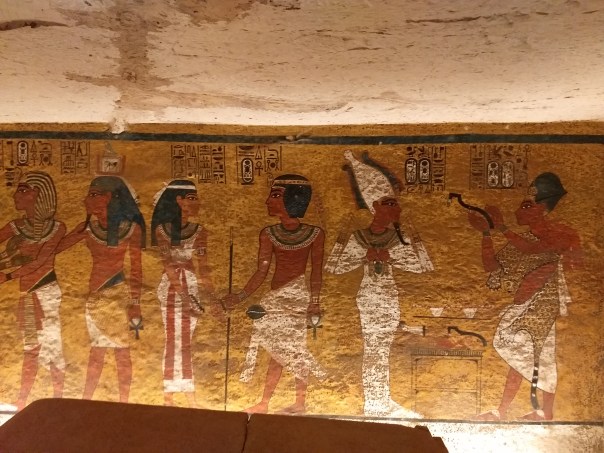
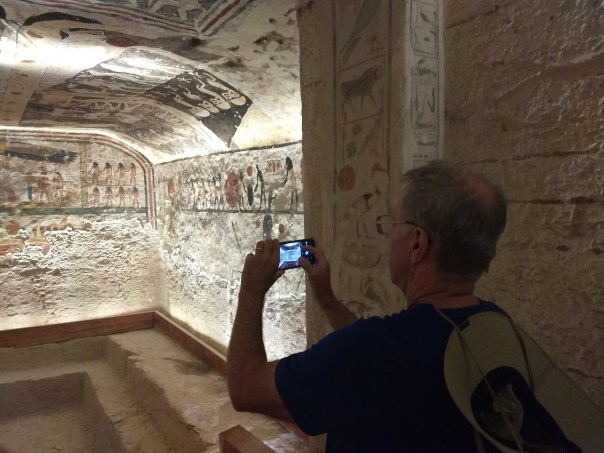
Fantastic colors in tomb of Ramses IX, Valley of the Kings
Just an update: we are making our second of three connections in our 25 hour journey back to Naples, Florida from Cairo. It is Tuesday, and due to time zone changes, it will still be (very) early Wednesday morning when we arrive home (God willing).
We only made it into our airport hotel bed at midnight after a delayed flight from Luxor to Cairo. Then we were up at 3:30 am to return to the airport. After many days of super early starts, exciting excursions in blazing heat, and our various respiratory and digestive challenges, we are sleep deprived and exhausted. But so grateful for our amazing experiences and new friends and looking forward to sharing stories with our family and friends at home.
Talk and see you soon!!!! (After a recovery period of undetermined length…)
PS London Heathrow has made wonderful and huge improvements to their Connecting Flights process since a few years ago. Kudos to them.
Today we visited the Valley of the Kings in Luxor, just one of the amazing and beautiful sites we have visited in Jordan and Egypt, since leaving Spain. We have not been able to blog from the Middle East earlier due to an extremely full schedule combined with sketchy wifi. Now we look forward to a last day (tomorrow) to visit the East Bank at Luxor, and then a 20-hour series of flights to return to the US and Naples, Florida.
Jordan was wonderful and we particularly enjoyed Jerash, a stunningly complete Roman city, and Petra, which was even more beautiful than imagined from the movies. Cairo traffic was an experience all its own — oh, and by the way, there are the pyramids and Sphinx.
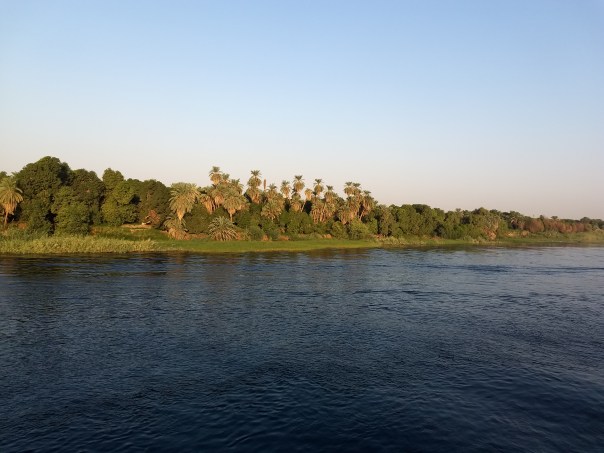
From our cabin on Nile cruise
The contrast between Spain and here in temperature (over 100 degrees in Luxor) and pace (did I mention the traffic in Cairo?) has been startling. But people have been very friendly and charming. They are happy to see the tourist business picking back up after 9 very lean years.
Somewhere between Jordan and Spain Ed caught a cold (which he shared with me) and we’ve been burdened with various and related health discomforts all the time we’ve been in the Middle East. It turns out that everyone here has a home remedy from their grandma which they insist on Ed trying: cumin, lemon, strong coffee with lemon, etc, etc. At least one result: an upset tummy! So maybe it is time for us to go home and let our systems settle down…
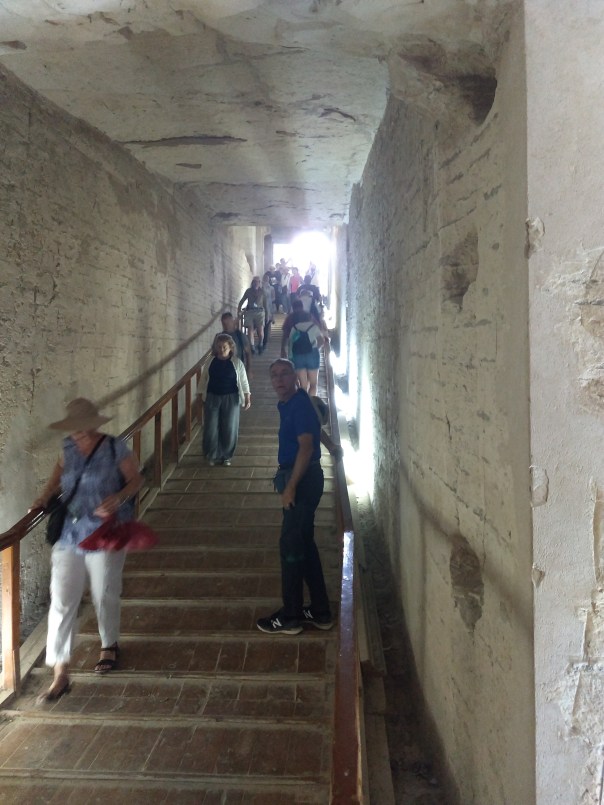
Valley of the Kings: Down and up from the tomb Ramses IX (must double check the number)
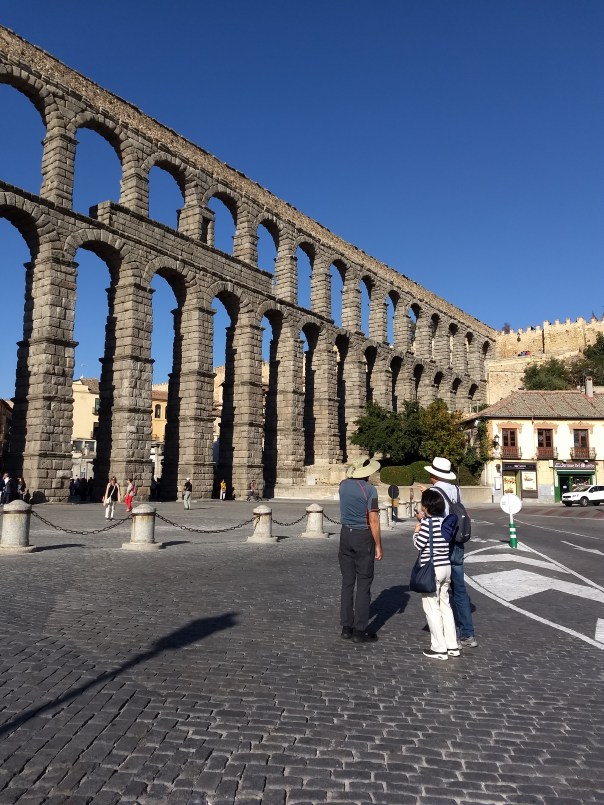
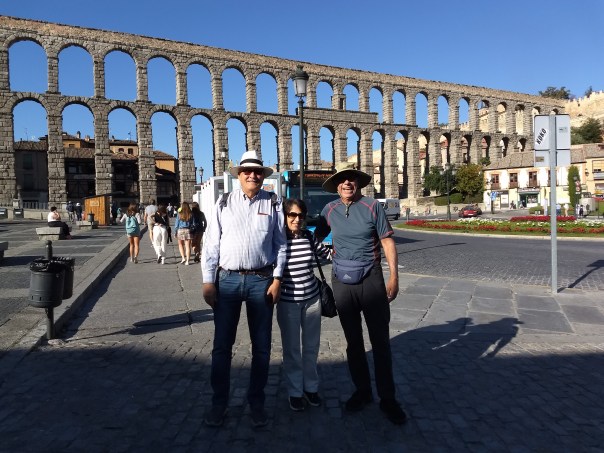
Our wonderful Madrileno friends, Julio and Luz, took us to the magical city of Segovia on Friday. On one end of the town is a magnificent Roman aqueduct, which was still operational as recently as 50 years ago!
On the other end of town is the former royal palace and fortress of Alcazar. Looking like a fairy-tale castle, it dominates a tall eminence and is guarded by an incredibly deep moat. In between, there are well- preserved residences, civic buildings and churches that testify to the prosperity and artistry of Segovians of hundreds of years ago.
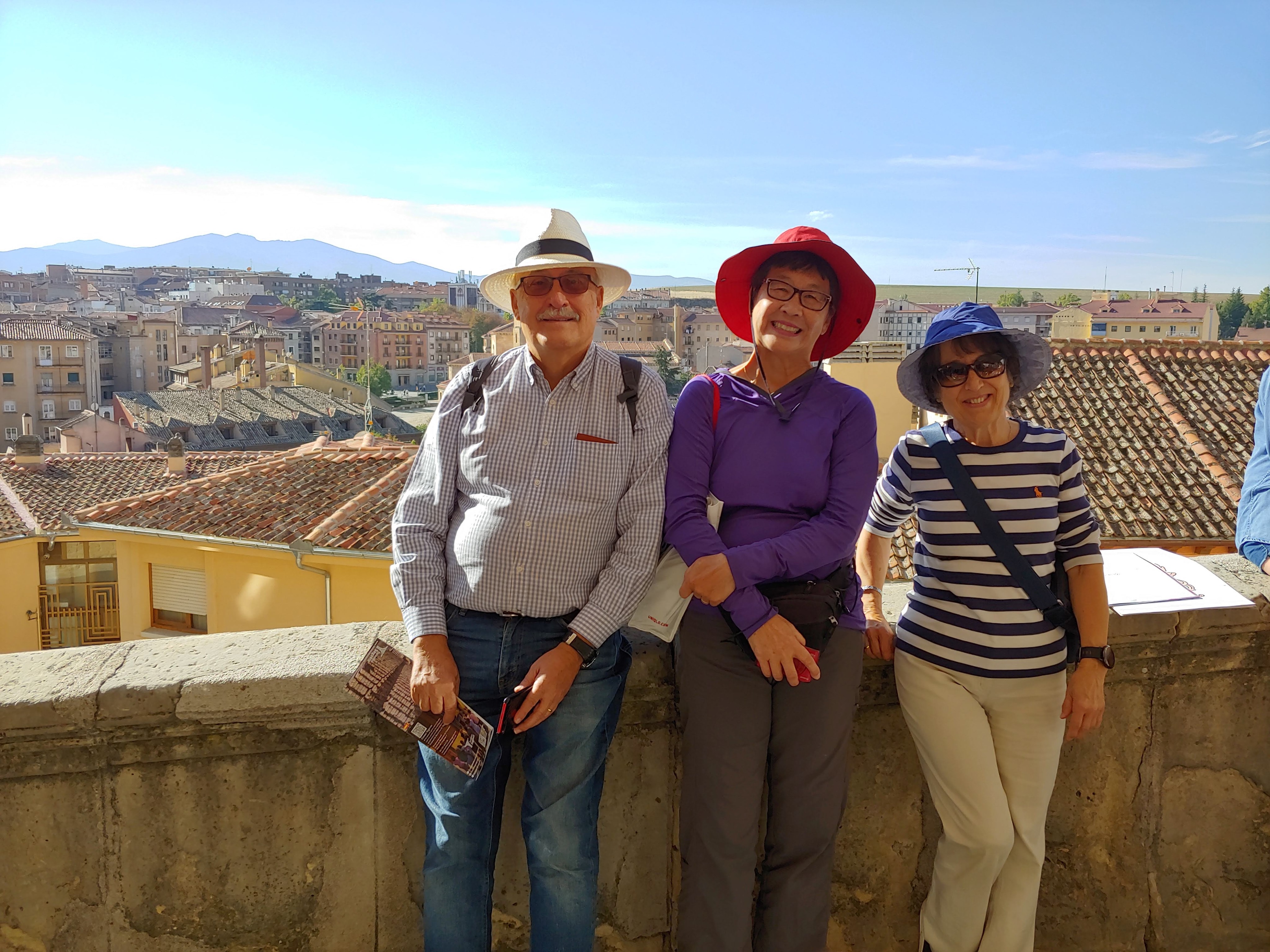
View of Guadarrama mountains from the Alcazar palace, Segovia. Julio, Anne and Luz
We regretfully say hasta luega to our friends and their beautiful country. Sunday night we are scheduled to arrive in Amman, Jordan.
Yes, that is the Cathedral of Santiago de Campostela in the background. We reached the pilgrimage point on Monday, October 7 in a chilly rain, not atypical of Galician weather. This milestone of our journey had its own ups and downs. Up: the laundromat started by a pilgrim-supporter three years ago was still in business and we were able to process a big load. Down: the hotel had erroneously rejected our luggage from the Correos Paq-Mochila baggage forwarding service.Up: a trip to the Central Correos (Post office) reunited us with our bags. Down: when we went to the Pilgrim Office to obtain the credentials certifying completion of the pilgrimage, we were issued numbers 1106 and 1107. The Office was dealing with number 525 at the time (2:45 pm). Only 581 people in the queue ahead of us!Up: at 9:15 pm that night, we received our credentials!Above is the credential, known as a campostella, for Lady Mariam Muldoon MacDonald (Ed’s sister, Mary, in whose memory we walked this Camino). In Latin, the ancient form of words had been used for many of the 1,100 years that pilgrims have been making their way through hills, valleys, mountains, rivers, mud, dust and other perils to the resting place of Saint James the Apostle.Perhaps those 1,100 years of pilgrims is the reason our queue numbers were 1,106 and 1,107. The high numbers also mean that the daily total was higher than 1,100. In the city, there were more pilgrims than we expected to see in October. Indeed, when the 2019 numbers are compiled, we may find that recent annual counts of 250,000 on all the various routes of the Camino are exceeded this year.
As you see from the lead photo, the facade of the Cathedral has been magnificently cleaned and restored over a ten year period. We finally viewed the Portico della Gloria on this, our third attempt, and it did not disappoint. (Photography was not allowed). Maestro Matteo, the designer and artist, somehow converted cold stone into the grace, warmth and vitality of human and angelic forms.
What’s next? We are already enjoying the incredible hospitality of our friends, Marta and Rafael, appearing in the lead photo with us, at their beautiful finca across the ria from Vigo. Tomorrow we’ll go to spend three days in Madrid and to see our friends, Luz and Julio. Then, on to Jordan and Egypt!We’ll continue to blog until we return to the States.
We just learned that our nephew, Kevin Muldoon, passed away in his sleep. Another death we were not expecting. So we add Kevin, and his wife, children and grandchild, and Kevin’s dad, Ed’s oldest brother, Arthur, to our litany of loved ones whom we are carrying in our hearts to Santiago de Campostela. In addition to Ed’s sister, Mary and her husband, Bill MacDonald, those we’ve lost just recently include nephew Thomas Muldoon and dear family friend, Gary Thomas.
We should reach Santiago tomorrow, God willing. The Camino had taught us much about patience, persistence, providence and kindness. In the free quiet moments before going into tired sleep, Anne has been re-reading Richard Rohr’s book The Universal Christ, to absorb more of its insights. We’ve also been fortunate to participate in Mass many times — in Spanish, Asturiana or Gallega — another “universal” experience.
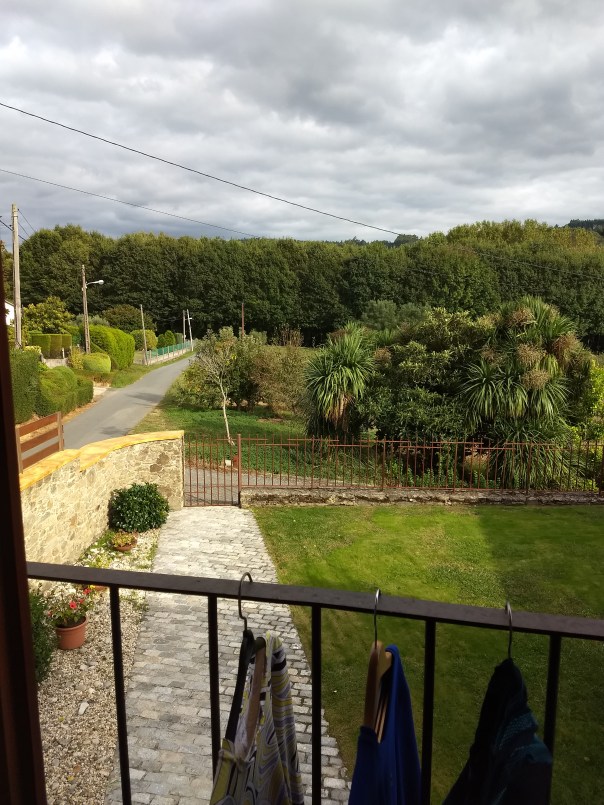
Penultimate night before Santiago: clothes dry on our balcony overlooking farm and woods.
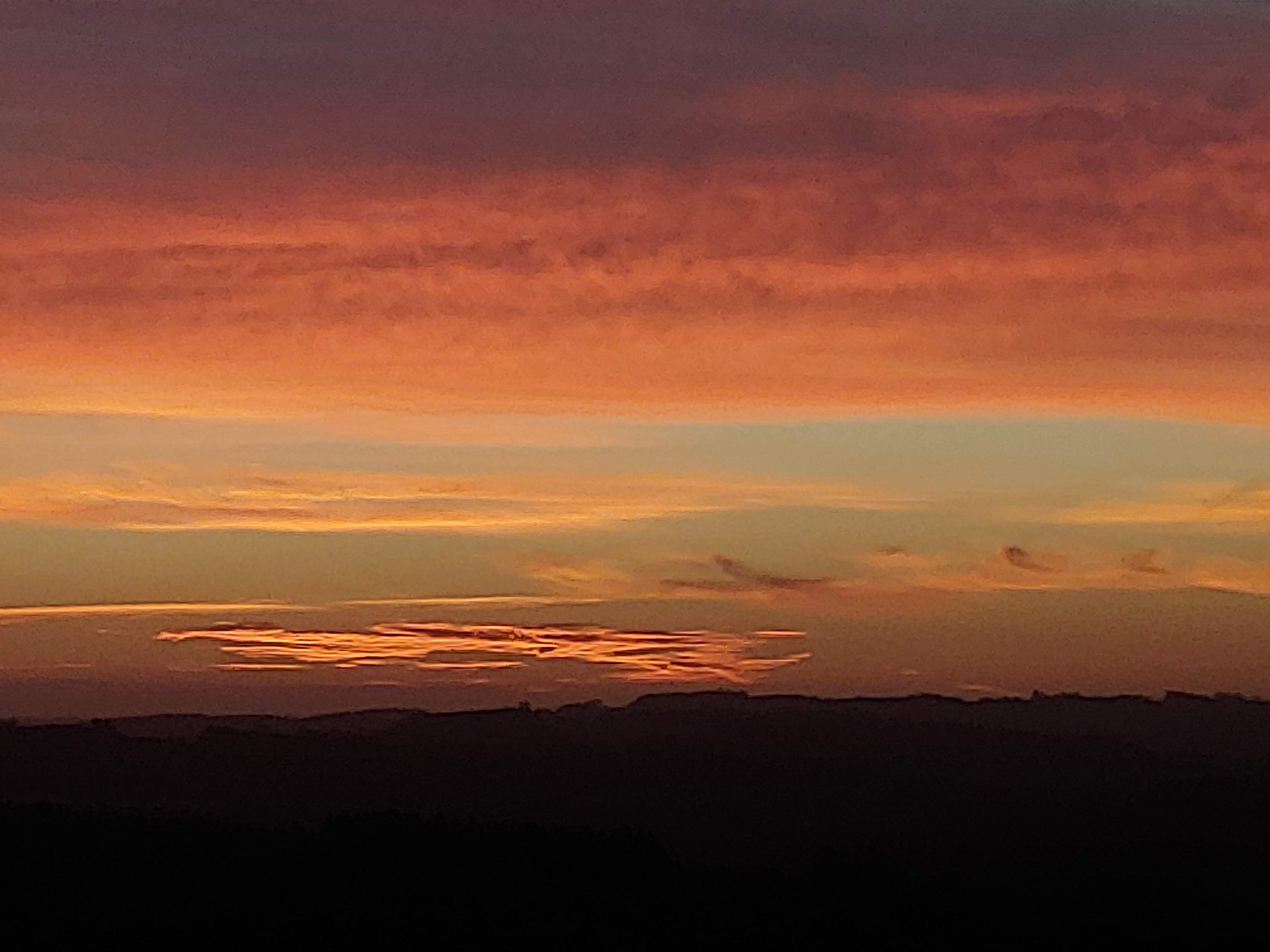
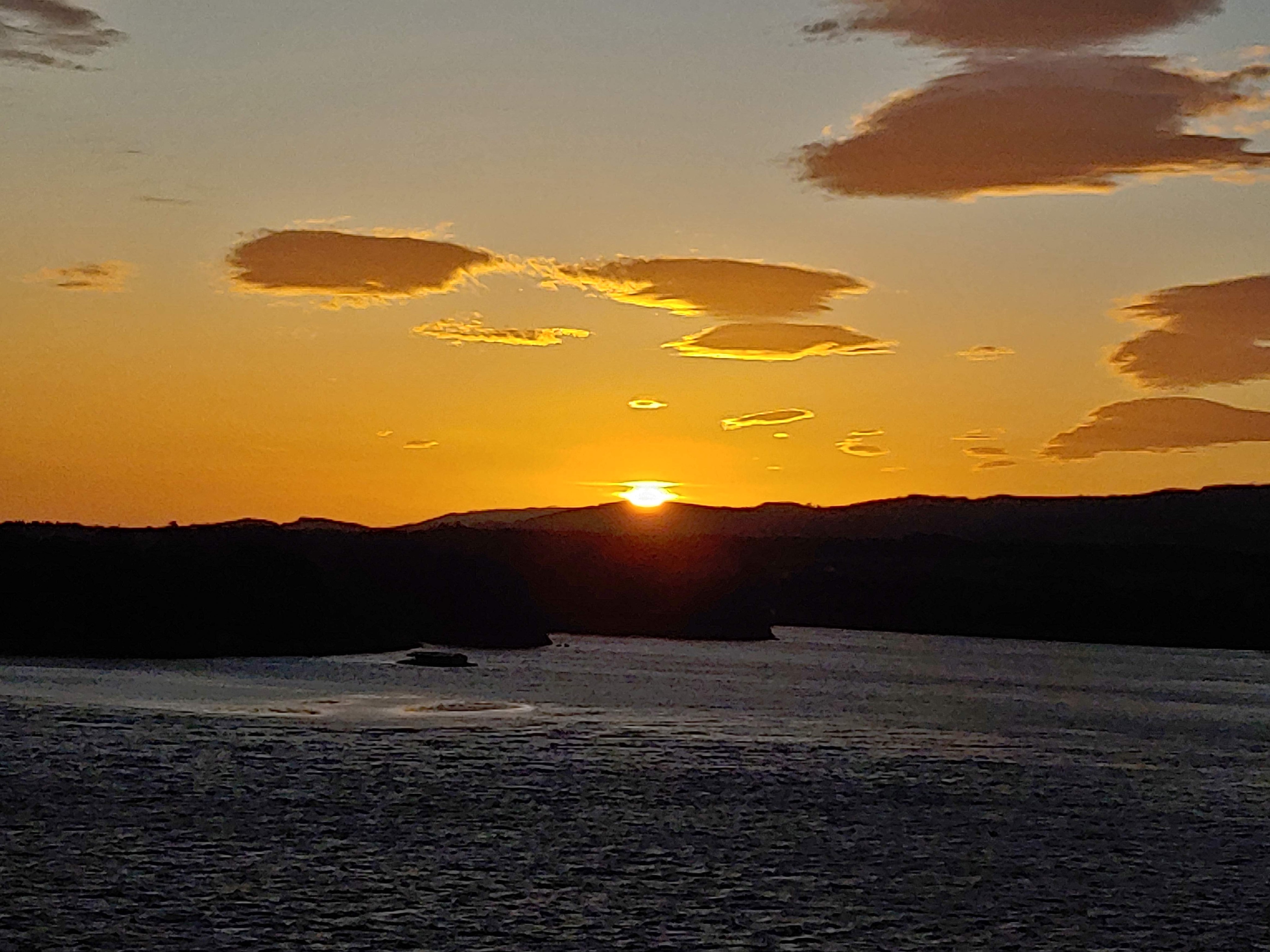
The last sunset (below) before we walk into Santiago and our prayer for Kevin, Mary, Bill, Thomas, Gary and all our departed family and friends:
Eternal rest grant unto them O Lord and may perpetual light shine upon them.
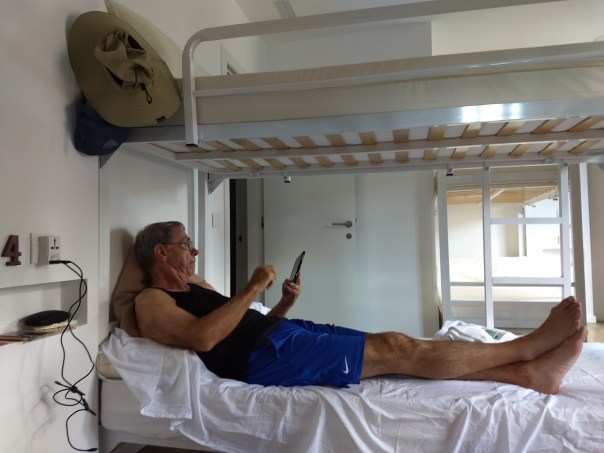
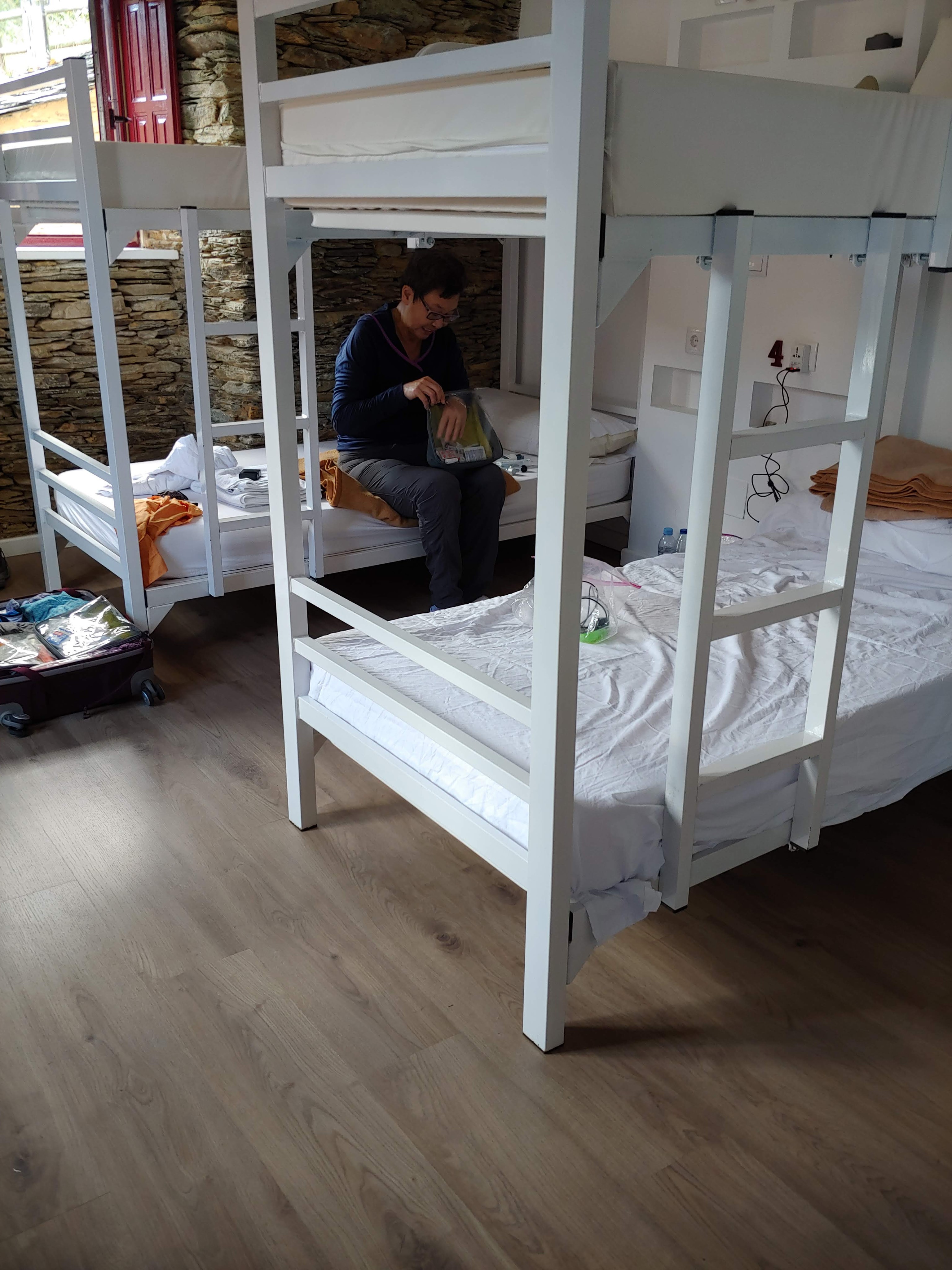
What’s this? You may remember our story from the first Camino of Anne’s unfortunate experience in the top bunk at an albuergue, the most modest level of pilgrim lodging. At an albuergue, on a first-come basis, a pilgrim can get a bed for about 12 Euros including shared showers and toilets. Sheets, pillows and blankets may, or more likely, may not be included.
After our early experience in 2015 that also included a cacaphony of snorers and a bad night’s sleep for Anne, we have mostly reserved ahead at casa rurales or pensions (modest lodgings with private rooms). But last night, deep into the Camino del Norte along the inland portion in a little town called Lourenza, we enjoyed a flashback to an bunk bed albuergue.
This one was pretty nice, with beds actually anchored to the walls rather than freely swaying from side to side, and both bottom and top sheets! And we each got a bottom bunk, hooray. Our roommate was a young German woman who had walked 40 kms that day (almost 25 miles) because the albuergue she assumed would have space for her was full, and the next one was 10 miles further! Ouch!
Although the TV playing at our modest dinner location announced scary predictions of Hurricane Lorenzo threatening Galicia, our walk today was under sunny skies with cooler temperatures (63°) and some wind.
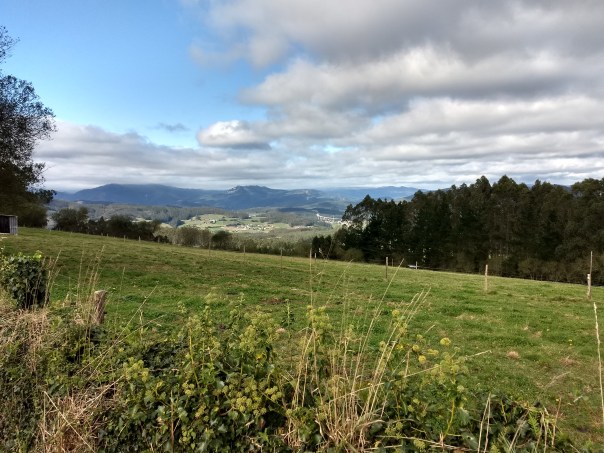
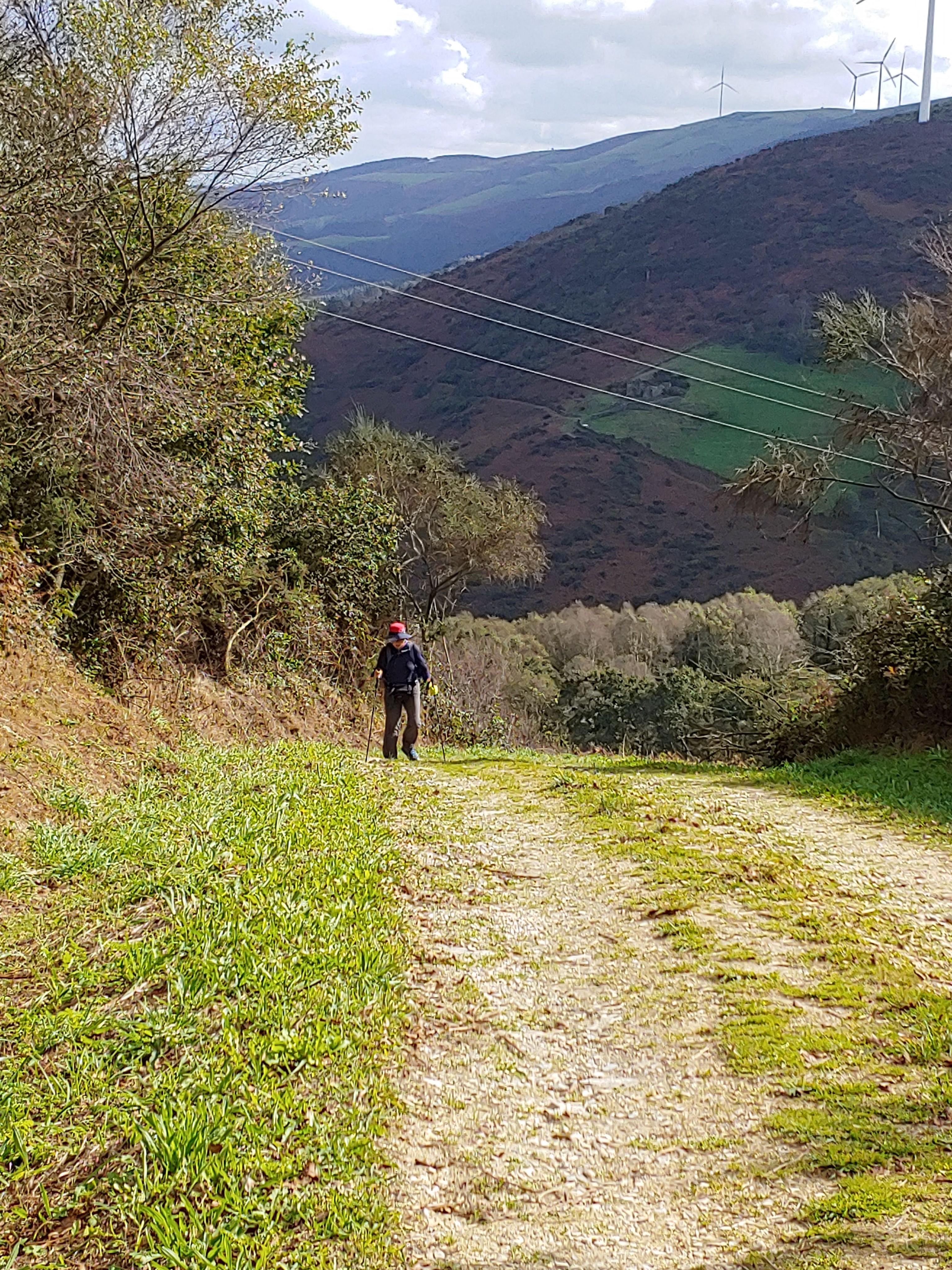
Today’s walk was an up and down hill day which resulted in our walking from the valley floor up and out of that valley into the next one. The elevation change was about 800 to 900 feet but the up and down terrain meant that we walked up at least twice that much. You can see the valley in the next photo.
Today was another good day on the Camino. We think every day of all of our family and friends with joy. What a blessing to walk quietly and to recall the good (and not so good) times we have shared. Thanks to all of you for all that we have shared.
Climbing from valley floor to ridge top over and again.
On Saturday we left the beautiful province of Asturias to enter Galicia. Asturias –apple capital of Spain, as you will recall — has a stunning coastline and abundant hilly and even mountainous terrain. Naturally, it has an indigenous language (Asturiana), foods and customs. We have been surprised, however, at the extent to which fields of ripening maize adjoin cow pastures almost to the top of the shoreline cliffs.
Ed has been very curious as to how the maize is harvested, so imagine our pleasure when we encountered an active harvesting operation on our last day in the province! In case you are wondering, it turns out that the entire stalks, ripened ears and all, are cut, ground and stored as animal feed.
Leaving Asturias, in which we have walked for 15 days, not only means a nostalgic goodbye, but a somewhat harrowing walk over a long and high highway bridge over the estuary of the River Eo to the beautiful port town of Ribadeo. (The walkway is only wide enough for one person, and the outer rail is only at waist height.)
On the other side, however, we have been rewarded with gorgeous views of the salmon-rich estuary, sea birds and hills and mountains stretching into the distance. Since dawn happens around 8:25 am, we witnessed the sun coming up over the bridge to set the water sparkling.
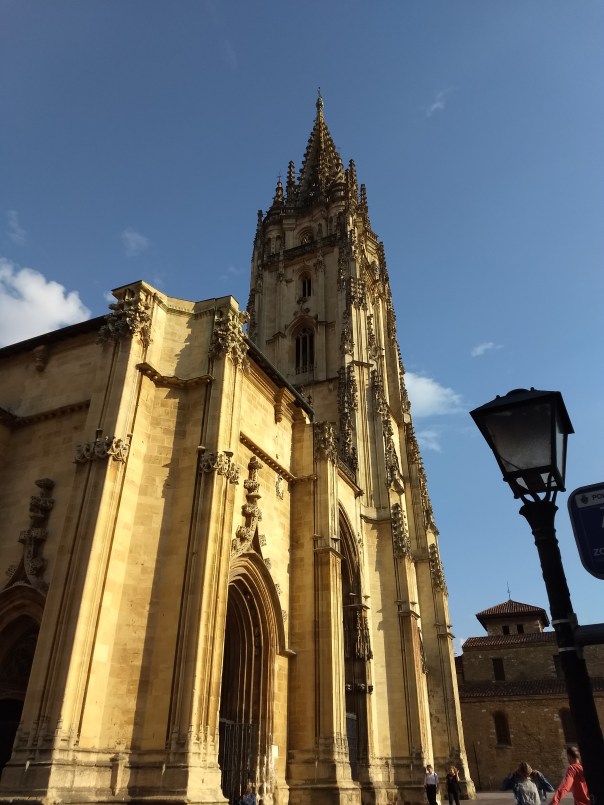
We felt impelled to take a detour off the Camino del Norte to visit Oviedo, one of the most storied locations in Spain. The cathedral (seen above) is wonderful. Its huge altarpiece presents 23 scenes of the Life of Jesus and the Virgin which are more brilliant and eloquent than any movie or video. Its Sacred Chamber holds many priceless relics. Although bombed at least twice (once during the Civil War and later by anarchists) its antechamber is decorated with wonderful stone sculptures of the Apostles talking, two by two.
No photo can do justice to the beauty of each scene and the overall effect.
Artists from Burgos, our favorite city along the Camino Frances, were brought in to decorate Oviedo’s cathedral. The Apostles chamber has been compared to the Portico della Gloria of the Cathedral of Santiago de Campostela. We are anxious to see that Portico on this Camino: it will be our third try as it had been under major restoration during both our previous visits.
God is smiling on us during our Camino. First, the weather has been almost completely dry and there has been very little mud (“la boue” in France, fango in Italy and barro in Spain). Second, the circus has been following us from one small town to another, and then our overnights have coincided with the town’s major annual festival three different times. (Lots of fireworks and drinking.)
Most significantly, when we inquired about mass last night in Oviedo, we learned that it was the penultimate night of the sacred week during which worshippers at Oviedo receive a plenary indulgence. If you don’t know what that means, let’s just say that we are very lucky, indeed.
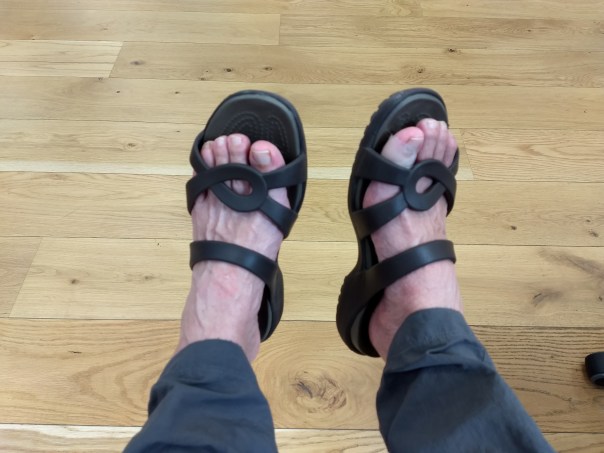
The feet are a bit tired. Your “likes” and comments on the blog are much appreciated!
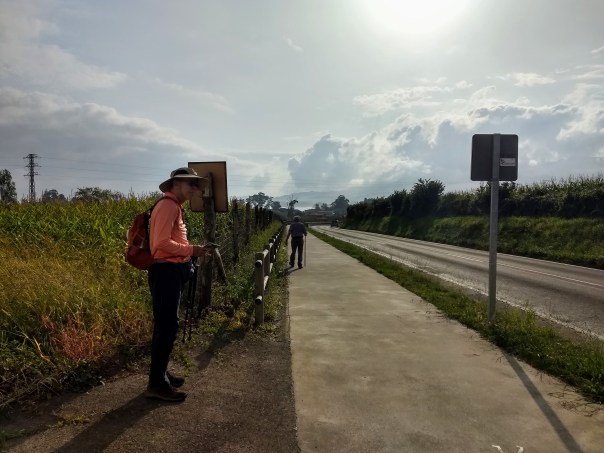
We had to catch a bus yesterday. The photo above shows Ed waiting at the stop. A sliver of the Atlantic ocean –actually, the Bay of Biscay– can be seen in the distance. The man who walked by was a local farmer (retired) using a staff.
After starting with a heavy downpour, the day turned partly sunny and very humid. While southern Spain has suffered from huge rains and floods, our northern slice has been blessed with good weather. There are still a stunning variety of wildflowers and only a few traces of autumn, seen in the bountiful apples, pumpkins and tomatoes we pass on the road.
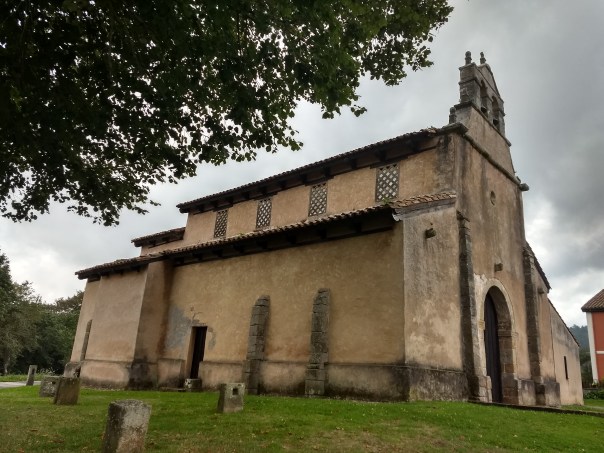
A long and steep climb was rewarded with a visit to one of the oldest churches on the Camino. In San Salvador at the top of the hill in tiny La Priesca, 9th century frescoes can still be seen. The colors and shapes are faded but lovely. It’s amazing that they have survived more than 1,000 years, despite the local humidity!
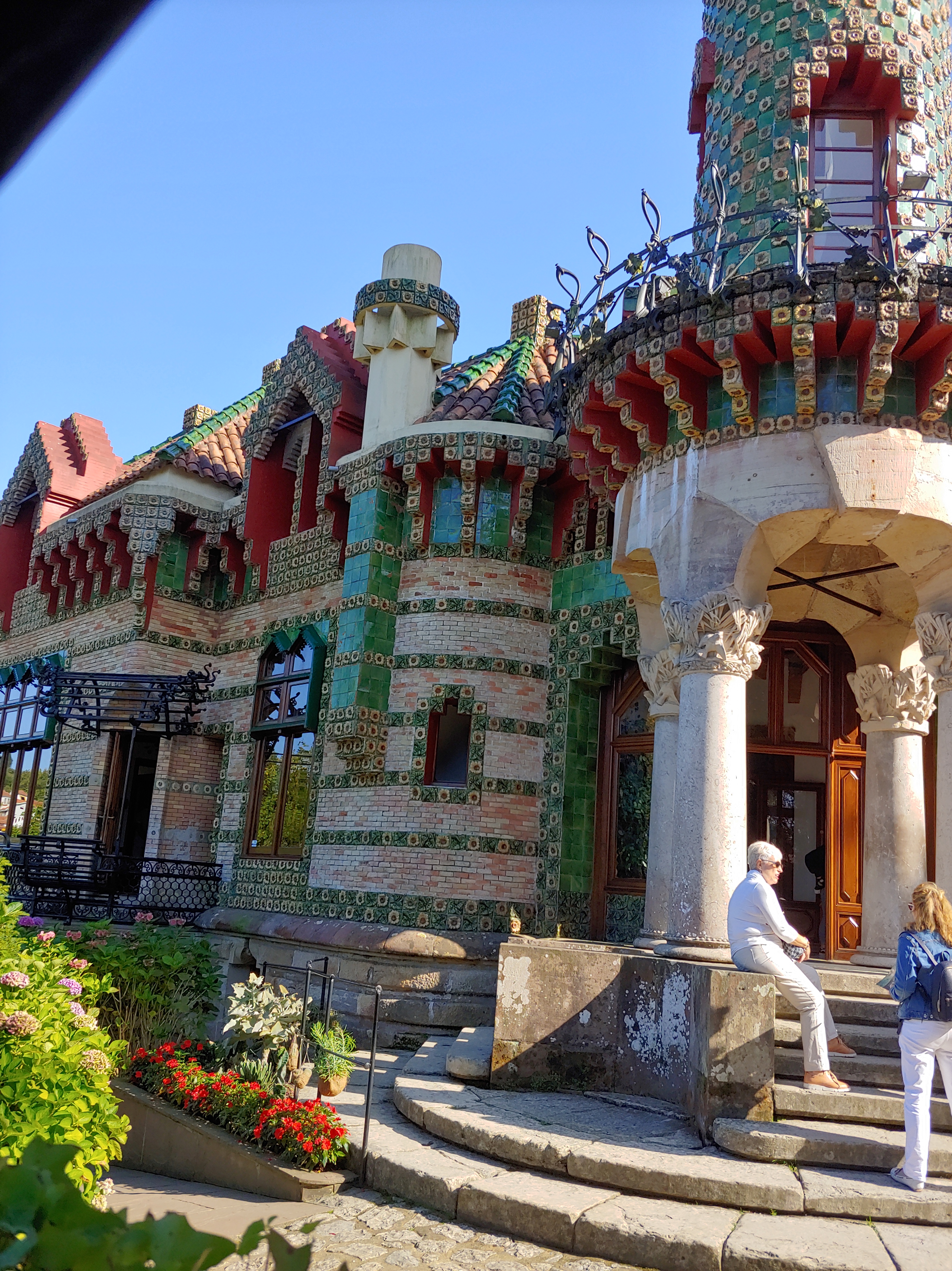
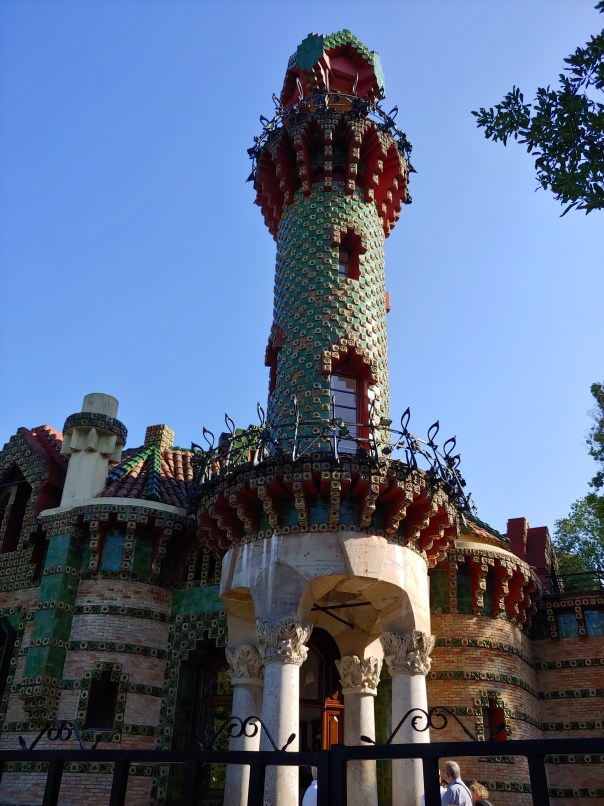
Our friend, Rafa, who had given us so many wonderful suggestions for our journeys through Spain, urged us while in Comillas (end of Day 2) not to miss el Capricho de Gaudi. This residence, one of the artist’s early creations, was dubbed by the locals as Caprice of Gaudi because it seemed so fanciful and impractical.
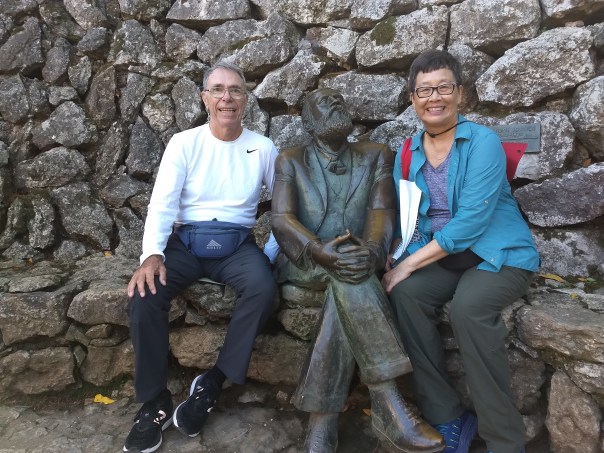
Ed and Anne sit with Maestro Gaudi on a bench
Crowned with a minaret and covered with bright sunflowers, the house is a burst of color and curving lines. Inside, it is amazingly practical and comfortable, with innovations like double-hung windows whose counterweights play musical tones and interior shutters that roll into curved cases like sidewise roll top desks.
Tragically, the wealthy lawyer, Massimo, who commissioned the house, lived there only one week before succumbing to illness. Massimo was an “Indiano,” an to immigrant to Spain from the New World (probably Cuba). So here in Comillas we see a century and half old example of the persistence and creative benefits of human migration.
Gaudi loved and appreciated the beauty of Islamic culture and art and married Islamic elements with Western European to create loveliness and joy.

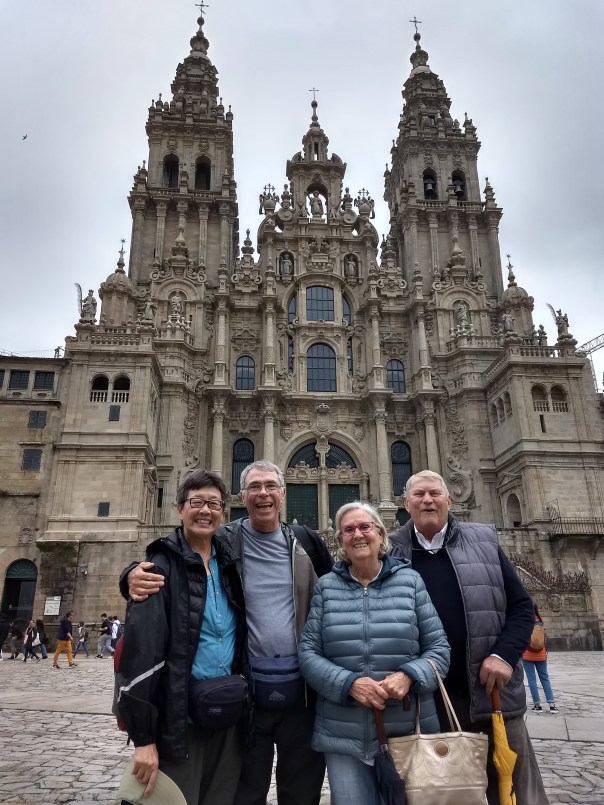 Yes, that is the Cathedral of Santiago de Campostela in the background. We reached the pilgrimage point on Monday, October 7 in a chilly rain, not atypical of Galician weather. This milestone of our journey had its own ups and downs. Up: the laundromat started by a pilgrim-supporter three years ago was still in business and we were able to process a big load. Down: the hotel had erroneously rejected our luggage from the Correos Paq-Mochila baggage forwarding service.Up: a trip to the Central Correos (Post office) reunited us with our bags. Down: when we went to the Pilgrim Office to obtain the credentials certifying completion of the pilgrimage, we were issued numbers 1106 and 1107. The Office was dealing with number 525 at the time (2:45 pm). Only 581 people in the queue ahead of us!Up: at 9:15 pm that night, we received our credentials!
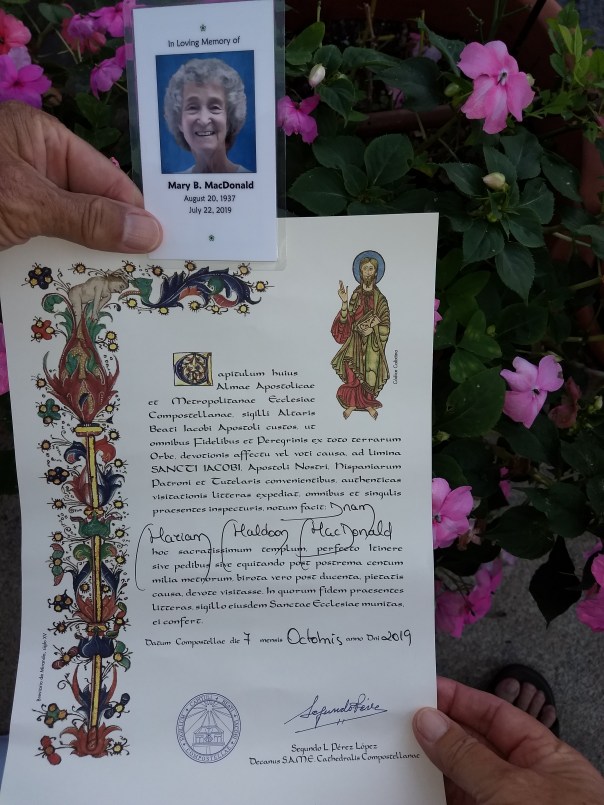 Above is the credential, known as a campostella, for Lady Mariam Muldoon MacDonald (Ed’s sister, Mary, in whose memory we walked this Camino). In Latin, the ancient form of words had been used for many of the 1,100 years that pilgrims have been making their way through hills, valleys, mountains, rivers, mud, dust and other perils to the resting place of Saint James the Apostle.Perhaps those 1,100 years of pilgrims is the reason our queue numbers were 1,106 and 1,107. The high numbers also mean that the daily total was higher than 1,100. In the city, there were more pilgrims than we expected to see in October. Indeed, when the 2019 numbers are compiled, we may find that recent annual counts of 250,000 on all the various routes of the Camino are exceeded this year.



 Anne and Ed Blog