We left Assisi on Settembre 29, a Friday morning, after visiting the Basilica di Santa Chiara. Our goal today is to walk 20 kilometers to Spello down from the top of Mt. Subasio. While there were some uphill sections to the walk(approx. 1,000 ft in total) the slope was much less severe than on the paths that we walked before we arrived in Assisi. In Spello we stayed at the Albergo Il Cacciatore. Spello was a very nice medieval walled town built on the side of a mountain.We went to Messe at an 11th century chiesa- Santa Maria Maggiore. We secured a timbro there for our pasaporta. There are some 2,000 year old remains in Spello- Porta di Venere and Porta Consulare – that we visited. We enjoyed our afternoon and evening in Spello.
On Ottobre 1 we walked from Spello, through Foligno, to Trevi. Since it was Sabado (Saturday) there were crowds of people in Foligno’s town square. There was an Italian TV cooking show being set up in the central piazza which attracted lots of gentile (people). We continued beyond the city for another 2 hours on the floor of the valley. Then we started to climb uphill (1,300ft) for the last 1 1/2 hours of the 26 Km walk into Trevi. We had a reservation in the “center of Trevi”, but learned that the albergo was located 6Kms out of town with no restaurant near it. No problem if you are driving, but a big problem if you are walking. Neither Anne or I were up to the additional walking so I walked round town until I found another albergo that had a room available. Later that day we had some difficulty and confusion on where the 6:00 Messe was offered that night. We walked around the town square and eventually found the correct chiesa and went to Messe. After Messe we had cena (dinner) and went back to our room for the night.
On Otttobre 2 (Dominga) we walked 27 kms to Spoletto. This was the most unpleasant walk on the whole Camino. WHile the terrain was mostly fairly level, the path took us for several miles next to a river and a sewage treatment plant. There millions of gnats that couldn’t be escaped. Then the path took us along a heavily travelled autostrada with two feet of shoulder to walk on next to speeding cars and lorries. The road was under repair and soon concrete barriers further Narrowed our walking path. For the last hour, the walk was also steeply uphill. Our albergo was at the farthest, uphill corner of this famous town, and we were glad to reach it and then eat a nice cena at a neighborhood ristorante.
After walking about 80 Kms. in three days while seeing very few places specifically significant to San Francesco, we decided not to walk to the next two towns on our original itinerary and instead to take public transportation to Rieti, in order to continue to focus on San Francesco’s life. So, on Ottobre 3 we started our day by visiting the Spoletto Duomo and Museo which house some beautiful frescoes and paintings. We rode the ascensore up to the castle and Museo overlooking the town and valley below. On our way back we visited a church devoted to Saint Philip Neri. We went in and said a oray r for our friends and for Father Richard and Msgr. Andrew who are followers of this Saint at our home parish of Saint ThOma’s Apostle in DC.
On our way from Spoletto to Rieti, we had an exciting Trenitalia experience. We were standing at platform 5 waiting for the train, with only one minute before departure, there was a load speaker announcement and everyone started to dart for the stairs. We followed them to platform 1, where a tiny rail car, covered in graffiti, left the platform just after we clambered aboard. It climbed a winding route through the mountains, mist and clouds. According to the step counter, we walked 15 Kms even though this was a “non-walking” day!
We received a message to call home and learned that a very close friend had fallen seriously ill. We went to Chiesa Arcangel Michael to pray for our friend.
Ottobre 4 is the Memorial of St. Francesco in the church calendar, who died on October 3, 1226. Our commemoration included a visit near Rieti to Sanctuario Fonte Columbo (Fountain of the Doves). Like so many of the sites beloved by St. Francis, it was a mountaintop, wooded and quiet. Fonte Colombo was a place of rest and medical attention for Francesco toward the end of his life. The Bishop of Rieti ordered a doctor to treat Francesco’s eyes. The doctor used a hot poker to cauterize the optic nerves, rendering him almost blind.
Toward the end of the day, we went to Mass at Rieti’s Chiesa di San Francesco, an ancient and beautiful church in bad repair. For the Memorial of St. Francesco, the bishop and dozens of Franciscan priests concelebrated, with a full choir. It was good to see the large church filled with happy local people.
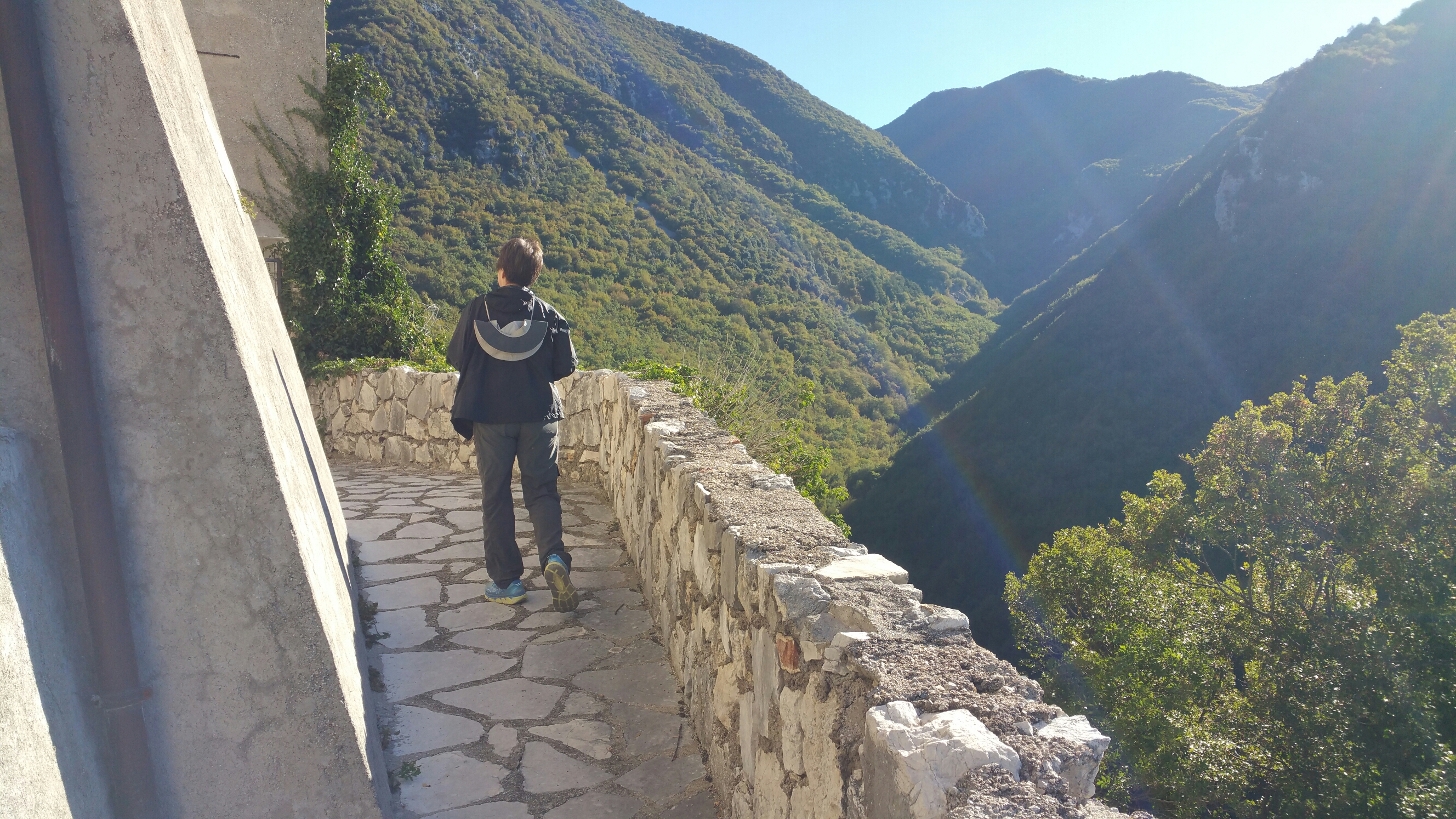
On the following day we took a taxi to Poggio Bustone. This is another Sanctuario that Francesco visited when he was going to or coming from Roma. The photo on this page was taken at Poggio Bustone and shows the valley and hills that Francesco walked over while he lived and the same hills that Anne and I have been walking for the last 3+ weeks. you can understand why Francesco loved to stop and pray on the top of the mountains, looking down on the scenes below. Poggio Bustone is the Sanctuario where Francis finally believed that God forgave him his sins, after many years of penance and prayer. Accepting forgiveness is difficult for many of us, even someone like Francis. We walked the 28 Km back to Rieti and finished the day with Messe at the Chiesa Arcangel Michael, dinner and back to our albergo for the night.
We decided to go directly to Roma from Rieti by TrenItalia since there were no important Franciscan sites to visit on the way to Roma.
 Anne and Ed Blog